
Are Door Frame Repairs Building Code Compliant?
Table of Contents
- Building Code Compliance for Door Frame Repairs: The Short Answer
- NFPA 80 Fire Door Inspection Requirements
- When Is a Permit Required for Door Repairs?
- Commercial Door Frame Repair vs Replacement
- Residential vs Commercial Door Frame Repair: Different Rules Apply
- Common Code Violations in Door Frame Repairs
- Frequently Asked Questions
Last Updated: September 10, 2026
Building Code Compliance for Door Frame Repairs: The Short Answer
A door frame repair is building code compliant when it restores the door assembly to its original fire-resistance rating, structural integrity, and egress characteristics. Compliance isn't about whether you repaired the frame, it's about whether the repaired assembly still performs as tested.
The International Building Code (IBC) treats the door opening as a complete assembly: frame, door slab, hinges, latching mechanism, and self-closing device. Repairing the frame in isolation is where most compliance failures begin.
A Jamb Patch or Jamb Anchor installed correctly keeps a rusted steel or corroded aluminum frame within its tested configuration, which is what code officials want to see. A patch installed without regard to hinge pocket depth or gap tolerances does not.

Below, we break down the standards that govern door frame repairs, when permits come into play, and how to tell a minor repair from a replacement.
NFPA 80 Fire Door Inspection Requirements
NFPA 80 requires fire door assemblies to be inspected annually, and any repair that affects the frame must restore the assembly to its original fire-resistance rating. (nfpa.org) That's the standard code enforcement officers reference when they walk a facility.
NFPA 80 fire door inspection requirements cover the full door assembly: frame dimensions, gaps and tolerances, latching mechanism function, self-closing device operation, and hardware condition. A frame repair that leaves a gap wider than the tested tolerance fails inspection, even if the patch looks solid.
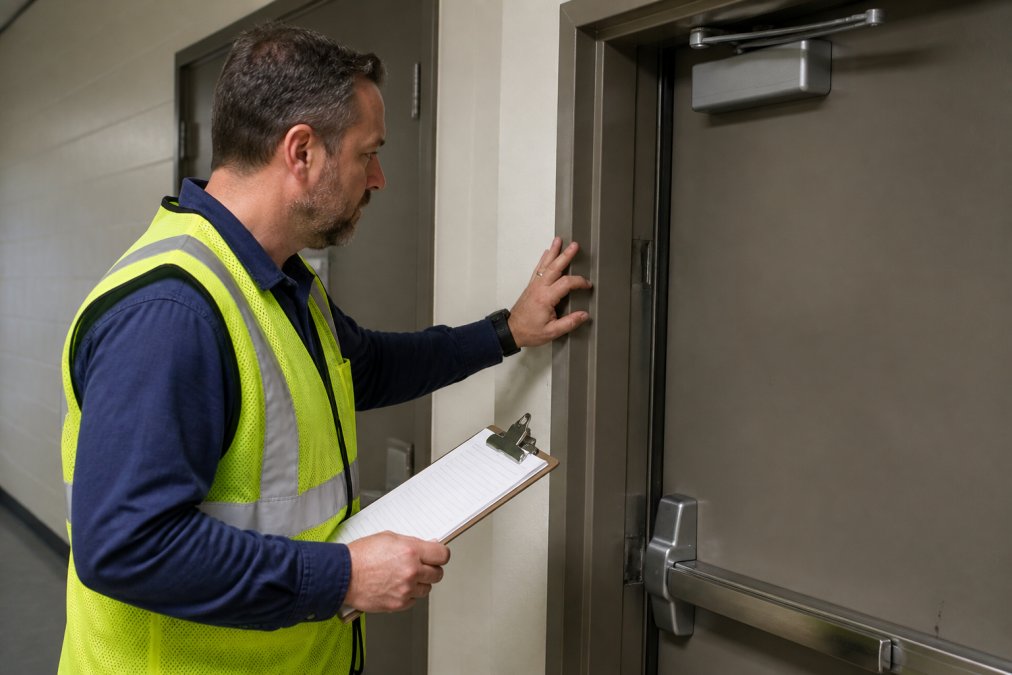
Annual Inspection Checklist for Fire-Rated Assemblies
- Frame is firmly anchored, no movement when the door closes
- Gaps between door and frame fall within tested tolerances
- Self-closing device fully latches the door from an open position
- Latching mechanism engages without binding
- Hinges are tight, no missing or stripped screws
- No visible rust perforation or corrosion on the frame
- Door hardware matches the original listing
- Inspection records are logged and dated
Inspection documentation matters as much as the repair itself. A maintenance log showing when the frame was patched, what product was used, and who installed it gives a code official a clear compliance trail. Without it, you're relying on their visual assessment alone.
When Is a Permit Required for Door Repairs?
A permit is generally required when a door repair meets the code definition of an alteration rather than a repair, meaning it changes the assembly's fire-resistance rating, its egress characteristics, or its structural configuration. Patching localized rust or corrosion on an existing listed frame typically does not trigger a permit. Replacing the frame, changing the door swing, altering the opening size, or substituting hardware that isn't listed for the assembly usually does.
The IBC draws the line between repair and alteration in Chapter 2 definitions and enforces it through Chapter 34 (existing structures). A repair restores something to its original condition; an alteration changes the configuration, capacity, or use. Alterations to rated assemblies trigger a full compliance path: permitted drawings, inspection, and documentation that the assembly still meets its original listing.
The four questions that decide it
Before you call the AHJ, answer these. If any answer is yes, plan on a permit.
- Does the frame carry a fire label, and does the repair touch the labeled portion? Patching a rusted strike plate area on a labeled frame is generally a repair. Cutting, welding, or replacing a section of the labeled frame is an alteration.
- Does the repair change the clear opening width or height? Any reduction in egress width is an alteration under IBC Chapter 10.
- Does the repair change the door swing, handing, or hardware function? Changing from a swing door to a sliding door, or reversing the handing, is an alteration.
- Does the repair require removing the frame from the wall? Full frame removal and reinstallation is treated as a replacement in most jurisdictions, even if the same frame goes back in.
What the AHJ actually wants to hear
When you call the building department, lead with the facts, not the question:
"I have a [steel/aluminum/wood] frame on a [20-minute/60-minute/90-minute] rated assembly in a [Group B office / Group R-2 apartment / Group E school]. The damage is [localized rust at the strike / a stripped hinge screw / a bent jamb]. I plan to install a listed jamb patch that restores the frame to its tested configuration without changing the opening size, swing, or hardware. Does this require a permit in your jurisdiction?"
That framing gives the inspector everything they need to answer in one call. Vague questions get vague answers, and vague answers are how projects end up red-tagged.
Documentation that satisfies an inspection
Whether or not a permit is pulled, keep a file on every rated assembly you touch, including:
- A photo of the fire label before work begins, showing the listing agency and rating
- The product data sheet for any patch, anchor, or hardware used, showing it's listed for the assembly
- A photo of the completed repair showing gap tolerances at the top, strike side, and hinge side
- The installer's name, date, and, where required, certification number
- A post-repair function test log: door closes, latches, self-closes from open, releases without binding
This file turns a visual inspection into a documented compliance record. Inspectors who see it move quickly; inspectors who don't look harder.

When in doubt, treat it as an alteration
The cost of pulling a permit on a job that didn't need one is small, a fee and a short inspection. The cost of skipping a permit on a job that did need one is the full replacement plus fees plus the schedule hit. For any repair on a labeled assembly, the conservative call is correct.
Commercial Door Frame Repair vs Replacement
Commercial door frame repair is the right call when the frame's structural integrity is intact and the damage is localized to rust, corrosion, or stripped hardware points. Replacement becomes necessary when the frame is bent, the opening is out of square, or building settlement has shifted the frame beyond adjustment range.
A rusted hinge jamb with solid surrounding metal is a repair candidate. A frame that flexes when the door closes, or one where the strike plate no longer aligns because the wall has moved, is a replacement candidate.
Door Innovation's Jamb Patch and Jamb Anchor kits are built for the first scenario. The Jamb Anchor Side Jamb Kit re-anchors loose aluminum frames to the wall structure, and the Strike Side Jamb Patch restores a rusted strike side on steel frames. Both keep the assembly within its tested configuration.

Cost Comparison: Jamb Patch Kits vs Full Frame Replacement
| Approach | Product Cost | Typical Labor | Facility Downtime | Code Path |
|---|---|---|---|---|
| Jamb Patch (strike side) | $180.91 | Same-day install | Hours, not days | Minor repair |
| Jamb Anchor side jamb kit | $119.00 | Same-day install | Hours, not days | Minor repair |
| Full frame replacement | Varies by frame type | Multi-trade, multi-day | Door out of service | Permitted alteration |
The downtime difference is where the real money sits. A full replacement takes the opening out of service, which matters in healthcare, education, and any facility where a blocked corridor creates an occupancy problem.
Residential vs Commercial Door Frame Repair: Different Rules Apply
The same physical repair can be a homeowner's weekend project or a permitted commercial alteration, and the deciding factor is the assembly's rating and the building's occupancy classification, not the size of the damage. That distinction is where most guides blur, and it's the first thing an inspector will test you on.
The two code paths, side by side
Residential construction in most jurisdictions follows the International Residential Code (IRC), which governs one- and two-family dwellings and townhouses. The IRC does not require fire-rated door assemblies at interior room openings, so a typical bedroom or closet frame repair in a single-family home has no fire-rating obligation (codes.iccsafe.org). The concerns that do apply are structural soundness, egress from sleeping rooms, and, in pre-1978 homes, lead-safe renovation under the EPA's Renovation, Repair and Painting (RRP) Rule.
Commercial, multi-family (three units and up), and most institutional construction follows the International Building Code (IBC). Under the IBC, door assemblies in fire-rated walls, stairwell enclosures, corridor separations, exit passageways, shaft walls, and hazardous-area separations, must carry a listed fire-resistance rating, and any repair must preserve the listing. If the frame is part of a rated assembly, you're in IBC territory regardless of how small the patch is.
What actually flips a repair into regulated territory
A few concrete triggers push a job from "maintenance" into "regulated work":
- The door carries a fire label. Look at the hinge jamb or the top of the frame for a metal or foil label from a listing agency such as UL, Intertek, or Warnock Hersey. If it's there, the assembly is rated and NFPA 80 applies.
- The opening is in a required means of egress. IBC Chapter 10 governs egress width, swing direction, and hardware operation. A repair that narrows the clear opening or changes the swing direction is an alteration, not a repair.
- The building is a Group I, R-1, R-2, E, or similar occupancy. Hospitals, hotels, apartments, dormitories, and schools carry stricter maintenance and documentation expectations than a Group B office.
- The home was built before 1978. Disturbing painted surfaces on the frame triggers the EPA RRP Rule, which requires a certified renovator and specific work practices. This applies to residential repairs that would otherwise be unregulated.
The practical split for facility managers and homeowners
For a homeowner in a single-family house: if the door isn't fire-rated and the repair doesn't change the rough opening, you're generally in maintenance territory. Check local amendments, some jurisdictions adopt the IRC with additions that touch egress door hardware.
For a facility manager: assume every door in a rated wall is regulated until you've confirmed otherwise. Walk the building with the original life-safety drawings and a flashlight, and log the label information on every door. That log becomes your compliance baseline, and it's the document an AHJ will ask for first.
Where the two regimes overlap
Egress is the common ground. Both the IRC and the IBC require that egress doors open without special knowledge or effort, that the clear width meet the minimum for the occupancy, and that the door latch reliably. A frame repair that leaves the door binding, shifts the strike so the latch won't engage, or reduces the clear opening below the minimum fails under either code. That's why the post-repair function check, open, close, latch, release, matters as much as the structural fix.
ICC code adoption map by state and jurisdiction
Common Code Violations in Door Frame Repairs
The most frequent door frame repair violations are painted-over hardware, undersized patches that leave gaps beyond tested tolerances, missing self-closing devices, and repairs made without restoring the frame's anchorage. Each one fails inspection for a different reason, but they share a root cause: treating the frame as a cosmetic surface instead of a structural component of the assembly.
A few more that show up repeatedly:
- Rabbeted frame damage left unrepaired, which compromises the door stop and allows smoke passage
- Frame reinforcement added without matching the original listing, which voids the assembly's certification
- Threshold requirements ignored, creating an egress trip hazard
- No compliance certification or maintenance log to document the work
Building settlement is the quiet culprit behind many of these. When a foundation shifts, the frame moves with it, and door clearance tightens or opens beyond tolerance. Patching rust without addressing anchorage leaves the underlying problem in place.
The fix is a visual inspection checklist your team runs before and after every repair:
- Confirm the assembly's fire-resistance rating from the door label
- Measure gaps at top, strike side, and hinge side
- Check frame anchorage at every fastener point
- Verify self-closing and latching function after repair
- Photograph the completed work and file it with the maintenance log
DIY versus professional certification is the other gap. A maintenance tech can install a Jamb Patch with basic tools, but fire-rated assembly work in many jurisdictions requires a certified installer or licensed contractor to sign off. Door Innovation's Certified Installer program gives locksmiths and maintenance teams a documented credential.
Door frame repairs that hold up to inspection come down to three things: knowing whether the assembly is rated, restoring it to its tested configuration, and documenting the work. Door Innovation builds the Jamb Patch and Jamb Anchor kits specifically for that middle step, with a three-step installation process your maintenance team can complete in an afternoon, plus a Certified Installer program. Get started with Door Innovation and extend the life of your existing door openings without the cost and downtime of full frame replacement.
Frequently Asked Questions
Are door frame repairs building code compliant?
Yes, if the repair restores the frame to its original fire-resistance rating and meets NFPA 80 and IBC requirements. Repairs using listed components like Jamb Patch kits maintain compliance when installed per manufacturer instructions. Local code officials may require documentation. Always verify that the repair method preserves the assembly's fire rating and egress function.
What are the NFPA 80 requirements for fire door frame repairs?
NFPA 80 requires that repairs to fire-rated door frames use components listed for the assembly. Field modifications must not compromise the fire-resistance rating. The frame must maintain proper clearances, latching, and self-closing operation. Annual inspections must document that the frame is undamaged, securely anchored, and free of rust or corrosion that affects performance.
When is a permit required for door repairs?
Permits are typically required when the repair changes the door's size, location, or fire rating, or when it involves structural modifications. Minor repairs like patching rusted steel frames with listed kits often don't need a permit, but check local building department rules. Commercial fire door repairs may require a permit if the assembly's rating is affected.
Can a handyman replace a door frame?
A handyman can replace a non-fire-rated residential door frame in many jurisdictions, but commercial fire-rated assemblies usually require a certified installer. NFPA 80 and local codes mandate that fire door repairs be performed by qualified individuals. Door Innovation offers a Certified Installer program.