
Are Door Frame Repairs Safe? A 2026 Guide for Facilities
Table of Contents
- What Makes a Door Frame Repair Safe or Unsafe
- Warning Signs Your Door Frame Is Failing
- How Locksmith Door Frame Repair Methods Compare to Kits
- How to Fix Rusted Steel Door Frames Safely
- NFPA 80 Fire Door Inspection Requirements and Repairs
- Security Ratings, Insurance, and Liability After a Repair
- Long-Term Durability: Will the Repair Actually Hold?
- Conclusion
- Frequently Asked Questions
Last Updated: September 14, 2026
What Makes a Door Frame Repair Safe or Unsafe
Door frame repairs are safe when they restore the frame's structural integrity, keep the door hardware anchored, and meet the fire and life-safety requirements that apply to that opening. It becomes unsafe the moment a patch, filler, or reinforcement hides damage that has already compromised the frame's ability to carry load, hold a lock, or close against smoke and fire.
That distinction matters more than most facility teams realize. Maintenance crews sometimes treat every rust spot as a cosmetic problem, then wonder why a strike plate pulls loose a year later. The frame is not trim. It is the structure the door hangs on and the lock bites into.
Structural Integrity and Load-Bearing Limits
Structural integrity is the frame's ability to carry the door's weight and resist force without deflecting or failing. A hollow metal frame carries that load through its corners, anchors, and the wall opening itself.
Here's the part most guides miss: the jamb isn't load-bearing in the way a beam is, but it absolutely transfers force. Every slam, every kick, every hydraulic closer pushing back sends energy into the frame and its anchors. Once rust or corrosion eats into the metal around a hinge or strike, that force has nowhere good to go.
When Repair Crosses Into Replacement
Repair is the right call when damage is surface-level or localized. Replacement wins when the frame has lost section thickness across a hinge or strike, when anchors have pulled free of the wall, or when the frame is twisted enough that the door no longer sits square.
A practical rule: if a repair restores full section thickness at every hardware point, it's safe. If it merely covers damage, it isn't.
Warning Signs Your Door Frame Is Failing
Watch for these before they become emergencies:
- Door sag that returns after hinge adjustment
- Visible wood rot or soft, crumbling metal at the threshold
- Kick-in damage or a bent strike side after a forced entry
- Frame alignment drift, where the door rubs the jamb at the top or bottom
- Loose hinge screws that won't hold in their holes
- Split wood or cracked welds at the miter joint
- Corrosion weeping rust stains down the door casing
- Weather stripping and door sweep gaps that let light or air through
How Locksmith Door Frame Repair Methods Compare to Kits
Locksmith door frame repair methods and purpose-built patch kits solve different problems, and knowing which you need prevents wasted labor.
Traditional locksmith methods focus on re-anchoring hardware: longer screws into studs, jamb reinforcement plates, and filler to rebuild stripped screw holes. These work well when the metal is sound and only the fastener has failed.
Patch kits take a different angle. They replace the damaged section of jamb outright, restoring thickness and giving hardware fresh metal to bite into. Door Innovation's Jamb Patch and Jamb Anchor catalogue covers both approaches for rusted steel and corroded aluminum frames.
| Method | Best For | Limits |
|---|---|---|
| Longer screws / re-anchoring | Stripped screw holes, sound metal | Doesn't restore lost section |
| Epoxy filler / wood filler | Small holes, cosmetic gaps | No structural strength |
| Jamb patch kit | Rusted or corroded jamb sections | Requires clean, prepped surface |
| Jamb anchor kit | Loose aluminum side jambs | For outboard jamb anchoring |
| Full frame replacement | Twisted, collapsed, or fully compromised frames | Highest cost and downtime |
How to Fix Rusted Steel Door Frames Safely
The safe process for fixing a rusted steel door frame is to remove the corrosion, restore the section with a patch, and seal it so moisture can't return. Skipping any step shortens the repair's life.
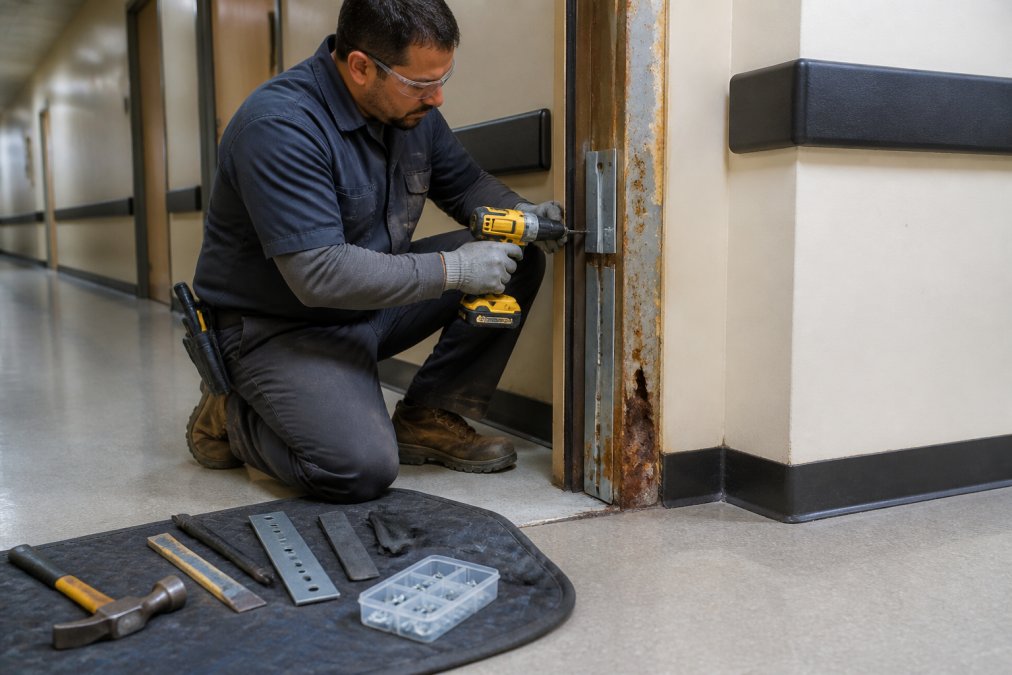
Step 1: Clean and Prep the Rusted Area
Remove loose rust, scale, and old paint with a wire brush or grinder until you reach sound metal. Wipe the surface clean and let it dry fully. A common mistake is patching over damp metal, which traps corrosion underneath.
Step 2: Install the Patch and Hardware
Fit the patch over the damaged section, align it with the hinge or strike, and fasten it with the supplied hardware. Door Innovation's Jamb Patch Kit comes with two 4-inch non-handed patches, installation hardware, and instructions, so a maintenance tech can complete the repair without special training.
Step 3: Seal, Prime, and Paint
Seal the patch edges, then prime and paint to match the frame. This is what stops moisture from restarting the cycle. The Strike Side Jamb Patch uses a 21-5/8 inch non-handed patch for strike-side damage, which is where forced-entry repairs usually concentrate.
NFPA 80 Fire Door Inspection Requirements and Repairs
NFPA 80 fire door inspection requirements govern how fire-rated door assemblies must be maintained, and any field repair to a fire-rated frame has to keep the assembly compliant. That means the frame must still hold the door square, the hardware must function as designed, and the opening must close and latch fully.
This is where DIY shortcuts get risky. A patch that restores the frame but leaves the door unable to latch defeats the entire purpose of a rated opening. The NFPA 80 standard for fire doors sets the inspection and maintenance expectations that facility teams are held to, and local authorities having jurisdiction enforce them during inspection.
Security Ratings, Insurance, and Liability After a Repair
A repaired frame can carry the same security rating as the original opening, but only if the repair restores the strike and hinge anchoring to the level the frame was tested to. If it doesn't, the rating is effectively void, and that has real consequences for both coverage and legal exposure.
What 'Security Rating' Actually Means on a Door Frame
Door assemblies are tested as a system, not as a frame alone. The relevant benchmarks most specifiers and insurers reference are:
- ASTM F476, the standard test method for security of swinging door assemblies, which grades resistance to forced entry attempts (F476 Standard Test Methods for Security of Swinging Door Assemblies).
- ANSI/BHMA A156.13, the grading standard for mortise locks and latches, which assumes the lock is anchored into a frame of a given material thickness.
- ASTM F588, the test method for measuring forced-entry resistance of window and door assemblies.
A frame that passes one of these tests does so with a specific jamb gauge, a specific anchor pattern, and a specific strike reinforcement. When a repair changes any of those, thinner patched metal, shorter screws, filler instead of steel, the assembly is no longer the one that was tested. That is the mechanism most guides skip.
How Insurers Treat a Repaired Frame After a Break-In
Homeowners and commercial property policies generally cover the resulting damage from a break-in, but the analysis changes when the question becomes whether the opening was maintained in its rated condition. A common pattern in claims handling is:
- Coverage for the loss itself, the stolen property and the damaged door are typically covered under standard HO-3 or commercial property forms.
- Scrutiny of the opening, if the insurer or an adjuster can show the frame was already compromised before the loss, they may argue the loss was foreseeable and reduce or deny the claim.
- Subrogation and liability, in a commercial setting, if a tenant is injured or robbed because a repaired frame failed, the facility's maintenance records become the defense or the liability.
This is why documentation matters as much as the repair itself. A photo log, the hardware used, and the date of the repair are the difference between a defensible position and an indefensible one.
What to Verify Before You Rely on a Repair
- Confirm the frame's original rating (look for a label on the frame or the door).
- Match the repair material to the original jamb gauge, a 16-gauge frame repaired with 20-gauge patch stock is a downgrade.
- Keep the hardware spec sheet with the repair record.
- If the opening is fire-rated, the repair must also satisfy the fire assembly requirements covered in the NFPA 80 section above.
A repair that restores the tested condition is safe and insurable. A repair that only looks finished is neither.
Long-Term Durability: Will the Repair Actually Hold?
A properly executed door frame repair holds for years, provided the corrosion source is eliminated and the hardware is anchored into sound material. The failure mode isn't the patch itself; it's moisture returning, or a fastener seated in material that was never structurally sound. But 'years' is not a useful answer on its own, durability depends heavily on the repair method and the frame material.
Durability by Repair Method
| Repair Method | Typical Service Life | Failure Mode |
|---|---|---|
| Epoxy or wood filler | Months to a few years | Cracks under load; screw threads strip out |
| Longer screws into studs | Years, if studs are sound | Stud splits or screw bends under repeated force |
| Steel jamb patch kit | Long-term, comparable to original frame | Patch edge corrosion if not sealed |
| Aluminum jamb anchor kit | Long-term | Anchor pull-out if substrate is thin |
| Full frame replacement | Full frame service life | None specific to the repair |
Most practitioners find that filler-based repairs fail first at the screw holes, because filler has no thread-holding strength. A patch kit that restores steel thickness at the hinge and strike is the only repair method that behaves like the original frame under repeated load.
Material-Specific Durability Notes
Hollow metal (steel) frames, Durability depends on gauge. A 16-gauge frame repaired with a matching-gauge patch outlasts the door cycle in most commercial settings (Fire Doors and NFPA 80 FAQs). A 20-gauge frame repaired with a 20-gauge patch is thinner to begin with and will deform sooner under the same traffic.
Solid wood frames, The repair only lasts if the moisture source is fixed. Epoxy consolidants can restore rotted sections, but if the frame stays wet, the repair is temporary. Borate-based treatments slow fungal decay but do not restore lost section.
Hollow-core wood frames, These are the weakest substrate for any repair. A patch or filler has almost nothing to anchor into, and the frame was never designed to resist forced entry. Repair is usually a stopgap before replacement.
Aluminum frames, Outboard side jambs loosen because the anchor points were undersized from the start. Re-anchoring with a purpose-built side jamb kit addresses the root cause; tightening the existing hardware only delays the next failure.
The Three Conditions That Determine Durability
- Sound substrate, the repair must bond to or fasten into material that still has its designed strength.
- Correct fasteners, the right length, gauge, and type for the frame material and the load path.
- Sealed surface, primer and paint on steel, proper sealant on wood, to keep moisture out of the repair zone.
Get those three right and the repair outlasts the door cycle. Miss any one and the repair becomes a recurring maintenance item, which is the outcome most facility teams are trying to avoid in the first place.
Conclusion
The real challenge with door frame repairs isn't the repair itself, it's knowing when a fix restores structural integrity and when it only hides damage that will fail under load. Door Innovation builds kits specifically for that decision, with the Jamb Patch Kit for early rust on steel frames and the Jamb Anchor Side Jamb Kit for loose aluminum side jambs, both installable in three steps by your existing maintenance team. For facilities managing dozens of aging openings, that's the difference between a maintenance line item and a capital project. Get started with Door Innovation and extend the life of the door systems you already have.
Frequently Asked Questions
Is it cheaper to repair or replace a door frame?
Repair almost always costs less. A Door Innovation Jamb Patch Kit is $130.37 and a Strike Side Jamb Patch is $180.91, while a full frame replacement typically runs several hundred dollars per opening plus labor and downtime. For facilities with many rusted frames, patching the damaged section keeps the existing frame and avoids the cost of tearing out and refitting a new one. The savings grow with volume, which is why maintenance teams with dozens of affected doors often repair first.
Do door frame repairs meet NFPA 80 fire door requirements?
They can, if the repair preserves the frame's ability to hold the door and hardware in place. NFPA 80 requires fire door assemblies to be inspected annually and after any damage or repair, and it does not allow field modifications that reduce the assembly's rating. A patch that restores the jamb surface and re-secures the strike or hinge is generally acceptable, but any repair that changes the frame's profile or weakens the anchorage can fail inspection. Always document the repair and re-inspect afterward.
Will insurance cover a rotted or rusted frame repair?
Coverage depends on the cause. Sudden damage, such as a break-in or a vehicle strike, is often covered under property policies. Gradual rust or rot from long-term moisture exposure is usually excluded because it counts as deferred maintenance. Document the damage with photos and dates, keep repair receipts, and check whether your policy treats the frame as part of the building or as door hardware. For commercial properties, liability exposure from an unsecured opening can matter more than the repair cost itself.
How do I know if my door frame is structurally sound after a repair?
Test it the way an inspector would. Open and close the door several times and check for sag, sticking, or a gap at the threshold. Push against the strike side with steady pressure and look for movement in the jamb. Confirm the hinge screws bite firmly and the strike plate holds. If the frame flexes, the patch has not restored structural integrity and the opening needs a closer look from a qualified technician before it goes back into service.