
Best Alternative to Full Door Replacement
Table of Contents
- Why Full Door Replacement Isn't Always Necessary
- Door Frame Replacement Cost vs. Repair Solutions
- Commercial Door Frame Repair Kit Options
- How to Fix Rusted Door Frames Without Full Replacement
- Structural Integrity and Load-Bearing Considerations
- Thermal Efficiency and Acoustic Performance Trade-Offs
- Building Code Compliance and Safety Standards
- Maintenance and Longevity of Repair Solutions
- Frequently Asked Questions
Last Updated: October 2, 2026
Why Full Door Replacement Isn't Always Necessary
Full door frame replacement is expensive and often unnecessary. When rust or corrosion appears on a steel or aluminum door frame, facility managers typically assume the entire frame needs to come out. That's rarely true.
Most door frame damage is localized to the bottom where moisture collects or along strike sides and hinge jambs where metal meets weather. These areas can be repaired in place without removing the frame, restoring structural integrity and extending the life of your door system.
This approach saves thousands in labor and materials while minimizing downtime. A full replacement takes days or weeks; a targeted repair takes hours. Door Innovation offers repair kits designed for commercial facilities, healthcare properties, and educational institutions.
The best alternative to full door replacement depends on damage severity. Early-stage rust and advanced corrosion require different solutions. Understanding which repair method fits your situation prevents costly mistakes.
Door Frame Replacement Cost vs. Repair Solutions
A standard commercial steel frame replacement is a significant investment, including removal, disposal, a new frame, installation, and finishing. For facilities with multiple damaged frames, costs multiply fast.
Repair solutions cost a fraction of replacement. The Jamb Patch Kit (4") costs $130.37 for early-stage rust. Strike Side and Hinge Jamb Patches cost $180.91 each for advanced corrosion. With 2-4 hours of labor per repair, costs remain well below replacement.

The financial advantage compounds across multiple doors. A facility with 40 rusted frames facing $20,000 to $60,000 in full replacements can address the same problem for $3,000 to $5,000 in materials and labor combined.
Downtime also matters. Replacement requires frame removal, which can compromise door security temporarily. Repair kits work in place, keeping your opening functional. For healthcare facilities, educational institutions, and commercial buildings, this is critical.
Commercial Door Frame Repair Kit Options
Door Innovation offers specialized repair kits matched to damage severity. Each addresses a specific stage of rust or corrosion progression.
Jamb Patch Kit for Early-Stage Rust
The Jamb Patch Kit (4") targets rust less than 2 inches deep at the frame base. It includes two 4-inch patches, installation hardware, and instructions for $130.37.
The non-handed patches install on either side without modification and are compatible with frames from Steelcraft, ASSA Abloy, Dean Steel, Ceco, Curries, DCI, Republic, Pioneer, and Mesker. The patented design (US Patent #9,284,739) ensures structural integrity after installation.
Use this kit for early detection. Once corrosion exceeds 2 inches, a larger patch becomes necessary.
Strike Side and Hinge Jamb Patches for Advanced Corrosion
For rust deeper than 2 inches or extensive strike-side or hinge-side corrosion, the Strike Side Jamb Patch or hinge-specific patches address corrosion across the full jamb height, providing complete structural restoration.

The Strike Side Jamb Patch ($180.91) handles the latch side. Left and Right Hand Hinge Jamb Patches ($180.91 each) include a 4-1/2-inch commercial hinge pocket pre-cut for standard hinges.
These patches work on the same compatible frame types and are designed for advanced corrosion. Installation takes hours, not days.
| Repair Kit | Best For | Cost | Damage Depth |
|---|---|---|---|
| Jamb Patch Kit (4") | Early rust detection | $130.37 | Less than 2" |
| Strike Side Jamb Patch | Advanced latch-side corrosion | $180.91 | More than 2" |
| Left Hand Hinge Jamb Patch | Advanced hinge-side damage (LH) | $180.91 | More than 2" |
| Right Hand Hinge Jamb Patch | Advanced hinge-side damage (RH) | $180.91 | More than 2" |
How to Fix Rusted Door Frames Without Full Replacement
Repair installation follows a straightforward three-step process that most maintenance teams can complete in an afternoon.
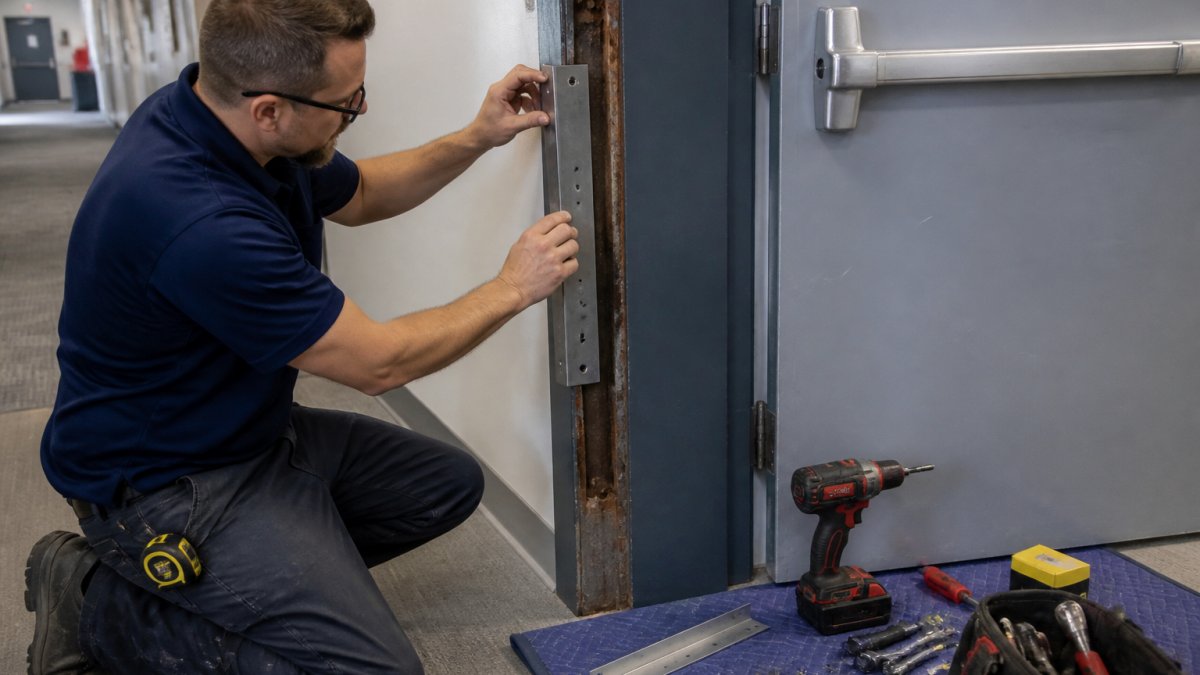
Step 1: Prepare the Damaged Area
Clean away loose rust, scale, and debris using a wire brush or grinding tool to expose solid metal. Remove paint or coatings from the patch area to ensure proper bonding.
Step 2: Position and Secure the Patch
Align the patch over the damaged section, matching the frame profile. For hinge-specific patches, verify you've selected the correct hand. Secure the patch using the included installation hardware, following the kit's instructions for fastener spacing and torque.
Step 3: Seal and Finish
Seal the perimeter with caulk or sealant to prevent moisture infiltration. Paint or finish the patch to match your frame and protect against future corrosion.
The entire process typically takes 2-4 hours per opening. Download detailed installation instructions before starting.
Structural Integrity and Load-Bearing Considerations
Door frames absorb impact from door closure, support the door slab and hardware, and resist lateral forces from wind or collision.
Understanding when a repair restores structural adequacy and when replacement is necessary requires assessing three failure modes:
Corrosion Depth and Metal Thickness Loss
When corrosion penetrates more than 50 percent of remaining wall thickness, the frame's ability to resist bending and lateral loads diminishes.
If corrosion penetrates completely through the frame wall, a patch cannot restore full load-bearing capacity. A qualified inspector can measure corrosion depth using ultrasonic thickness testing.
Corrosion Location and Load Path
Jamb Patch - Jamb Anchor Catalogue →
Rust at the bottom of the jamb is often cosmetic or low-stress.
Hinge jambs must support the door's weight and absorb door closure shock. Corrosion around the hinge pocket reduces the frame's ability to hold hinges securely.
Patches work well for localized corrosion.
Multi-Point Damage and Cumulative Weakness
A frame with rust in one location is a candidate for repair.
Assessment Framework
Before selecting a repair approach, answer these questions:
- Is corrosion depth less than 50 percent of remaining wall thickness? (Measure with ultrasonic gauge or probe.) If yes, repair is structurally feasible.
- Is damage limited to one or two locations on the frame? If yes, targeted patches work. If damage is widespread, replacement is more reliable.
- Are hinge pockets or strike areas severely corroded? If yes, verify that patch fasteners will have solid metal to grip. If the hinge pocket is compromised, replacement may be necessary.
- Is this frame part of a pattern of corrosion in your facility? If multiple frames show similar damage, address the environmental cause (moisture, salt spray, chemical exposure) alongside repair or replacement.
Repair solutions maintain structural integrity when applied to frames that meet these criteria. The patched section bridges the corroded area, restoring load-bearing capacity.
For most commercial facilities, early intervention with repair kits prevents damage from reaching the point where replacement becomes unavoidable.
Thermal Efficiency and Acoustic Performance Trade-Offs
Repair patches maintain the same thermal and acoustic properties as the original frame. If your facility is upgrading for energy efficiency or sound control, a repair-only approach leaves the frame unchanged. Repairs preserve existing performance at lower cost; replacements offer an opportunity to improve performance at higher cost.
Building Code Compliance and Safety Standards
Steel door frames must meet building codes for fire rating, accessibility, and structural safety.
Fire Rating and Material Compatibility
Fire ratings are assigned to the entire door assembly. When installing a repair patch, verify that the patch material and installation method maintain the frame's fire rating.
Egress and Life Safety Requirements
For doors serving as emergency exits, verify that repairs maintain egress function.
Accessibility Compliance
A corroded frame that causes the door to bind may violate ADA standards. A repair that restores smooth operation brings the door back into compliance.
Security and Latch Function
Building codes and facility security standards often require that doors lock securely and that frames support latch hardware without excessive play or flex.
A repair patch on the strike side restores the frame's rigidity and allows the latch to function properly.
Jurisdiction-Specific Requirements
Before committing to a repair approach, contact your local building department to verify that frame repairs are permitted, whether fire-rated frames require manufacturer certification, and if inspections are required.
Maintenance and Longevity of Repair Solutions
A properly installed repair kit extends frame life, depending on environmental conditions. Inspect repaired frames annually for rust around patch edges, water infiltration, or loose fasteners. Repairs bridge the gap at a fraction of the cost. Frames exposed to constant moisture, salt spray, or harsh chemicals deteriorate faster and require more frequent inspections.
The best alternative to full door replacement is a targeted repair matched to your specific damage severity. Early-stage rust calls for the Jamb Patch Kit (4"). Advanced corrosion requires Strike Side or Hinge Jamb Patches. Each solution restores structural integrity, maintains security, and costs a fraction of replacement.

Door Innovation's repair kits are engineered for commercial facilities managing multiple damaged frames. With a simple three-step installation process and compatibility with frames from major manufacturers, you can extend the life of your door systems while keeping maintenance budgets realistic. Order the Jamb Patch Jamb Anchor Catalogue to evaluate your facility's specific repair needs and find the right solution for your doors.
Frequently Asked Questions
Is it cheaper to repair a door frame or replace it?
Repair is significantly more cost-effective. A commercial door frame repair kit like the Jamb Patch Kit costs $130.37. For facilities with multiple doors, repair kits offer dramatic savings. A 40-door facility with rust issues can address early corrosion for under $6,000 using repair kits.
Can you repair a rusted or corroded door jamb without removing the wall?
Yes. Jamb patch repair kits are designed specifically to address rust without wall removal. The patented Jamb Patch installs over the corroded section, restoring frame integrity. If rust exceeds 2 inches at the bottom, use a Strike Side Jamb Patch ($180.91) instead of the standard kit. The installation requires no structural modification to the surrounding wall.
What is a door jamb anchor and how does it work?
A jamb anchor (or jamb patch) is a reinforcement panel that covers corroded or rusted sections of a door frame. It anchors to the existing frame using installation hardware, restoring structural integrity without full frame removal. The non-handed design allows installation on either side. It works for steel frames from major manufacturers like Steelcraft, ASSA Abloy, and Ceco. The Jamb Patch - Jamb Anchor Catalogue also features products for aluminum door frames.
How long do door frame repair kits last compared to full replacement?
Jamb patch repairs extend frame life significantly when applied at the first sign of rust. Early intervention with the standard Jamb Patch Kit prevents corrosion from advancing, maintaining structural integrity for years. Strike Side and Hinge Jamb Patches address deeper rust and provide comparable longevity to partial frame repairs. Proper maintenance and environmental controls determine actual lifespan in both cases.