
Commercial Door Frame Rust Removal: A Step-by-Step Guide
Table of Contents
- Identifying Rust Damage and When to Repair vs. Replace
- Tools and Materials Required for Door Frame Rust Removal
- Best Rust Removal Tools for Steel Doors
- Step-by-Step Rust Removal Process
- How to Patch Rusted Door Frame Bottom
- Repair Rusted Hollow Metal Door Frame with Professional Kits
- Commercial Door Frame Rust Prevention and Long-Term Maintenance
- Safety and Compliance Considerations
- Frequently Asked Questions
Last Updated: September 21, 2026
Identifying Rust Damage and When to Repair vs. Replace
Rust on commercial door frames weakens structural integrity and creates security vulnerabilities, making door frame rust removal essential for facility safety. The decision to repair or replace depends on damage extent and safety requirements.
Visual inspection checklist for rusted door frames
Start with a thorough visual inspection. Look for these signs:
- Surface oxidation: Light discoloration or powdery rust on the frame surface
- Flaking paint: Rust pushing through the protective coating
- Pitting: Small holes or craters in the metal surface
- Structural damage: Visible gaps, warping, or separation from the wall
- Bottom deterioration: Rust concentrated at the frame base (most common)
- Moisture stains: Water marks or rust bleeding from inside the frame
Press the rusted area with a screwdriver or awl. If the metal resists pressure, you have surface rust; if the tool penetrates easily, corrosion has compromised integrity. This determines whether repair or replacement is necessary.
Galvanic corrosion identification
Galvanic corrosion occurs when dissimilar metals (steel frames with aluminum components, or different steel grades) contact each other in moisture. Look for rust patterns following the contact line between metals, this spreads faster than standard oxidation and indicates more severe damage. Address galvanic corrosion immediately, as it compromises frames faster and becomes harder to repair once advanced.
Tools and Materials Required for Door Frame Rust Removal
Essential tools for rust removal:
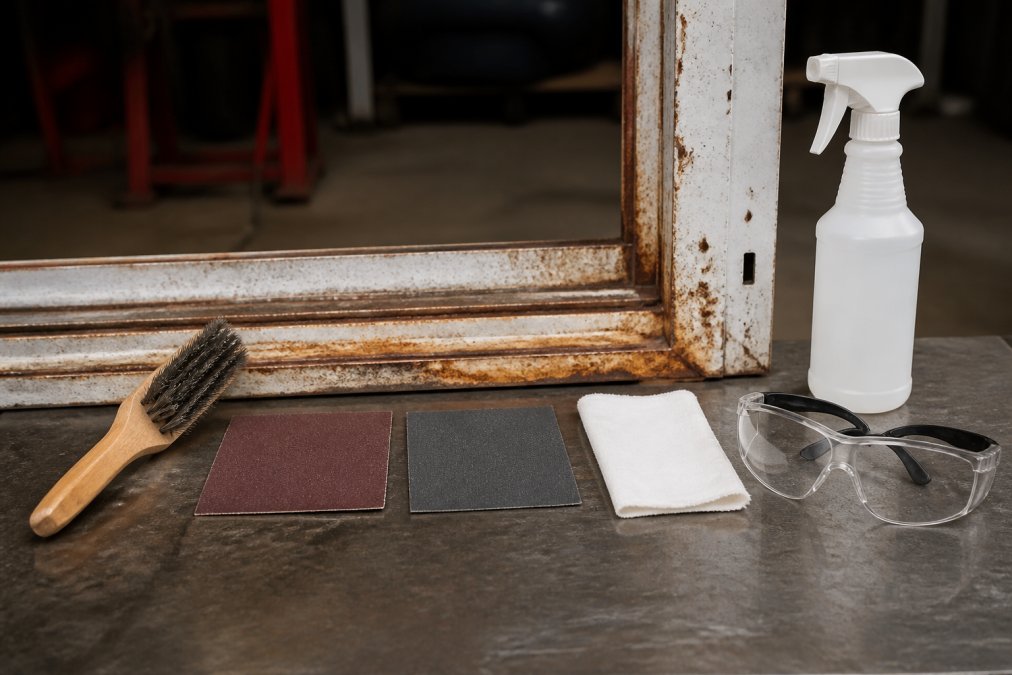
- Wire brush or wire wheel: Removes loose rust and flaking paint
- 80-grit sandpaper: Aggressive abrasive for heavy rust removal
- 150-grit sandpaper: Smooths the surface after initial rust removal
- Tack cloth: Removes dust before primer application
- Degreaser or solvent: Cleans oil and contamination from the metal
- Safety equipment: Gloves, eye protection, dust mask or respirator
Materials for surface protection:
- Rust-inhibitive primer: Creates a barrier against future corrosion
- Topcoat paint: Provides final protection and finish
- Epoxy filler: For small pits or surface irregularities (optional for minor damage)
Having these materials on hand before you start prevents delays and ensures consistent results across multiple frames.
Best Rust Removal Tools for Steel Doors
Steel door frames require specific tools designed for metal surface preparation. The right tool selection determines how quickly and effectively you remove rust.
Step-by-Step Rust Removal Process
The rust removal process follows a logical sequence. Each step prepares the surface for the next, building toward a durable, long-lasting repair.
Step 1: Surface preparation and cleaning
Use a wire brush to scrub away loose rust, flaking paint, and debris. Apply degreaser per product instructions (typically 5-10 minutes), then wipe clean. Allow the frame to dry completely, moisture trapped under primer causes new rust.
Step 2: Sanding and abrasive cleaning
Start with 80-grit sandpaper in circular motions to expose bare metal and remove corrosion. Switch to 150-grit sandpaper to smooth the surface and improve paint adhesion. Use a tack cloth to remove all dust, this step is critical and often rushed.
Step 3: Applying rust-inhibitive primer and topcoat
Apply rust-inhibitive primer per manufacturer instructions; most require 24 hours curing. Apply topcoat paint in two thin coats for better coverage and protection. Allow adequate drying time between coats before returning the door to service.
How to Patch Rusted Door Frame Bottom
The bottom of commercial door frames experiences the most rust damage. This area collects moisture and receives less airflow, creating ideal conditions for corrosion. Patching the bottom is often the most cost-effective repair approach.
Repair Rusted Hollow Metal Door Frame with Professional Kits
Hollow metal door frames dominate commercial construction. Professional repair kits provide a middle ground between patch-and-paint and full replacement, addressing structural damage while preserving the existing opening and hardware.
Commercial Door Frame Rust Prevention and Long-Term Maintenance
Prevention is more cost-effective than repair. Preventative maintenance strategies: quarterly inspections, moisture control, reapply topcoat every 3-5 years in high-moisture areas, maintain hardware, and apply weatherstripping. Moisture is the primary rust driver; coastal properties face accelerated corrosion from salt air. A repair kit costs significantly less than a full frame replacement.
Safety and Compliance Considerations
Commercial door frames are safety-critical components that must maintain fire ratings, accessibility compliance, and security integrity. Before repair, assess whether rust damage has violated compliance requirements and whether your repair method will restore compliance.
Fire-rating integrity and rust damage
Fire-rated door frames are tested and labeled to contain fire and smoke for a specified duration (typically 20, 45, 60, or 90 minutes). This rating depends on the frame's structural integrity, seal quality, and material thickness. Rust damage affects all three.
Assess fire-rating risk:
- Locate the frame label stating fire-rating duration and testing standard (NFPA 252, UL 10B, or similar).
- Measure rust depth: If rust has penetrated more than 25% of frame thickness, structural capacity is compromised.
- Inspect the frame seal: If rust has damaged the intumescent seal channel or seal material is deteriorated, the fire-rating is compromised.
- Check for frame separation: If rust has caused warping, bowing, or separation from the wall, the fire-rating seal is broken.
ADA accessibility compliance and rust damage
The Americans with Disabilities Act requires that commercial doors operate smoothly, without binding or excessive force. Rust that causes the frame to warp, bind, or misalign violates accessibility requirements.
Assess accessibility compliance risk:
- Operate the door: Open and close the door through its full range of motion. Does it bind, stick, or require excessive force? If yes, rust damage has already created an accessibility violation.
- Inspect the frame for warping: Look at the frame from the side (perpendicular to the door). Is the frame straight, or does it bow inward or outward? Rust-induced warping misaligns the door and increases operating force.
- Check the threshold and bottom seal: Rust at the frame bottom often causes the threshold to shift or the seal to compress unevenly, creating binding at the bottom of the door swing.
Security and structural integrity
Rust weakens the frame's ability to withstand forced entry attempts and reduces the holding power of fasteners that secure the frame to the wall. A severely rusted frame may fail under impact or deliberate force, creating a security breach.
Security assessment:
- Test frame rigidity: Push firmly on the frame at multiple points (top, middle, bottom). The frame should not flex, move, or shift. If it does, the fasteners or frame material are compromised.
- Inspect fastener holes: Look at where the frame fastens to the wall. Are fasteners corroded, loose, or missing? Rust on fasteners reduces their holding power.
- Check for frame separation: Is there a gap between the frame and the wall? Rust can cause the frame to shift away from the wall opening, reducing its structural support.
Documentation and compliance record
After repair, document the work performed, materials used, and the date of completion. Keep records of:
- Original fire-rating label and certification number
- Rust damage assessment (depth, location, extent)
- Repair method used and materials applied
- Contractor name and license (if applicable)
- Date of repair completion
- Any compliance testing or inspection performed after repair
Frequently Asked Questions
How can I remove rust from a commercial metal door frame without replacing it?
Rust can be removed through surface preparation, abrasive cleaning with wire brushes and 80-150 grit sandpaper, and application of rust-inhibitive primer and protective coating. For frames with rust deeper than 2 inches at the bottom, patching kits like the Strike Side Jamb Patch offer a cost-effective repair alternative that avoids full frame replacement while restoring structural integrity and appearance.
What are the best tools for removing rust from steel door frames?
Essential tools include wire brushes for loose rust removal, 80-grit sandpaper for initial abrasion followed by 150-grit for smoothing, a tack cloth for dust removal, and degreaser for solvent cleaning. Safety gear including gloves and respiratory protection is critical. Rust-inhibitive primers and topcoats provide the protective coating needed for long-term corrosion resistance on hollow metal doors.
How do I know when to repair versus replace a rusted door frame?
Repair is cost-effective for surface rust, light pitting, and damage confined to the bottom 2-4 inches of the frame. Replace the frame if structural damage compromises the frame's integrity. Facility managers should conduct a visual inspection to assess pitting depth and extent of flaking paint before deciding.
Will a patched door frame hold up long-term in a healthcare or educational facility?
Yes, when properly installed using commercial-grade repair kits and following manufacturer specifications. Jamb Patch kits are designed for steel door frames and include rust-inhibitive protection. Proper surface preparation, primer application, and maintenance of the protective coating ensure durability. Regular preventative maintenance, including inspection for new moisture barriers and touch-ups, extends frame life and maintains safety and security compliance for high-traffic facilities.
Rust damage to commercial door frames doesn't require expensive full replacements. Early identification and proper repair techniques restore frame integrity while saving time and money. Door Innovation's specialized repair kits provide facility managers with a practical, cost-effective solution that maintains safety and compliance standards. By addressing rust damage promptly and implementing preventative maintenance, your facility can extend the life of existing door systems for years to come.