
7 Commercial Door Frame Security Upgrades That Work
Table of Contents
- Why Commercial Door Frame Security Matters
- 1. Reinforced Door Frames and Materials
- 2. High-Security Lock Mechanisms and Deadbolts
- 3. Electric Strikes vs. Mortise Locks: Which Secures Better
- How to Reinforce Commercial Door Frames with Repair Kits
- Commercial Door Frame Repair Kits vs. Full Replacement
- Access Control System Integration and Keyless Entry
- Commercial Door Hardware Security Standards and Compliance
- Frequently Asked Questions
Last Updated: September 28, 2026
Why Commercial Door Frame Security Matters
Rusted and corroded door frames are a silent liability. A compromised frame fails to support locks properly, makes doors hang crooked, and signals to anyone passing by that your facility's security isn't a priority. For facility managers, this creates a cascade of problems: increased maintenance costs, potential liability if a door fails, and the looming threat of a full frame replacement that can cost thousands per opening.
Most guides miss this: you don't always need to replace the entire frame. Targeted reinforcement, addressing rust damage, securing loose jambs, and upgrading locking hardware delivers security and durability at a fraction of replacement cost.
This guide covers practical upgrades that address the root causes of frame failure and keep your facility secure.
1. Reinforced Door Frames and Materials
The frame is the foundation of door security. A weak frame undermines even the best lock. Commercial-grade door frames come in two primary materials: hollow metal steel and aluminum. Steel offers superior strength but corrodes in high-moisture environments. Aluminum resists corrosion but can loosen over time when subjected to impact or vibration.
Frame reinforcement adds structural support through specialized patches or anchor kits that re-establish integrity without full replacement. Address rust at the bottom of the frame where moisture accumulates. Early intervention, catching rust in the first 2 inches, prevents more invasive repairs later.
Coastal properties, facilities with frequent cart traffic, and buildings exposed to road salt require more aggressive protection. Reinforced frames with protective plates and proper drainage prevent water pooling against jambs.
2. High-Security Lock Mechanisms and Deadbolts
The lock mechanism is only as secure as the frame holding it, the weakest point wins.
Commercial-grade deadbolts and mortise locks offer superior security. Mortise locks distribute force across a larger area and resist picking through patented keyway designs. Both work best in properly reinforced, aligned frames.
Mortise locks provide better security but require precise installation; cylindrical locks are easier to install for standard applications. Both require a structurally sound frame.
For healthcare facilities, secure storage, or restricted zones, keyless entry systems integrated with reinforced frames offer remote access control while maintaining security benefits.
3. Electric Strikes vs. Mortise Locks: Which Secures Better
Electric strikes and mortise locks serve different purposes. Choosing between them depends on your security goals and infrastructure.
Mortise locks are mechanical devices built into the door that remain locked during power loss. They're ideal for high-security applications and distribute locking force across the frame's depth.
Electric strikes replace the strike plate and allow remote unlocking. They're ideal for facilities needing remote access and building system integration, but require stable power and frame reinforcement to prevent loosening.
For most facilities, use mortise locks as primary security and add electric strikes for convenience. This layered approach provides redundancy if the electronic system fails.
How to Reinforce Commercial Door Frames with Repair Kits
Reinforcing a commercial door frame with repair kits is straightforward. Select the right kit for your frame material and damage level, then follow the installation process.
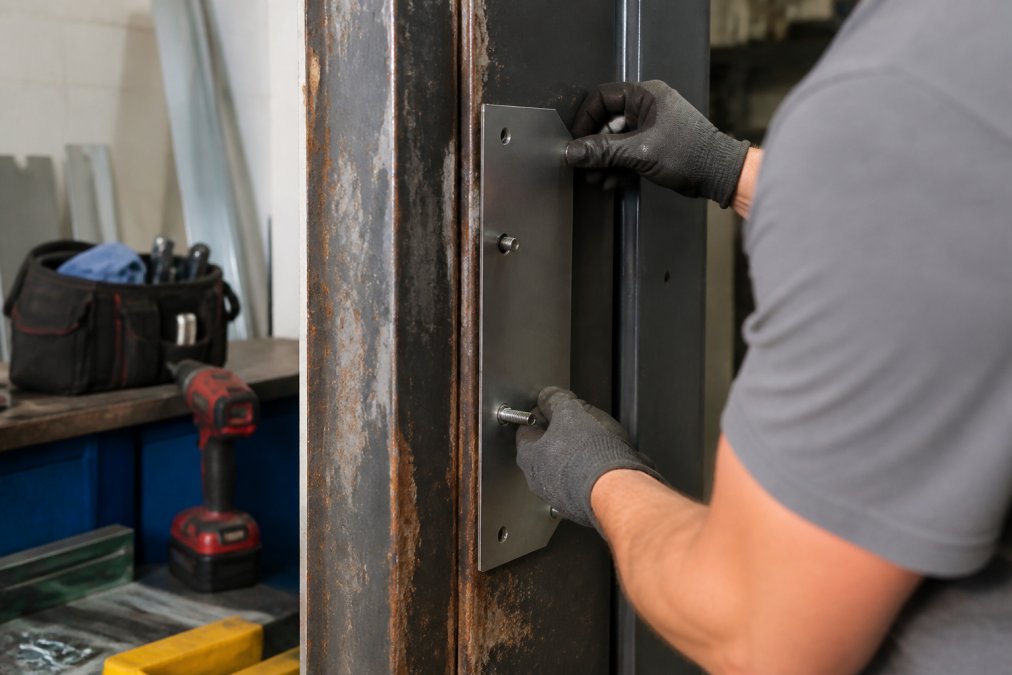
Addressing Rust and Corrosion Before Upgrading
Assess rust damage first. Light surface rust can be cleaned and painted. Moderate rust (less than 2 inches) can be addressed with repair patches. Deep rust (more than 2 inches) requires full-height patches or replacement.
Start with cleaning: use a wire brush to remove loose rust and paint. For deeper corrosion, light grinding removes oxidized material. Clean thoroughly with a cloth, patches won't adhere to dirty surfaces.
Jamb Patch - Jamb Anchor Catalogue →
After cleaning, inspect the frame for alignment. A warped or misaligned frame won't accept a patch cleanly. If the frame is severely bent, straightening may be necessary before patching. For most facilities, minor misalignment can be corrected as part of the installation process.
Three-Step Installation Process
The installation of a commercial door frame repair kit follows a consistent three-step process that works across different kit types and frame materials.
Step 1: Position the patch and mark fastener holes (10 minutes) Hold the patch against the damaged area and align it with the frame. Mark the fastener holes using a pencil or marker. For kits like Door Innovation's Jamb Patch, the non-handed design allows installation on either side of the door opening. Ensure the patch covers the damaged area completely with at least 1 inch of overlap on all sides.

Step 2: Drill fastener holes and prepare the surface (15 minutes) Drill holes according to the marked locations. Use the correct drill bit size specified in the kit instructions. Clean any debris from the holes. Apply a thin coat of rust-inhibiting primer to the back of the patch and the frame surface where the patch will sit. This prevents new corrosion from forming underneath the patch.
Step 3: Secure the patch with fasteners and seal (20 minutes) Install fasteners according to kit specifications. Tighten fasteners evenly, alternating between opposite sides to ensure even pressure. Once all fasteners are secure, apply sealant around the patch edges to prevent water intrusion. Allow sealant to cure according to product instructions before testing the door.
This three-step process takes approximately 45 minutes per door opening. For facilities managing multiple damaged frames, the process becomes faster with repetition.
Commercial Door Frame Repair Kits vs. Full Replacement
The decision between repair kits and full replacement hinges on three factors: the extent of damage, your budget, and the frame's age and condition.
Repair kits work best when damage is localized. If rust is confined to the bottom 12-24 inches of the frame and the rest of the frame is structurally sound, a patch addresses the problem without the cost and downtime of full replacement. Door Innovation's Jamb Patch kits, for example, start at $130.37 for early rust repair and go up to $320 for kits that address both sides of the frame. These costs are significantly lower than full frame replacement.

Full replacement becomes necessary when rust damage affects more than 50% of the frame height, when the frame is severely warped or misaligned, or when the frame has failed multiple times. Replacement also makes sense for facilities undergoing major renovations or upgrading to new security systems that require structural modifications.
The labor cost difference is substantial. Repair kits can be installed by in-house maintenance teams in under an hour.
| Repair Approach | Material Cost | Labor Hours | Timeline | Best For |
|---|---|---|---|---|
| Repair Kit (early rust) | $130-180 | 0.5-1 hour | Same day | Localized corrosion under 2 inches |
| Repair Kit (both sides) | $320 | 1-1.5 hours | Same day | Rust on hinge and strike sides |
| Full Replacement | $400-800 | 4-8 hours | 1-2 days | Severe damage or major renovation |
Access Control System Integration and Keyless Entry
Modern commercial door frame security increasingly involves integration with access control systems. Keyless entry, whether biometric, card-based, or mobile credential systems, requires a secure frame to function properly.
Commercial Door Hardware Security Standards and Compliance
The relationship between frame integrity and compliance is direct: a compromised frame cannot properly support hardware, which means your security system is not functioning as designed. Reinforcing the frame is often the first step toward achieving both security and compliance goals.
Frequently Asked Questions
Can you repair a rusted commercial door frame instead of replacing it?
Yes. Rusted steel frames can be repaired using specialized repair kits like Jamb Patches, which address rust at the bottom of the frame where corrosion typically starts. The Jamb Patch Kit ($130.37) handles early-stage rust on steel frames, while deeper corrosion (more than 2 inches) requires Strike Side or Hinge Jamb Patches ($180.91 each). These repairs extend frame life by years and cost significantly less than full replacement, making them ideal for facilities managing multiple doors.
What hardware is required to reinforce a commercial steel door frame?
Reinforcement hardware includes high-security cylindrical locks, deadbolts, protective strike plates, continuous hinges, and door closers. For corroded aluminum frames that have come loose, Jamb Anchor kits ($119 each for side or center jambs) re-anchor frames firmly. For steel frames with rust damage, Jamb Patch kits provide structural reinforcement. All Door Innovation repair kits include installation hardware and are compatible with major manufacturers like Steelcraft, ASSA Abloy, and Ceco, ensuring proper fit and security.
How do security upgrades impact ADA compliance for commercial doors?
Security upgrades must balance protection with accessibility. Electric strikes and biometric scanners can integrate with ADA-compliant push-bar exit devices, allowing secure entry without compromising emergency egress. Door closer settings must meet ADA force requirements (typically 5 pounds of pressure). When upgrading frames with repair kits, ensure hinges and hardware don't protrude beyond ADA guidelines. Consult your local building code and ADA compliance officer before implementing upgrades in healthcare, educational, or public facilities.
How much does it cost to upgrade commercial door frame security versus full replacement?
Repair kits range from $119-$320 per frame, plus labor. A full frame replacement typically costs more per opening. For a facility with 40 doors, using repair kits could save $5,000-$20,000 compared to replacement, depending on damage severity. The Right Hand Hinge Jamb Patch Kit ($320) addresses both sides of a rusted steel frame, providing comprehensive restoration at a fraction of replacement cost while maintaining security and structural integrity.