
Commercial Door Hardware Compliance Checklist
Table of Contents
- Why Commercial Door Hardware Compliance Matters
- Commercial Door Hardware Inspection Checklist: Core Components
- Fire Door Inspection Checklist: Labels, Ratings, and Certification
- Commercial Door Closer Inspection: Operation and Maintenance
- Accessibility and ADA Compliance for Commercial Doors
- Commercial Door Frame Repair: When Inspection Reveals Damage
- Inspection Frequency, Documentation, and Corrective Action
- Frequently Asked Questions
Last Updated: October 9, 2026
Why Commercial Door Hardware Compliance Matters
Commercial door hardware compliance is a legal and safety requirement that protects occupants, reduces liability, and extends the life of your entry systems.
A properly maintained commercial door hardware system keeps people safe, ensures accessibility, and prevents costly frame failures.
Building codes require every commercial door hardware assembly, from hinges and closers to locks and fire ratings, to meet specific standards.
Commercial Door Hardware Inspection Checklist: Core Components
Your commercial door hardware compliance inspection should cover four areas: door and frame condition, locking mechanisms, hinges and fasteners, and closing operation. Each has specific pass/fail criteria.
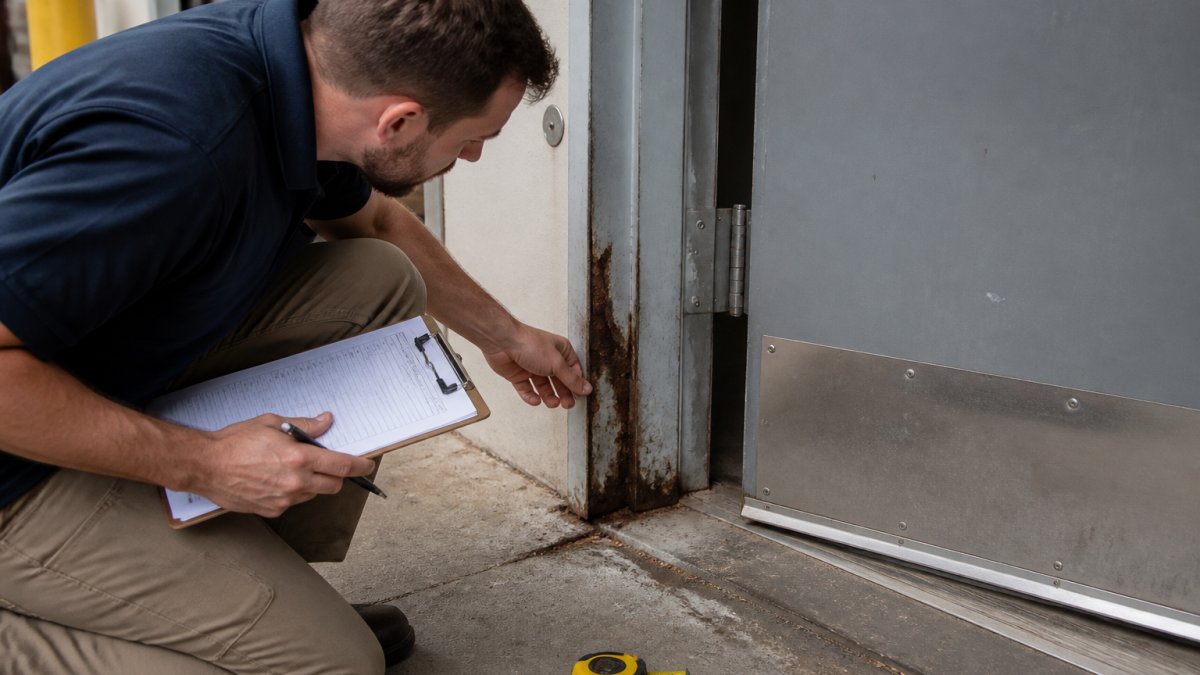
Door and Frame Condition Assessment
Start with a visual assessment of the door leaf and frame. Look for rust, corrosion, dents, warping, and separation from the surrounding masonry or wall.
What to check:
-
Rust on steel frames: Surface rust is cosmetic; deep rust (more than 2 inches) at the bottom of the frame indicates structural compromise and requires repair. Door Innovation's Jamb Patch Kit (4") addresses early-stage rust at the first sign of corrosion on steel frames, while the Strike Side Jamb Patch handles advanced rust damage.

Strike Side Jamb Patch -
Corrosion on aluminum frames: Salt, water, cleaning solutions, and repeated impacts cause aluminum frames to loosen and separate. The Jamb Anchor Side Jamb Kit re-anchors compromised aluminum frames without full replacement.

Jamb Anchor Side Jamb Kit -
Frame separation: If the frame has pulled away from the wall or masonry, the door assembly fails the compliance check. This is a safety and security issue that must be corrected.
-
Door leaf warping: A warped door leaf prevents proper closing and latching. This is a fail condition that requires either door replacement or, in some cases, adjustment of the closing mechanism.
Pass/fail criteria: The frame and door must be structurally sound with no gaps larger than 1/8 inch between the door and frame at any point. Rust or corrosion that compromises structural integrity is a fail.
Locks, Latches, and Locking Hardware
Locking hardware must function reliably and meet security ratings appropriate to the building type. Test every lock and latch for smooth operation, full engagement, and rating compliance.
What to check:
-
Lock operation: Locks must turn smoothly without binding or grinding. Stiff locks indicate wear, corrosion, or misalignment.
-
Latch engagement: The latch must fully extend and retract without resistance. A latch that doesn't fully engage is a security and safety fail.
-
Strike plate alignment: The strike plate must be properly aligned with the latch. Misalignment prevents proper latching and is a common source of security failures.
-
Security rating: Verify that the lock meets the security rating required for the door's location and use. A retail storefront requires a higher security rating than an interior office door.
Pass/fail criteria: All locks and latches must operate smoothly and engage fully. Security ratings must match or exceed code requirements for the door's location.
Hinges and Fasteners
Hinges support the door leaf and must be structurally sound, with tight, corrosion-resistant fasteners.
What to check:
-
Hinge condition: Look for rust, corrosion, bent or broken hinge leaves, and loose pins. Damaged hinges compromise door operation and safety.
-
Fastener tightness: All screws and bolts must be tight. Loose fasteners cause the door to sag or bind, leading to operational failure.
-
Fastener corrosion: Corroded fasteners lose holding power and may fail under load. Stainless steel or coated fasteners resist corrosion better than plain steel.
-
Hinge pocket damage: If the hinge pocket in the frame is damaged or corroded, the hinge cannot seat properly. Door Innovation's Left Hand Hinge Jamb Patch and Right Hand Hinge Jamb Patch include a 4-1/2 inch commercial hinge pocket for hinge side repairs.

Left Hand Hinge Jamb Patch
Pass/fail criteria: All hinges must be secure, undamaged, and properly seated. All fasteners must be tight and corrosion-resistant.
Door Closers and Closing Operation
Door closers control closing speed and ensure proper latching. They're critical for fire safety, accessibility, and security.
What to check:
-
Closer operation: The door must close smoothly and consistently. A closer that closes too fast or too slow is a fail.
-
Closing force: The force required to open the door must not exceed 5 pounds for most commercial doors (ADA requirement). Healthcare facilities and some other buildings may have different requirements.
-
Latching: The door must close fully and latch without sticking or binding.
-
Closer leaks: Oil leaks from the closer indicate internal failure and require replacement.
Pass/fail criteria: The door must close smoothly, consistently, and completely within 3-6 seconds. Opening force must not exceed code limits.
| Inspection Item | What to Look For | Pass | Fail |
|---|---|---|---|
| Door and frame | Rust, corrosion, separation, warping | Structurally sound, no gaps >1/8" | Rust >2", frame separation, warping |
| Locks and latches | Smooth operation, full engagement, security rating | Smooth operation, full engagement, correct rating | Binding, incomplete engagement, wrong rating |
| Hinges and fasteners | Damage, corrosion, loose fasteners | Secure, tight, corrosion-resistant | Bent, corroded, loose fasteners |
| Door closers | Smooth operation, closing force, latching | Smooth, 3-6 second close, <5 lb opening force | Jerky, too fast/slow, >5 lb opening force |
Fire Door Inspection Checklist: Labels, Ratings, and Certification
Fire doors are a critical life-safety component. They must meet fire-rating standards and be properly labeled, certified, and maintained.
Fire doors are rated in hours: 20, 45, 60, 90, and 120 minutes.
What to check:
-
Fire label: Every fire door must have a permanent label attached to the door leaf or frame. The label identifies the manufacturer, fire rating, and certification authority. Missing or illegible labels are a fail.
-
Door assembly components: All components of the fire door assembly, door leaf, frame, hinges, closer, latch, and hardware, must be listed for that specific fire rating. Mixing components from different manufacturers or ratings compromises the assembly.
-
Gaps and clearances: Fire doors must have specific clearances between the door leaf and frame. Gaps larger than 1/8 inch at the top and sides, or 3/8 inch at the bottom, allow smoke and flame to pass and are a fail.
-
Closer function: Fire doors must have closers that function properly. A fire door without a working closer is a fail.
-
Automatic closing devices: Some fire doors are required to have automatic closing devices that pull the door closed if it's propped open. Check that these devices function.
Pass/fail criteria: The fire label must be present and legible. All components must match the rated assembly. Gaps must not exceed code limits. The closer must function properly.
Commercial Door Closer Inspection: Operation and Maintenance
Door closers are mechanical devices that control closing speed and ensure latching, and they require regular inspection and maintenance.
A properly functioning closer closes the door smoothly in 3-6 seconds, adjusts for different opening speeds, and latches without slamming.
Inspection steps:
-
Open the door fully and release it. The closer should pull the door closed smoothly without jerking.
-
Time the closing cycle. It should take 3-6 seconds from fully open to fully closed.
-
Check for smooth operation at different opening angles. The closer should move smoothly whether the door is opened 30 degrees or 90 degrees.
-
Inspect the closer body for oil leaks, cracks, or corrosion.
-
Test the latch. The door must latch fully without binding.
Maintenance:
-
Clean the closer periodically to remove dust and debris.
-
Lubricate moving parts with light machine oil if the closer is not self-lubricating.
-
Check fasteners and tighten if loose.
-
Replace the closer if it leaks oil, closes inconsistently, or fails to latch properly.
Pass/fail criteria: The closer must operate smoothly, close in 3-6 seconds, and ensure proper latching. Oil leaks, inconsistent operation, or failure to latch are fails.
Accessibility and ADA Compliance for Commercial Doors
The Americans with Disabilities Act (ADA) sets specific requirements for commercial door operation so people with disabilities can open and pass through doors independently.
ADA door requirements:
-
Opening force: The force required to open a door must not exceed 5 pounds for most doors. Fire doors and doors with automatic openers may have different requirements.
-
Door width: The clear opening width must be at least 32 inches for a single door, measured from the door edge to the opposite jamb when the door is open 90 degrees.
-
Threshold height: Thresholds must not exceed 1/4 inch in height. Beveled thresholds with a slope of 1:2 or less are acceptable up to 1/2 inch.
-
Hardware operation: Handles and controls must be operable with one hand without requiring tight grasping, pinching, or twisting of the wrist.
-
Door closers: If a door has a closer, the door must close slowly enough that a person can pass through without the door closing on them.
Pass/fail criteria: Opening force must not exceed 5 pounds. Clear opening width must be at least 32 inches. Thresholds must not exceed 1/4 inch. Hardware must be single-hand operable.
Commercial Door Frame Repair: When Inspection Reveals Damage
When inspection reveals damage, rust, corrosion, frame separation, or hinge pocket damage, you can repair or replace. For most commercial facilities, repair is faster and more cost-effective.
Door Innovation's repair kits address the most common frame damage scenarios: identify the damage type, select the appropriate kit, and install it in three simple steps.
Repair scenarios:
-
Early-stage rust on steel frames: Use the Jamb Patch Kit (4") at the first sign of corrosion. This kit includes two 4-inch patches and is designed for early intervention.
-
Advanced rust on steel frames (more than 2 inches): Use the Strike Side Jamb Patch for the strike side or Hinge Jamb Patch for the hinge side. These full-height patches replace the damaged jamb section.
-
Loose aluminum frames: Use the Jamb Anchor Side Jamb Kit or Jamb Anchor Center Jamb Kit to re-anchor frames that have separated due to corrosion or impact.
-
Both sides of frame damaged: Use the Right Hand Hinge Jamb Patch Kit or Left Hand Hinge Jamb Patch Kit for comprehensive repair of both the hinge and strike sides.
When to replace instead of repair: If the frame is severely damaged (more than 50% of the jamb is compromised), if multiple components have failed, or if the door is at the end of its life cycle, full replacement may be more economical.
Inspection Frequency, Documentation, and Corrective Action
A compliant facility requires a documented inspection schedule, clear pass/fail criteria, and a corrective action process.
Inspection frequency:
- High-traffic commercial doors (retail, healthcare, hospitality): Quarterly or semi-annually
- Standard commercial doors (offices, warehouses): Annually
- Low-traffic doors (emergency exits, storage): Annually or as needed
Documentation:
Create an inspection record for each door:
- Door location and identifier
- Inspection date and inspector name
- Condition of each component (door, frame, locks, hinges, closer, fire rating)
Corrective action process:
-
Document the defect clearly (e.g., "Rust 3 inches at bottom of strike side jamb").
-
Determine the corrective action (repair or replace).
-
Schedule the work with a specific completion date.
-
Complete the work and document completion in the inspection record.
-
Re-inspect the door after correction to verify the defect is resolved.
-
Update the inspection record with the re-inspection result.
Role ownership:
Assign clear responsibility for inspections, a facility manager or maintenance director, a contracted maintenance company, a certified door inspector or locksmith, or a mix of in-house staff and contractors. Whoever inspects should be trained on compliance requirements and your facility's standards.
| Inspection Task | Frequency | Owner | Documentation |
|---|---|---|---|
| Visual inspection | Quarterly to annually | Facility manager or maintenance | Inspection form |
| Component testing | Annually | Maintenance or contractor | Test results |
| Fire door verification | Annually | Certified inspector | Fire door label check |
| Corrective action | As needed | Maintenance | Work orders, completion dates |
| Audit preparation | Before inspections | Facility manager | Compiled records |
Frequently Asked Questions
What should be included in a commercial door hardware inspection?
A complete commercial door hardware inspection covers door and frame condition, all locks and latches, hinges and fasteners, door closers, fire-door labels and ratings, accessibility features, and panic hardware. Check for rust, corrosion, loose fasteners, proper operation, and compliance with fire codes and ADA requirements. Document findings and identify any damage requiring repair or replacement.
How often should commercial door hardware be inspected?
Most commercial facilities should conduct routine inspections quarterly or semi-annually, depending on door usage and environmental conditions. High-traffic areas, exterior doors, and fire-rated doors may need more frequent checks. Healthcare facilities and buildings with strict compliance requirements should establish monthly inspection schedules. Document all inspections to demonstrate due diligence.
What hardware is required on a fire-rated commercial door?
Fire-rated commercial doors must include fire-rated hinges, self-closing devices (door closers), automatic-closing mechanisms, and fire-rated locks or latches. The door leaf and frame must carry a fire-safety label indicating the fire rating (typically 20, 45, 60, or 90 minutes). All hardware must be certified for use in fire-rated assemblies and properly installed per manufacturer specifications.
How do you check whether a commercial door closes and latches properly?
Open the door fully and release it. The door closer should pull it closed smoothly without slamming or sticking. Listen for a clear latching sound when the door fully closes. Check that the latch bolt extends fully into the strike plate. The door should not drift open or require excessive force to close. If the closer needs adjustment or the latch is weak, maintenance or repair is needed.
What is the best way to repair a corroded or rusted commercial door frame?
For steel frames with rust at the bottom, patching kits like the Jamb Patch ($130.37-$320.00) address damage without full replacement. For aluminum frames that have come loose due to corrosion, the Jamb Anchor kits ($119.00) re-anchor the frame securely. Both options are cost-effective alternatives to replacing the entire frame and can extend door life by years with a simple three-step installation.
Commercial door hardware compliance is manageable when you break it down into clear inspection steps, document findings consistently, and address defects promptly. Most facility managers find that a quarterly or annual inspection schedule, combined with early repairs using Door Innovation's repair kits, keeps doors compliant and extends the life of existing door systems. The key is consistency: inspect regularly, document thoroughly, and fix problems before they become emergencies.