
Do Maintenance Crews Need Training: A Complete Guide
Table of Contents
- Why Maintenance Crews Need Training
- OSHA Maintenance Safety Requirements and Compliance
- Door Frame Repair Safety Standards Your Team Must Know
- Building an Effective Maintenance Training Program
- On-the-Job Maintenance Training Checklist
- The Cost of Not Training Your Maintenance Crew
- Onboarding New Maintenance Hires: A Step-by-Step Approach
- Reducing Equipment Downtime Through Proper Training
- Frequently Asked Questions
Last Updated: September 18, 2026
Why Maintenance Crews Need Training
Do maintenance crews need training? The answer is unequivocal: yes. Untrained maintenance teams create safety hazards, accelerate equipment failure, and drain budgets through costly mistakes and emergency repairs. A crew working without proper training is essentially operating in the dark, responding to problems rather than preventing them.
The cost of skipping training is steep. Facility managers who neglect crew development face recurring equipment breakdowns, safety violations, and liability exposure. More fundamentally, training transforms reactive maintenance into preventative maintenance. Your team stops fighting fires and starts anticipating them.
Training isn't optional for commercial facilities. It's the difference between a maintenance operation that runs smoothly and one that hemorrhages money through downtime and emergency repairs.
OSHA Maintenance Safety Requirements and Compliance
Maintenance work falls under strict federal safety regulations. The Occupational Safety and Health Administration (OSHA) mandates that workers receive training appropriate to their job duties and the hazards they face. For door frame repair and maintenance, this includes fall protection, proper tool use, electrical safety, and hazard communication.
Your crew must understand these requirements:
- Hazard communication: Workers need training on chemicals, solvents, and materials used in frame repair
- Personal protective equipment (PPE): Proper selection and use of gloves, eye protection, and respiratory equipment
- Fall protection: When working at heights or on ladders during frame installation
- Tool safety: Correct handling of power tools, drills, and fastening equipment
- Lockout/tagout procedures: If maintenance involves electrical components or powered equipment
OSHA doesn't specify exact training hours for maintenance crews, but it does require that training be documented and refreshed when procedures change or new hazards are introduced. Facilities that skip this documentation risk citations and fines.
Door Frame Repair Safety Standards Your Team Must Know
Door frame repair introduces specific safety considerations that your crew must understand before touching any equipment. When working with rusted steel or corroded aluminum frames, workers encounter sharp edges, unstable materials, and potential structural weakness.
Safety standards for door frame repair include:
- Structural integrity assessment: Your team must be able to identify frames that are too compromised to repair safely
- Material handling: Proper techniques for removing damaged sections without causing injury
- Dust and particulate control: When cutting or grinding rusted metal, workers must wear respiratory protection
- Electrical safety: Some door frames house electrical components; crews need to know how to identify and work around them safely
- Proper fastening and anchoring: Incorrect installation creates loose doors, which become security and safety hazards
Door Innovation's repair kits like the Jamb Patch and Jamb Anchor are designed with safety in mind, but only trained crews can install them correctly. Installation errors don't just waste materials, they create liability. A door frame that fails six months after repair exposes your facility to injury claims and security breaches.

Building an Effective Maintenance Training Program
Creating a training program doesn't require expensive consultants or elaborate curricula. Start with the fundamentals and build from there. Your program should address both technical skills and safety awareness.
A solid maintenance training program includes:
- Initial orientation: New hires learn facility layout, emergency procedures, and basic safety rules
- Equipment-specific training: Crews learn how to operate and maintain the specific equipment in your facility
- Procedure documentation: Standard operating procedures for routine tasks like door frame inspection and repair
- Hands-on practice: Supervised practice before crews work independently
- Refresher training: Annual updates on safety protocols and new procedures
- Certification tracking: Records showing who completed what training and when
The program should be tailored to your facility's needs. A healthcare facility has different priorities than a retail building. An industrial facility with heavy equipment has different hazards than an office complex.
Identifying Skill Gaps in Your Team
Before you build a training program, assess what your crew actually knows. Skill gaps are where accidents and costly mistakes happen.
Start by answering these questions:
- Can your crew identify when a door frame is beyond repair versus salvageable?
- Do they understand the difference between preventative and corrective maintenance?
- Can they safely use the tools required for frame repair and installation?
- Do they know how to recognize rust progression and corrosion patterns?
- Are they familiar with the specific repair products you use, like Door Innovation's Jamb Patch kits?
The simplest way to identify gaps is to observe your crew at work. Watch how they approach a repair. Ask them to explain their process. Listen for confidence and clarity. If explanations are vague or hesitant, that's a gap.

Document what you find. Create a skills inventory for each crew member. This becomes your training roadmap.
On-the-Job Training vs. Formal Certification
Your facility likely needs both. On-the-job training teaches your crew how to do work YOUR way, using YOUR equipment and YOUR procedures. Formal certification validates that workers meet industry standards.
On-the-job training is faster and directly applicable. A crew member learns by shadowing experienced workers, practicing under supervision, and gradually taking on tasks independently. This approach works well for facility-specific procedures and equipment. Door frame repair using Door Innovation's kits, for example, is best learned hands-on.
Jamb Patch - Jamb Anchor Catalogue →
Formal certification comes from external programs and provides credentials. OSHA certifications, fall protection cards, and equipment-specific certifications all carry weight. They document that your crew meets recognized standards and can be valuable for liability protection.
The best approach combines both. Use formal certification for foundational safety skills and compliance requirements. Use on-the-job training for facility-specific procedures and your preferred repair methods.
On-the-Job Maintenance Training Checklist
Use this checklist to ensure your on-the-job training covers all essential areas:
| Training Element | Duration | Frequency | Owner |
|---|---|---|---|
| Safety orientation | 2-4 hours | Once per hire | Supervisor |
| Tool safety and use | 4-8 hours | Annual refresh | Lead technician |
| Door frame inspection | 4 hours | Annual refresh | Supervisor |
| Repair kit installation (Jamb Patch/Jamb Anchor) | 4-6 hours | As needed | Certified installer |
| Hazard identification | 2 hours | Annual refresh | Safety officer |
| Emergency procedures | 1-2 hours | Annual refresh | Supervisor |
| Equipment-specific training | 2-4 hours | Per equipment | Manufacturer/trainer |
| Compliance documentation | 1 hour | Annual refresh | HR/supervisor |
Before a crew member works independently on door frame repairs, they should:

- Demonstrate proper use of all required tools
- Correctly install a repair kit under supervision
- Explain the inspection process for identifying rust and corrosion
- Describe safety protocols for the specific work environment
- Show understanding of when to escalate a problem to management
- Pass a practical competency assessment
- Have signed documentation of training completion
The Cost of Not Training Your Maintenance Crew
Skipping training feels like saving money in the short term. The reality is the opposite. Untrained crews generate costs that dwarf the investment in training.
Equipment downtime: An untrained crew misses early warning signs of problems. A door frame that could have been repaired with a Jamb Patch kit for $130 becomes a full replacement costing thousands when ignored. Meanwhile, the facility has a broken door creating security and accessibility issues.
Liability and safety violations: OSHA citations for inadequate training can reach thousands of dollars per violation. Injury claims from workers lacking proper safety training cost far more. A single serious injury can exceed six figures.
Rework and waste: Improperly installed repairs fail. Door frames repaired incorrectly become safety hazards. Your facility ends up paying for repairs twice, once for the failed attempt and again for the correct installation.
Staff turnover: Untrained workers feel lost and unsupported. They leave. Turnover is expensive. Recruiting, hiring, and training replacements costs time and money. Experienced crews that stay are far more valuable.
Operational disruption: When maintenance crews lack skills, routine tasks take longer.
Onboarding New Maintenance Hires: A Step-by-Step Approach
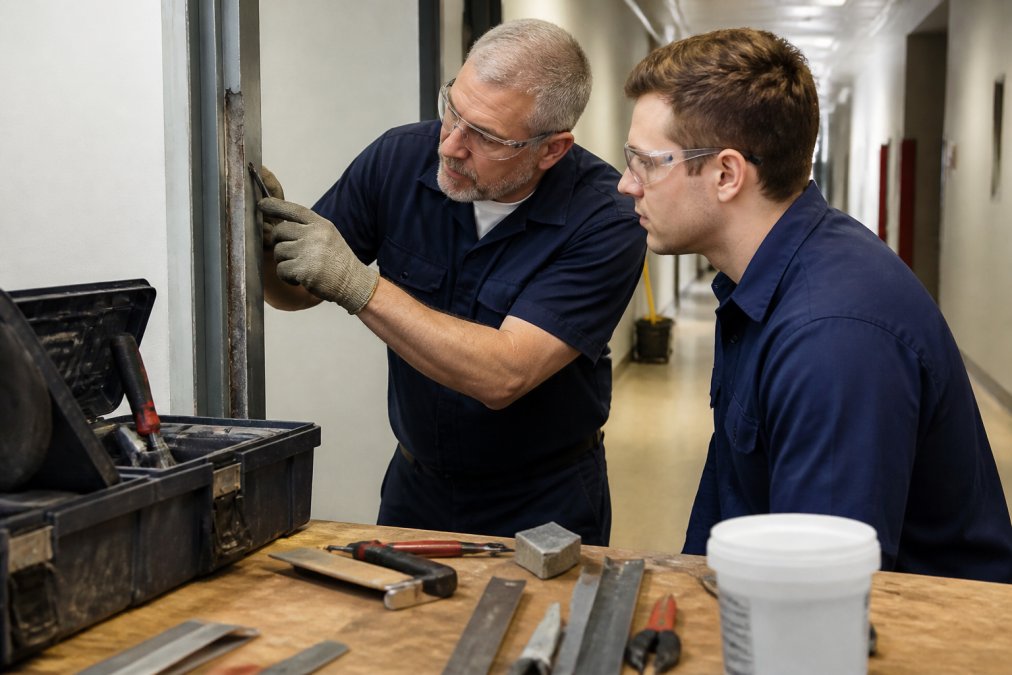
Bringing a new maintenance hire into your facility requires a structured approach. Poor onboarding sets them up to fail and creates safety risks.
Reducing Equipment Downtime Through Proper Training
Trained maintenance crews reduce downtime dramatically. Here's how:
Preventative maintenance: Trained crews inspect equipment regularly and identify problems before they become emergencies. A crew that understands rust progression can spot a corroding door frame early and apply a Jamb Patch before the frame becomes unusable. This prevents emergency repairs and facility disruption.
Frequently Asked Questions
Do maintenance jobs provide on-the-job training?
Many maintenance positions include on-the-job training, but the quality and depth vary significantly by employer. Facilities with structured training programs see better outcomes in safety compliance, reduced downtime, and staff retention. If your maintenance crew handles specialized tasks like door frame repairs, hands-on instruction from experienced technicians is essential to ensure proper installation of repair kits and adherence to safety standards.
What are the 5 basic maintenance skills every technician should have?
Essential maintenance skills include troubleshooting and problem diagnosis, preventative maintenance planning, equipment operation and safety, basic carpentry and metalwork, and documentation of maintenance protocols. For facilities managing door systems, crews also need proficiency in identifying rust and corrosion, understanding frame repair techniques, and recognizing when professional-grade solutions like Door Innovation's Jamb Patch kits are appropriate versus full replacement.
How does regular training impact facility maintenance costs?
Properly trained maintenance crews reduce operational costs by minimizing equipment downtime, preventing emergency repairs, and extending asset life through preventative maintenance. A well-trained team can address issues early, such as catching rust on door frames before extensive damage requires costly replacement. This proactive approach typically saves facilities on annual maintenance budgets while improving safety and reducing liability risks.
Is formal training required for door frame and hardware repairs?
While formal certification isn't always mandatory, OSHA standards and building codes establish safety requirements for door frame repairs in commercial facilities. Training ensures your crew understands load-bearing specifications, corrosion prevention, and proper installation techniques. Door Innovation's repair kits come with detailed installation instructions, but hands-on training on your specific door types and facility layouts ensures correct application and long-term durability.