
Door Frame Damage Repair: A 2026 How-To Guide
Table of Contents
- Identifying Door Frame Damage: A Visual Diagnostic
- What You'll Need for the Repair
- Step-by-Step Commercial Door Frame Repair
- Rusted Steel Door Frame Repair: Patching vs. Replacement
- Fixing Sticking Doors and Misaligned Frames
- Understanding the Cost of Door Frame Replacement
- Common Mistakes to Avoid
- Conclusion
- Frequently Asked Questions
Last Updated: October 1, 2026
Identifying Door Frame Damage: A Visual Diagnostic
Door frame damage is any physical deterioration of the vertical jamb, head, or stop that weakens how a door sits, seals, or locks.
Start with a slow close. Watch the gap between the door and the frame. Then check these spots:
- Rust or bubbling paint along the bottom 6 inches of a steel frame
- Cracked wood or soft spots you can push a screwdriver into
- Warping where the jamb bows away from the door
- Loose hinge screws that spin instead of biting
- Kick-in damage around the latch and strike plate
Cosmetic vs. Structural Damage
Cosmetic damage is surface-level: scuffs, chipped paint, or light rust that hasn't eaten into the metal. Structural damage is different. It affects frame integrity, meaning the jamb can no longer hold the door square, secure, or weather-tight.
Here's the quick test. If a screwdriver pokes through the wood like wet cardboard, that's rot, not a scratch. If the door drags or won't latch, the frame has moved. Those are structural problems, and they need more than paint.
What You'll Need for the Repair
Gather everything before you start. A half-finished repair leaves bare wood or metal exposed to more moisture, and the second trip to the hardware store is where most weekend jobs stall.
For wood frames:
- Two-part epoxy filler (for structural spots) or water-based wood filler (for cosmetic dents)
- Wood hardener for soft, rotted sections, apply until the wood stops absorbing
- Putty knife (1.5 in. and 3 in.), 120- and 220-grit sandpaper, sanding block
- Primer, paint matched to the existing finish, and a 2-in. angled brush
- Wood glue and clamps for splits and delamination
- A scratch awl or pick to probe for soft wood before you commit to filler
For steel frames:
- A jamb patch kit sized to the damage (measure the rusted height, not the visible paint blister)
- Cordless drill and self-tapping screws
- Wire brush and a rust converter (phosphoric acid-based)
- Touch-up paint matched to the frame
- A magnetic level to confirm the jamb is still plumb after the patch
For sticking doors:

- Replacement hinge screws, 3-in. screws that reach the framing stud, not the 3/4-in. screws that come with the hinge
- Wood shims for leveling
- A 24-in. level and a flat pry bar
- A hand plane or block plane for edge trimming as a last resort
Match the tool to the damage, not the other way around. A common mistake is buying filler for a problem that is actually structural. If a screwdriver sinks more than 1/8 in. into the wood, filler will not hold, you need to remove the soft material and rebuild with epoxy or replace the section. If rust runs more than 2 in. up a steel frame, filler and paint will fail within a season; a steel patch is the correct tool.
OSHA guidance on door and frame safety in commercial facilities
Step-by-Step Commercial Door Frame Repair
Commercial door frame repair follows a simple three-step process for most surface damage. Work in dry conditions, and don't rush the cure times.
Step 1: Prepare the Damaged Area
Remove all loose material first. Scrape out soft wood, wire-brush rust down to bare metal, and vacuum the dust. For rot, apply wood hardener and let it cure fully. Clean, dry surfaces are the only ones filler and patches will bond to.
Step 2: Apply Wood Filler or Epoxy
Press filler into cracks and dents with a putty knife. Overfill slightly, because filler shrinks as it dries. For deep holes, build up in thin layers rather than one thick blob. Epoxy filler works better in spots that take traffic or moisture.
Step 3: Sand, Prime, and Paint
Once cured, sand flush with 120 grit, then smooth with 220. Wipe away dust. Prime bare spots, then paint to match the finish. Feather the edges so the repair blends into the surrounding wood grain or metal.
For rusted steel, the process changes: you install a Jamb Patch over the damaged section rather than filling it. More on that below.

Rusted Steel Door Frame Repair: Patching vs. Replacement
Rusted steel door frame repair comes down to one question: how far has the rust spread? If rust covers more than 2 inches at the bottom of the frame, patching still wins in most cases. A full replacement is rarely necessary for bottom-of-frame corrosion.
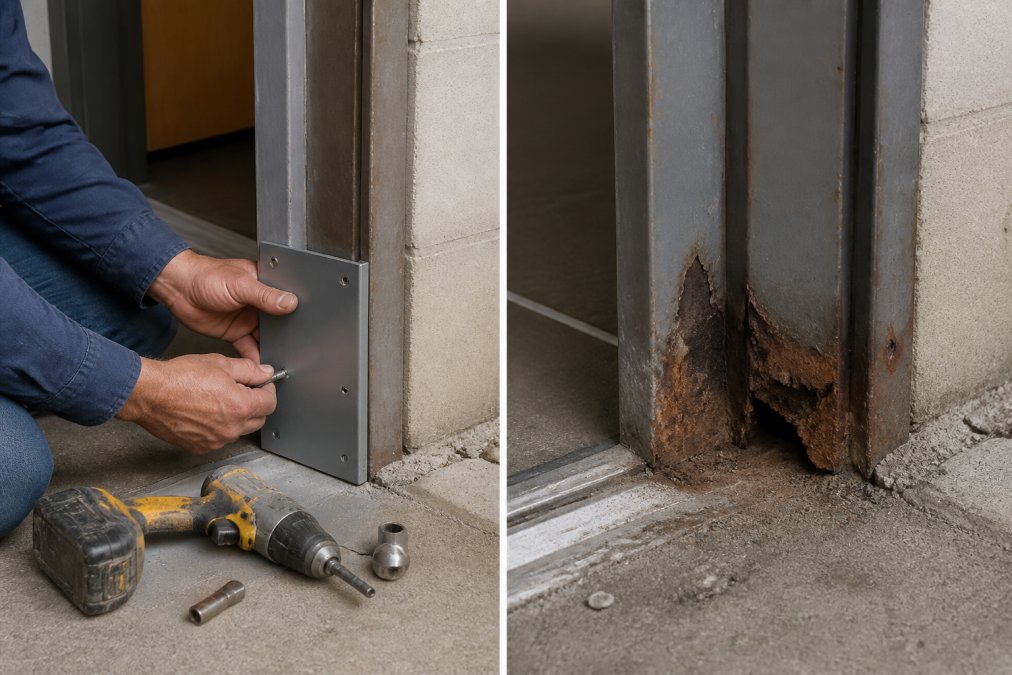
The Jamb Patch is designed for this problem. The 4-inch Jamb Patch Kit ($130.37) handles early rust at the first sign of corrosion.
| Damage Level | Best Fix | Product |
|---|---|---|
| Light rust, under 2 in. | Small patch | Jamb Patch Kit (4") |
| Rust over 2 in., latch side | Strike patch | Strike Side Jamb Patch |
| Rust over 2 in., hinge side | Hinge patch | Left or Right Hand Hinge Jamb Patch |
| Frame bent or twisted | Full replacement | Call a pro |
Fixing Sticking Doors and Misaligned Frames
A sticking door usually means the frame has shifted, not that the door itself is the problem. Structural settling pulls the jamb out of square, and the door rubs or won't latch.

Try these fixes in order:
- Tighten or replace hinge screws. Swap one short screw per hinge for a longer one that reaches the stud.
- Check the reveal. If the gap is uneven, the frame is out of square.
- Shim and level. Loosen the frame anchors, shim behind the jamb, and re-level.
- Plane the door edge only as a last resort. Removing door material hides the symptom, not the cause.
Understanding the Cost of Door Frame Replacement
What drives the cost of a full frame replacement:
- Demolition and disposal of the old frame and any damaged wall section
- New frame material (hollow metal, wood, or composite) and matching hardware
- Labor, typically two trades for a commercial opening, plus finish work
- Downtime: the opening is out of service during tear-out and reinstall
- Re-inspection or re-certification if the opening is part of a rated assembly
What drives the cost of a repair:
- The patch or filler material itself
- One maintenance tech's time, usually under an hour per opening
- Touch-up paint and cure time
- No demolition, no disposal, no opening downtime
Two costs most articles ignore:
- Energy. A misaligned frame breaks the weather seal. A door that will not close tight leaks conditioned air year-round. That shows up on the utility bill long before it shows up on a repair invoice.
- Security. A frame that has lost its structural integrity at the strike plate is a forced-entry risk. Patching restores the strike-side strength; a cosmetic fill does not.
Common Mistakes to Avoid
The biggest mistake is misreading cosmetic damage as structural, or the reverse. Both waste money. Here's what we see most:
- Filling rusted steel with wood filler. It won't bond and it hides the corrosion.
- Skipping the rust converter. New paint over active rust fails fast.
- Over-tightening hinge screws. Stripped holes make alignment worse.
- Ignoring moisture sources. Fix the leak or the damage returns.
- Mismatching the finish. A patch that doesn't match the frame looks like a patch.
Conclusion
Door frame damage rarely means you need a new frame. Most of the time, it means a patch, a patch kit, or a few new screws. The trick is reading the damage correctly and acting before it spreads.
Frequently Asked Questions
Can a damaged door frame be repaired without replacing the whole unit?
Yes. Cosmetic damage like cracks, dents, and small splits can be filled with wood filler or epoxy and repainted. For rusted steel frames, products like the Jamb Patch Kit ($130.37) cover early rust at the bottom of the frame. If more than 2 inches of rust is present, a Strike Side Jamb Patch or Hinge Jamb Patch ($180.91) is needed. Structural damage from settling or kick-ins may require professional assessment.
What is the average cost to replace a door frame?
A full commercial door frame replacement typically costs $300 to $800 or more per opening, including materials and labor. By comparison, a Jamb Patch Kit starts at $130.37 and installs in about an hour with basic tools. For facilities with multiple damaged frames, patching can save thousands compared to full replacement, especially when frames are otherwise structurally sound.
How do you fix a rusted or corroded metal door frame?
For rusted steel door frame repair, start by removing loose rust and debris. If rust is under 2 inches tall, install a Jamb Patch Kit ($130.37) over the affected area. For more than 2 inches, use a Strike Side or Hinge Jamb Patch ($180.91). These kits are non-handed and fit many masonry frames from US manufacturers. They restore frame integrity without welding or full replacement.
Is it cheaper to repair or replace a door frame?
Repair is almost always cheaper when damage is limited to rust, cracks, or cosmetic issues. A Jamb Patch Kit costs $130.37 versus $300 or more for a full replacement. Labor for patching is also lower since it requires no welding or frame removal. However, if the frame is warped, severely rotted, or compromised structurally, replacement may be the only safe option.