
Door Frame Restoration: Best Methods for 2026
Table of Contents
- Assessing Damage: Determining Repair vs. Replacement
- Surface Preparation and Cleaning for Door Frame Restoration
- Fixing Rusted Steel Door Frames with Jamb Patches
- Re-Anchoring Aluminum Frames with Jamb Anchor Kits
- Using Commercial Door Frame Repair Kits: Installation and Results
- Finishing: Priming, Painting, and Long-Term Protection
- Common Mistakes to Avoid During Door Frame Restoration
- Frequently Asked Questions
Last Updated: September 24, 2026
Assessing Damage: Determining Repair vs. Replacement
The decision between repairing and replacing a door frame hinges on structural compromise. Most facility managers assume visible rust means full replacement is necessary, an assumption that costs thousands annually in unnecessary work orders.
Door frame restoration is viable when damage is localized rather than systemic. If rust penetrates deeper than 2 inches at the bottom of the jamb or the frame has lost structural integrity, replacement is safer. However, most commercial door frame problems, surface rust, minor gouges, loose aluminum frames, and corrosion at strike plates or hinges, are repairable.
A frame with surface-level rust and intact structural bones is a candidate for repair kits. A frame that flexes, shows deep pitting, or has separated from its masonry opening requires replacement.
A full frame replacement typically requires a full day of skilled labor. A repair using commercial door frame repair kits takes a fraction of that time, which is why maintenance directors increasingly turn to restoration methods.
Surface Preparation and Cleaning for Door Frame Restoration
Before any repair kit goes on, the frame must be cleaned and prepped properly. This step determines whether the repair holds long-term or fails within months.
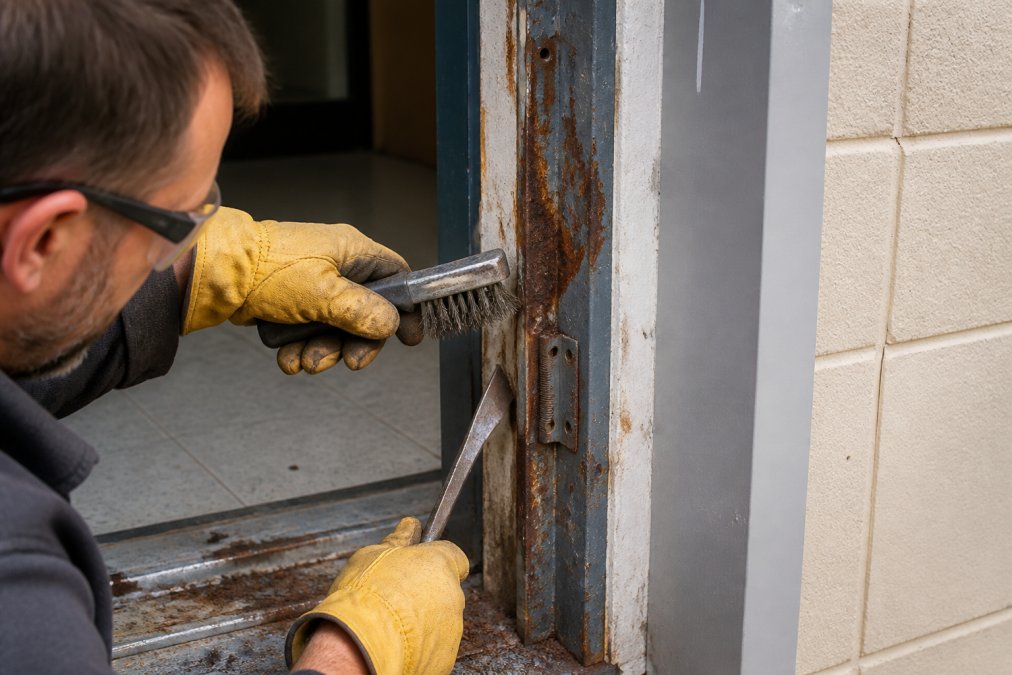
Identifying Rust Extent and Damage Type
Rust appears in two forms: surface rust (orange-brown discoloration without metal loss) and deep corrosion (pitting, flaking, and structural weakening where metal has been consumed).
Surface rust can be addressed with wire brushing, chemical rust converters, and topcoat protection. Deep corrosion requires jamb patches or section replacement. Run your hand over the area: if rough but solid, it's surface rust. If metal flakes away or shows holes and pitting, corrosion has progressed further.
Strike plate areas and bottom corners are rust hotspots, collecting moisture, salt spray, and cleaning solutions. Hinge side damage often comes from impact or door slamming, allowing water infiltration that triggers rust from inside.
Cleaning and Removing Corrosion
Start with a wire brush or wire wheel attachment on a power drill to remove loose rust, scale, and flaking material down to solid metal. For heavy buildup, a grinder works faster but requires care not to thin the metal further.
After mechanical removal, apply phosphoric acid-based rust converters per manufacturer instructions to neutralize rust in pitted areas and crevices that mechanical methods cannot reach.
For aluminum frames, use a soft wire brush or brass brush to avoid gouging. Aluminum corrosion appears as white powdery deposits. Remove the corrosion layer, then wipe with white vinegar to neutralize remaining oxidation.
Once cleaned, allow at least 24 hours of dry conditions before repair begins. Moisture trapped under patches causes rust to resume underneath.
Fixing Rusted Steel Door Frames with Jamb Patches
Jamb patches address localized corrosion at the bottom of the frame where moisture and salt accumulate. These metal overlays are mechanically fastened to restore structural integrity.
Selecting the Right Jamb Patch Kit
The standard Jamb Patch Kit (4") at $130.37 works for early-stage rust damage where less than 2 inches of corrosion is evident. This kit includes two non-handed patches, hardware, and installation instructions.

When rust extends more than 2 inches up the frame at the strike plate area, the Strike Side Jamb Patch at $180.91 covers the full strike side jamb and includes the strike plate pocket.

For hinge side repair, Door Innovation offers Left Hand Hinge Jamb Patch and Right Hand Hinge Jamb Patch options at $180.91 each, with a 4-1/2 inch commercial hinge pocket. For both sides, Right Hand Hinge Jamb Patch Kit or Left Hand Hinge Jamb Patch Kit at $320.00 provide both patches.

Step-by-Step Installation Process
Installation begins with a clean, dry frame. Lay out all components from the kit to confirm you have the patch, fasteners, and any shims or spacers.
Re-Anchoring Aluminum Frames with Jamb Anchor Kits
Aluminum frames corrode differently than steel. More commonly, aluminum frames come loose from anchoring points due to fastener corrosion, repeated impacts, or water infiltration.
Understanding Loose Frame Damage
A loose aluminum frame is a security and safety issue. Over time, it allows the door to sag, creating gaps that compromise weather sealing and security.
Installing Jamb Anchors for Structural Integrity
The Jamb Anchor approach adds years of life to aluminum frames by restoring structural support without the expense and disruption of replacement.
Using Commercial Door Frame Repair Kits: Installation and Results
Commercial door frame repair kits enable in-house teams or contractors to perform professional-grade restoration in hours rather than days.
Compatibility with Major Frame Manufacturers
Door Innovation's repair kits are engineered for compatibility with frames from major manufacturers: Steelcraft, ASSA Abloy, Dean Steel, Ceco, Curries, DCI, Republic, Pioneer, and Mesker.
Three-Step Installation Overview
Door frame restoration follows three core steps: preparation, installation, and finishing, making kits accessible to maintenance teams without specialized training.
Finishing: Priming, Painting, and Long-Term Protection
The finishing phase determines repair longevity. Exposed metal, cut edges, fastener heads, and patch seams are vulnerable to rust if left unprotected.
Applying Primer and Topcoat
After the patch or anchor is fully fastened, apply rust-inhibiting primer to all exposed metal surfaces. Primer seals the metal surface and provides adhesion for topcoat paint.
Matching Wood Grain and Stain
Some facilities use stained wood-grain finishes on door frames. Matching these finishes during repair requires careful attention to color and grain pattern.
Common Mistakes to Avoid During Door Frame Restoration
Experience with thousands of repairs reveals patterns in what goes wrong. Most failures aren't due to defective kits or poor design, they result from skipped steps or procedural shortcuts.
Frequently Asked Questions
Is it better to repair or replace a damaged door frame?
Repair is typically more cost-effective and faster than full replacement. If rust is limited to the bottom 2 inches or the frame is loose but structurally sound, repair kits like Jamb Patches or Jamb Anchors can restore functionality and extend frame life for years. Full replacement makes sense only if the frame is severely compromised, has extensive rot affecting multiple sections, or poses a security risk. For most commercial facilities, repair preserves safety while saving 50-70% compared to replacement costs.
How do you fix a rusted steel door frame using a commercial door frame repair kit?
Begin by assessing rust depth. If rust exceeds 2 inches at the frame bottom, use a Strike Side Jamb Patch or full Hinge Jamb Patch Kit. Clean the area with a wire brush to remove loose corrosion. Position the patch over the damaged section, align mounting holes, and secure with provided hardware. The patched area provides structural reinforcement while the frame behind remains intact. This three-step process typically takes 1-2 hours per door and works on frames from manufacturers like Steelcraft, ASSA Abloy, and Ceco.
What is the most cost-effective way to restore a door frame?
Repair kits offer the best value. A Jamb Patch Kit costs $130-$320 depending on damage extent, while full frame replacement ranges from $800-$2,000 plus labor. Repair kits reduce labor time since installation requires only basic tools and no masonry work. For facilities with multiple damaged doors, the savings multiply. Jamb Anchor kits at $119 each address loose aluminum frames caused by corrosion or impact, providing immediate stabilization without replacement costs.
Can you repair a rotted commercial door jamb?
Rot repair depends on severity and location. Surface rot in the bottom 2-3 inches can be addressed with Jamb Patches, which cover and reinforce the compromised area. However, if rot has penetrated the entire jamb thickness or spread across multiple sections, the frame may lack structural integrity for patching. In those cases, assess whether the rot affects security or safety. Jamb Patches work best for impact damage and rust; for extensive rot, professional inspection is recommended to determine if repair or replacement is appropriate.
What tools are needed for door frame restoration?
Basic hand tools suffice for most repairs: a wire brush or wire wheel to remove rust, a putty knife or chisel for scraping corrosion, a drill for fastening hardware, and a sanding block for smoothing edges. For finishing, you'll need primer and paint suitable for metal. Commercial door frame repair kits include all necessary fasteners and mounting hardware. No specialized equipment or advanced training is required; most maintenance staff can complete installation in an afternoon.
How long does a professional door frame repair take?
Repair time depends on damage extent and kit type. A Jamb Patch Kit installation typically takes 1-2 hours from surface preparation through final fastening. Jamb Anchor kits for loose aluminum frames take 30-45 minutes per door. Full frame replacement, by contrast, requires 4-8 hours including removal, installation, and finishing. For facilities managing 40+ doors with rust issues, repair kits allow crews to address multiple openings in a single day, minimizing downtime and operational disruption.