
How to Check a Door Frame's Fire Rating Step by Step
Last Updated: October 29, 2026
Quick Summary
To check a door frame fire rating, find the label on the hinge-side jamb, read the rating period and listing details, then confirm the frame's model matches the door leaf label. A matching label is strong evidence, but a qualified inspector should verify the opening still performs as labeled.
- Look for the label on the hinge-side jamb, top third, and on the head of the frame.
- Record the rating period, standard reference, inspection agency mark, and model number exactly as printed.
- Confirm the frame and door leaf share the same manufacturer, assembly reference, and rating period.
- Treat a mismatched or unreadable label as unverified and escalate to the building's fire-door records.
Table of Contents
- Why the Frame Rating Matters and What It Covers
- Step 1: Find the Fire-Rated Door Frame Label
- Step 2: Read What the Label Contains
- Step 3: Match the Frame Label to the Door Leaf
- What to Do When the Label Is Missing or Painted Over
- Fire Door Frame Inspection Checklist
- Repairing a Commercial Hollow Metal Frame Without Losing the Rating
- Frequently Asked Questions
Many people who need to check a door frame fire rating struggle to find the answer, often because the label is in an unexpected place or hard to read. This guide walks through each step.
Why the Frame Rating Matters and What It Covers
A door frame fire rating applies to a tested assembly, since the fire-rated door frame is one part of it. The door, frame, hardware, and seals were built and tested together to slow the spread of fire and smoke for a set number of minutes. If one part is swapped or repaired in a way that breaks that assembly, the rating may no longer apply.
That is why the frame matters as much as the door leaf. Many facility teams focus only on the door, but the frame carries its own label and its own rating information.
Step 1: Find the Fire-Rated Door Frame Label
Start by looking for a metal or adhesive label on the frame. On most commercial hollow metal frames, the label sits on the hinge-side jamb, near the top or near the hinge knuckles.
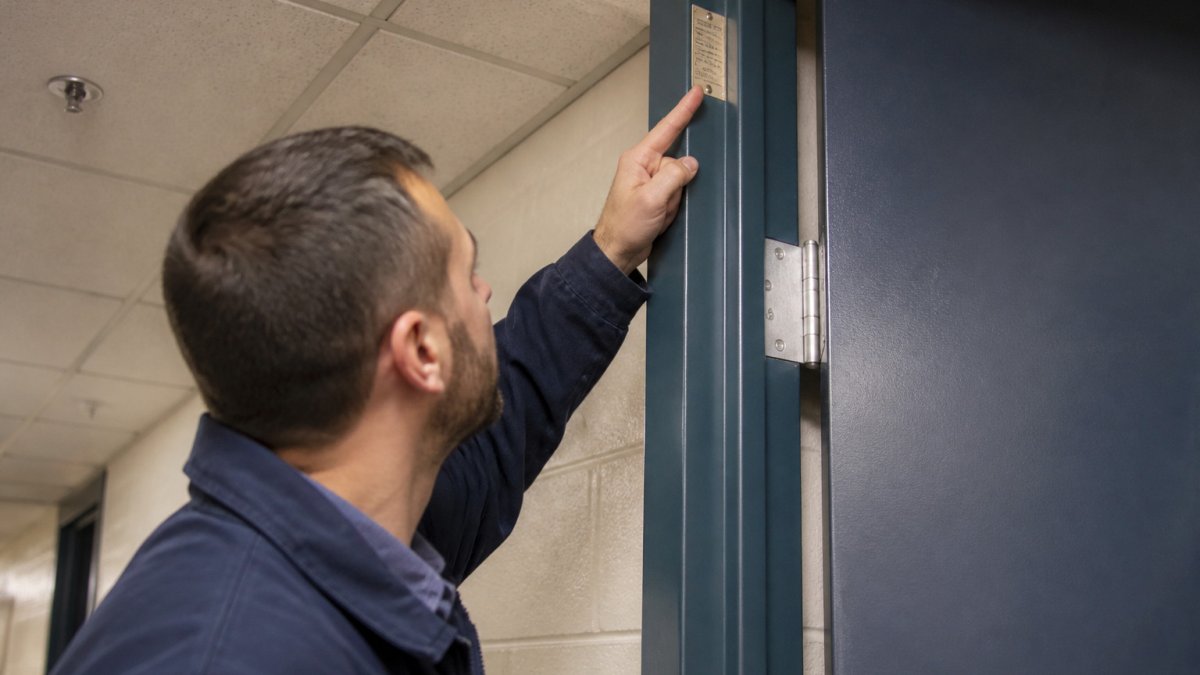
Check these spots first:
- The hinge-side jamb, top third
- The head (top horizontal piece) of the frame
- The inside edge of the frame, where the door closes against it
Labels are often painted over, so a raking light makes stamped text easier to see.
Step 2: Read What the Label Contains
Finding the label is only half the job. The label is the frame's evidence, and you need to read it the way an inspector or a code official would. A typical commercial hollow metal frame label includes:
- The manufacturer name and address
- A model or assembly identification number
- The fire-resistance rating, shown in minutes or hours
- A testing standard or listing reference
- The rating period and the inspection agency mark
Write down every number and name exactly as printed. Do not round or paraphrase, the model number and listing reference are what let you verify the assembly later.
What each field actually tells you
The rating period. This is the duration the assembly was tested to resist fire, expressed in minutes or hours.
The testing standard or listing reference. This tells you which test method and which listing the assembly was evaluated under. Note the standard number and the listing agency mark.
The inspection agency mark. Third-party listing marks indicate the assembly was evaluated by a recognized testing body. Record the mark and the listing number.
The model or assembly number. This is the key that ties the frame to the door leaf. Two labels can both say "90-minute" and still describe incompatible assemblies.
Reading a painted or stamped label
Many hollow metal frame labels are steel stamps rather than paper stickers, and years of paint can fill the characters. Use a raking light, a flashlight held almost parallel to the surface, to cast shadows in the stamped recesses. Do not use a metal scraper or chemical stripper on the label itself; either can destroy the characters you are trying to read.
If you can read the manufacturer and model but not the rating, contact the manufacturer with the model number. Manufacturers may be able to confirm the rating period and listing for a specific model.
What the label does not tell you
The label describes the assembly as tested. It does not tell you whether the frame is currently installed correctly, whether the door leaf has been replaced, or whether hardware has been swapped. Those are separate checks. A readable label is necessary evidence, but it is not proof that the opening still performs as labeled.
Step 3: Match the Frame Label to the Door Leaf
A frame rating only counts when the frame and the door leaf belong to the same tested assembly. This is the step most facility teams skip, and it is the step that decides whether the opening is actually rated.
Find the door leaf label first
Before you compare anything, locate the leaf label. On commercial fire doors it is commonly found in one of these places:
- The top edge of the door leaf, near the hinge side
- The hinge-side edge of the leaf, near the top
- On the face of the leaf near the hinge, on some older or labeled doors
Open the door and use a flashlight on the top edge, this is where most leaf labels live and where they are easiest to miss. As with the frame, photograph the leaf label before you close the door.
Compare the four things that matter
A frame and leaf match when all four of these line up:
- Manufacturer. The frame and leaf should come from the same manufacturer, or from manufacturers whose labels reference a common listed assembly. A frame from one maker and a leaf from another is a mismatch unless the documentation shows they were tested together.
- Assembly or model reference. The model or assembly number on the frame label should be compatible with the leaf label. If the numbers do not reference the same assembly, do not assume the opening is rated.
- Rating period. The rating period on the frame and the leaf must be consistent. A 60-minute leaf in a 20-minute frame gives you a 20-minute opening at best, and possibly no rated opening at all if the assembly was never tested as a pair.
- Hardware and components. Hinges, closers, latches, seals, and glazing are part of the tested assembly. If the hardware on the door does not match what the label lists, the assembly may no longer be in its tested configuration.
Why a rated-looking frame is not enough
A heavy steel frame with a readable label can still fail as a rated opening. The frame may have been installed in a wall type the assembly was never tested for, the leaf may have been replaced with a non-rated door, or the hardware may have been swapped during a renovation. The label on the frame describes what the frame was tested as, not what is hanging in it today.
This is the central limit of a visual check: you can confirm that evidence exists, but you cannot confirm that the current frame, leaf, hardware, and wall still form the tested assembly. That confirmation comes from matching the labels and, where records are incomplete, from a qualified inspector.
When the labels match but the opening still looks wrong
Matching labels are strong evidence, but they are not the whole picture. Check that the frame is set into a wall of the type the assembly was tested for, that gaps around the door are consistent with the label requirements, and that seals and hardware are intact.
For commercial hollow metal frames with rust or corrosion on the hinge side, a repair can restore the frame without replacing it, but only if the repair keeps the frame in its tested configuration. Confirm with the manufacturer or a qualified inspector before repairing a labeled frame, and compare the repair product's specifications with the frame label before you buy.
What to Do When the Label Is Missing or Painted Over
Missing or painted labels happen often in older buildings and after many coats of paint. Do not guess the rating from the door's appearance.
Try these steps:
- Scrape away paint gently around the label area with a plastic scraper
- Check the door leaf and the frame at different heights, since labels may be moved or hidden
- Ask the building's original door supplier or the manufacturer for records of the assembly
- Contact a qualified fire door inspector if you cannot confirm the rating
A visual check alone rarely confirms a rating. A qualified inspector or the original documentation provides the evidence you need. Check the frequently asked questions on fire ratings and repair compatibility.
Fire Door Frame Inspection Checklist
Use this checklist on every opening you review:
- Frame label is present and readable
- Manufacturer and model match the door leaf label
- Rating period is listed and clear
- Frame is free of cracks, large dents, or rust that breaks the seal
- Gaps around the door are consistent with the label requirements
- Hinges and latch hardware are present and working
- Door closes fully and latches without help
- Intumescent and smoke seals are intact
Record the results and the date. A written record helps when an inspector asks for evidence.
Repairing a Commercial Hollow Metal Frame Without Losing the Rating
Rust and corrosion can damage the hinge side of a commercial hollow metal frame. The strike side jamb patch addresses the latch side of a rusted frame.
The Jamb Patch and Jamb Anchor kits are made for rusted steel and corroded aluminum frames. Read more about why frames rust and how repair compares to replacement.
Before you repair any frame, check its label. A repair should keep the frame in its tested configuration.
Door Innovation's repair kits are one practical option for restoring a damaged hinge-side jamb. Find the left hand hinge jamb patch for your frame. Find the right hand hinge jamb patch for your frame.
The article's repair options for a labeled commercial frame can be compared at a glance, based on what it states.
| Item | Detail | Note |
|---|---|---|
| Frame type | Commercial hollow metal | Repair applies only to this type |
| Products named | Jamb Patch and Jamb Anchor | Made for rusted steel and corroded aluminum |
| Installation | Do-it-yourself, no professional needed | Designed for a DIY-type installer |
| Repair speed | Very quick | Waiting for Bondo to cure takes longest |
| Before repair | Check the frame label | Keep frame in its tested configuration |
Frequently Asked Questions
How do I know if my wall is fire-rated?
A wall's fire rating is usually documented in the building's construction drawings, the specifications, or the fire-resistance details kept by the building owner or architect. Visual checks alone are not enough, because the wall assembly, not just its finish, determines the rating. If records are unavailable, ask a qualified fire protection professional or building official to confirm the rating before you rely on it. Do not assume a wall is rated because it looks solid or is made of masonry or drywall.
How do you recognize a fire-rated door frame?
Look for a permanent metal or adhesive label on the frame, typically on the hinge side or the head, that names the manufacturer and states the rating period. Frames are often built to match a specific door, so check the door leaf too. A heavy steel frame or a hollow metal frame does not by itself prove a fire rating. The label is the primary evidence, and it should be read together with the rated door and its hardware.
Can a damaged commercial hollow metal frame be repaired and remain compliant?
A repair can keep a frame in service only if the repair method is suitable for the frame and the repaired assembly still matches its tested configuration and label. Patching a frame does not automatically preserve its fire rating, so confirm the repair product and method with the manufacturer or a qualified inspector before closing up the opening. Keep records of the repair so the building's fire-door inspection file stays complete.
What is the difference between a fire door rating and a fire wall rating?
A fire door rating describes how long the door assembly, including the frame, leaf, and hardware, can resist fire and smoke when tested as a unit. A fire wall rating describes how long the wall itself resists fire spread. A rated door is only effective within a wall that is also rated for the same or greater duration, so the two ratings must work together in the opening.
