
How to Fix Rotted Door Frames: A Complete Guide
Table of Contents
- Assessing the Extent of Wood Rot Before You Start
- Tools and Materials Required to Fix Rotted Door Frames
- Step-by-Step: How to Fix Rotted Door Frames
- Wood Rot Repair Kits for Commercial Door Frames
- Door Frame Rot Repair Cost: Repair vs. Full Replacement
- Preventing Wood Rot in Commercial Doors Long-Term
- Frequently Asked Questions
Last Updated: September 1, 2026
Assessing the Extent of Wood Rot Before You Start
Rotted door frames are one of the most common maintenance failures in commercial facilities, and the damage is almost always worse than it looks on the surface. Before you pick up a chisel or order materials, a proper assessment determines whether you're dealing with a surface repair or a structural problem.
Start by probing the affected area with a screwdriver or awl. Press firmly into the wood: if it sinks more than a few millimeters without resistance, the wood fibers have broken down. Soft wood that crumbles or feels spongy indicates active fungal decay that has penetrated beyond the surface. Tap the surrounding area with a hammer; a hollow sound suggests the rot has spread beneath a layer that still looks intact.
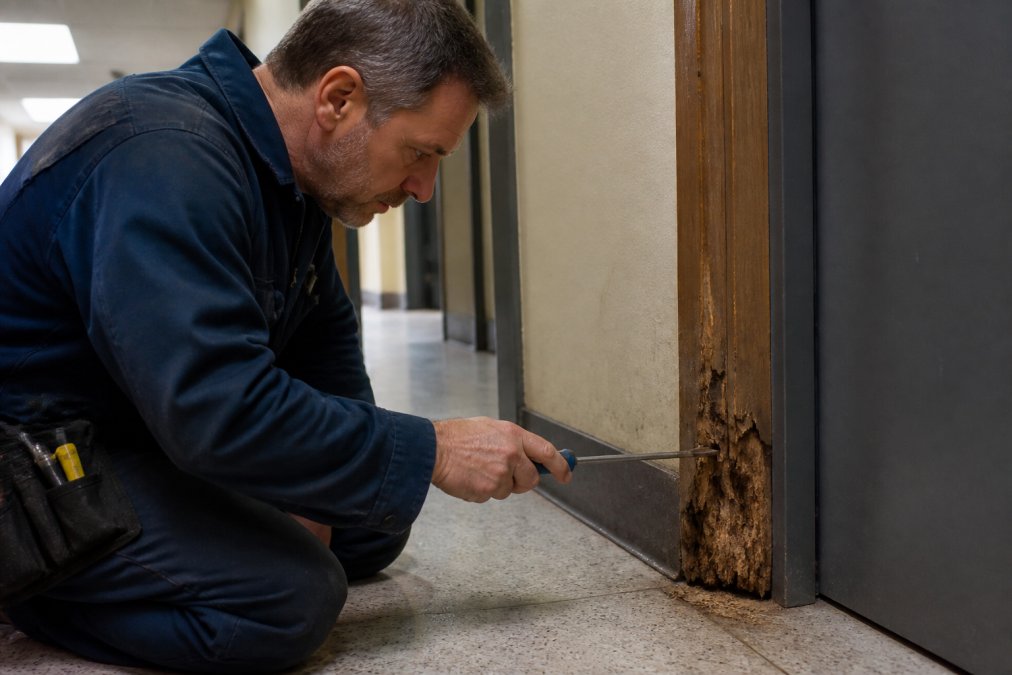
Pay particular attention to the door jamb at the threshold and the bottom corners of the frame, where moisture accumulates first.
Structural Integrity Check: Surface Rot vs. Deep Decay
Surface rot is decay confined to the outer 6-12 millimeters of the wood. The underlying structure retains its load-bearing capacity, and the frame can be stabilized with a wood hardener and epoxy filler. This is the ideal repair scenario.
Deep decay penetrates to the structural core of the door jamb, compromising the frame's ability to support the door's weight or resist lateral force. In commercial settings, a compromised frame also creates security vulnerabilities.
The rule of thumb: if more than one-third of the frame's cross-section is compromised, replacement deserves serious consideration.
When to Replace the Entire Door Frame Instead of Repairing
Replace the frame when decay has spread to the structural framing behind the door jamb, the door threshold or surrounding masonry shows water infiltration, multiple sections show deep decay simultaneously, or the frame has been previously patched and rot has returned. For commercial facilities managing dozens of openings, repair is almost always faster and more cost-effective when damage is caught early.
Tools and Materials Required to Fix Rotted Door Frames
Removal and preparation:
- Oscillating multi-tool or reciprocating saw
- Wood chisel set
- Putty knife or scraper
- Wire brush
- Shop vacuum
Treatment and filling:
- Wood hardener (penetrating consolidant)
- Two-part wood epoxy filler or exterior-grade wood filler compound
- Mixing board and sticks
Finishing:
- Rasp or coarse file
- Sanding block with 80-grit, 120-grit, and 220-grit sandpaper
- Exterior-grade primer
- Exterior paint matched to existing finish
- Paintbrush or small roller
Sealing and prevention:
- Exterior caulk
- Wood preservative (borate-based products)
- Weatherstripping
- Moisture barrier tape or flashing
According to the Wood Products Council guidance on decay prevention, selecting materials with appropriate moisture resistance ratings is critical for exterior applications. For commercial door frames, two-part epoxy systems consistently outperform standard wood filler compounds in durability.
Step-by-Step: How to Fix Rotted Door Frames
Sequence matters. Applying wood hardener before fully removing decayed material traps moisture and accelerates further decay underneath the repair.
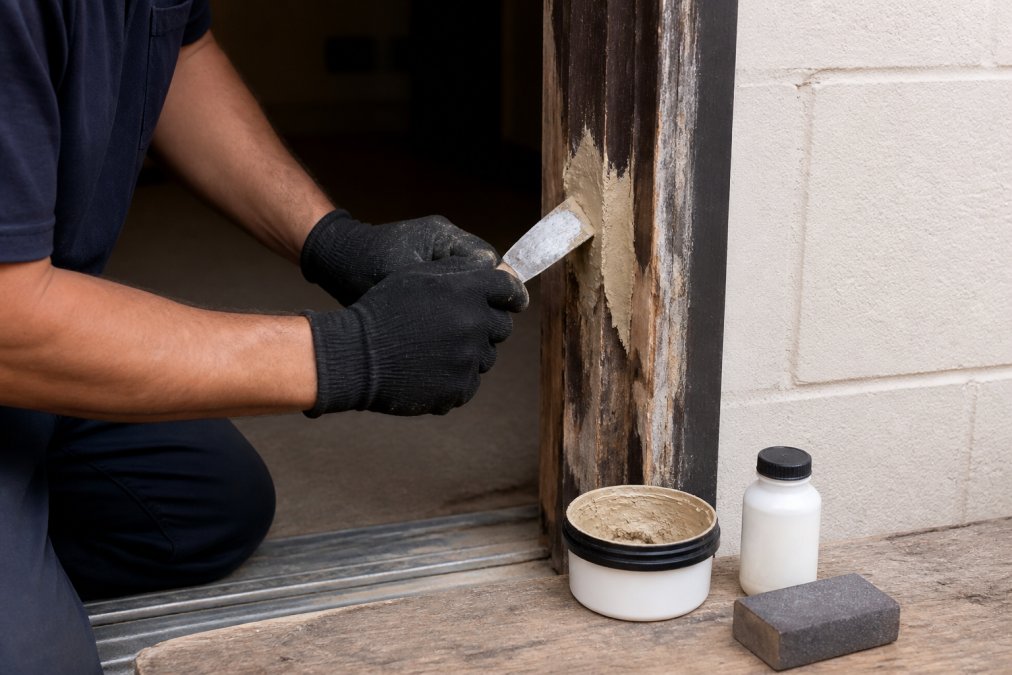
Step 1: Remove Rotted Wood and Prepare the Surface
Cut away all soft wood until you reach solid material. Use a wood chisel to excavate decayed material, working along the wood grain. For larger voids, an oscillating multi-tool gives better control.
Once soft material is removed, use a wire brush to clean the cavity and a shop vacuum to remove all dust and debris. The surface must be dry before treatment; if the wood feels damp, allow it to dry for 24-48 hours or use a heat gun on low setting.
Step 2: Apply Wood Hardener to Stabilize Remaining Wood
Wood hardener is a penetrating resin that consolidates remaining porous wood fibers into a stable substrate that bonds reliably with epoxy filler. Apply generously with a brush, working it into all exposed surfaces. Most products require two coats; check manufacturer instructions. Allow full curing time before proceeding, typically 2-4 hours under normal conditions.
Step 3: Fill Voids with Wood Epoxy or Wood Filler Compound
Two-part wood epoxy is the professional standard for structural repairs. It bonds aggressively to hardened wood, accepts fasteners, resists moisture, and doesn't shrink during curing. Mix according to manufacturer ratio, typically 1:1 by volume, and work quickly as most formulations have a 5-15 minute working time.
Pack epoxy into the void in layers if deep, pressing firmly to eliminate air pockets. Slightly overfill; you'll shape it during sanding. For shallow cosmetic repairs, a wood filler compound rated for exterior use is acceptable. Allow full curing time before sanding: most two-part epoxy reaches working hardness in 1-2 hours but achieves full cure in 24 hours.
| Filler Type | Best For | Curing Time | Accepts Fasteners | Moisture Resistance |
|---|---|---|---|---|
| Two-part wood epoxy | Structural voids, load-bearing areas | 1-2 hrs (working), 24 hrs (full) | Yes | Excellent |
| Wood filler compound | Cosmetic surface repairs | 30-60 min | No | Moderate |
| Scrap wood splice | Large structural sections | N/A | Yes | Depends on species |
Step 4: Sand, Prime, and Paint the Repaired Area
Once epoxy has fully cured, shape the repair with a rasp or coarse file to approximate the original profile. Follow with a sanding block: start with 80-grit to shape, move to 120-grit to smooth, and finish with 220-grit before priming. Apply exterior-grade primer to seal the repair and improve paint adhesion. Allow primer to dry fully, then apply two coats of exterior paint matched to the existing frame finish. Finish with a bead of exterior caulk at joints or seams.
Wood Rot Repair Kits for Commercial Door Frames
Standard wood rot repair products work well for wooden residential frames. Commercial door frames typically use hollow metal: steel or aluminum door jambs that corrode and rust rather than rot, compromising security and appearance.
Door Innovation's specialized repair kits address this gap. The Jamb Patch and Jamb Anchor systems are engineered for rusted steel and corroded aluminum frames in commercial environments. The three-step installation process allows facility maintenance staff to complete repairs without specialized training.
For facilities with a mix of wood, steel, and aluminum frames, matching the repair system to the frame material is critical. As the Steel Door Institute's installation and troubleshooting guide notes, improper repairs on hollow metal frames can compromise fire rating and security performance.
Door Frame Rot Repair Cost: Repair vs. Full Replacement
The cost-benefit calculation consistently favors repair when damage is caught early. Full frame replacement involves material costs, labor for removal and installation, disposal, and potential recertification requirements for fire-rated or security-rated openings.
For planning purposes, compare total repair cost versus total replacement cost, including materials, labor hours, operational disruption, and compliance recertification. For facilities managing multiple openings, savings compound when maintenance teams can complete repairs in-house using straightforward kits.
Preventing Wood Rot in Commercial Doors Long-Term
The most common mistake is treating rot as an isolated repair problem rather than a symptom of an unresolved moisture issue. Fix the frame without addressing the moisture source, and the rot returns.
Eliminating the Moisture Source
Wood decay requires sustained moisture content above roughly 20 percent to grow. Eliminate the moisture, and you eliminate the rot. Common moisture sources include failed or missing flashing at the top of exterior frames, damaged weatherstripping, clogged door threshold drainage, condensation from HVAC systems, and leaking roof or wall assemblies.
Inspect the area above and around any repaired frame carefully. Look for gaps in caulk, missing flashing, or weatherstripping that no longer seals. Reapply exterior caulk at all joints and install or replace flashing at the head of exterior frames. Replace weatherstripping whenever a frame repair is completed.
According to the Building Science Corporation's guidance on moisture management in building envelopes, addressing the moisture pathway rather than just the resulting damage is the defining factor in whether a repair lasts.
Material-Specific Protection for Wood, Steel, and Aluminum Frames
Wood frames benefit from a wood preservative applied to all exposed surfaces, particularly at end grain where moisture absorption is highest. Borate-based preservatives penetrate the wood and inhibit fungal growth. Reapply every few years as part of routine maintenance. Maintain paint and primer coatings; a compromised paint film is the primary moisture entry pathway.
Steel frames corrode when the factory coating is breached. Apply a rust-inhibiting primer to any bare metal and maintain the paint finish. For frames showing active corrosion, remove rust to bare metal before priming. A moisture barrier at the frame-to-masonry junction prevents the most common corrosion pathway.
Aluminum frames are naturally more corrosion-resistant but not immune. Galvanic corrosion occurs when aluminum contacts dissimilar metals in the presence of moisture. Use compatible fasteners and isolating washers where aluminum contacts steel hardware. Clean aluminum frames regularly to remove salt deposits in coastal environments.
For facilities managing mixed frame materials, a documented annual inspection schedule checking each opening for coating integrity, weatherstripping condition, and moisture infiltration is the most practical long-term prevention strategy.
Managing rotted door frames across a commercial facility is a resource challenge as much as a technical one. The repair process is straightforward when you follow the right sequence, but at scale, labor and downtime are the real cost drivers. Door Innovation's Jamb Patch and Jamb Anchor kits are engineered for steel and aluminum commercial frames, installable by your existing maintenance staff without specialized training, and designed to extend the life of your existing door systems rather than trigger a full replacement cycle. Order Now and restore your door openings without the disruption of a full frame replacement.
Frequently Asked Questions
Can you fix rotted wood on a door frame without replacing it?
Yes, in many cases rotted door frames can be repaired without full replacement. If the rot is limited to the surface layer of the door jamb and the surrounding wood is still structurally sound, applying a wood hardener followed by a wood epoxy or filler compound restores the frame to working condition. The key test: if a screwdriver penetrates more than 25mm into the wood or the frame shifts when pressure is applied, replacement becomes the safer option.
What is the best wood filler for a rotted door frame?
Two-part wood epoxy is the strongest option for repairing rotted door frames, particularly on exterior applications where moisture exposure is ongoing. It bonds directly to treated wood, resists shrinkage during curing, and can be shaped to match the original wood grain before sanding. Standard wood filler compounds work for minor surface voids on interior door jambs, but they absorb moisture over time and are not recommended where fungal decay has already occurred.
How much does it cost to fix a rotted door frame?
Repair costs vary significantly based on the extent of the wood rot, the number of frames involved, and whether you use a DIY approach or hire a contractor. For commercial facilities managing multiple doors, specialized repair kits designed for door jambs can reduce per-door costs substantially compared to full frame replacement. Contact Door Innovation directly for current pricing on their repair kit options, as costs depend on volume, frame material, and delivery requirements.
How do you prevent future rot in exterior door frames?
Preventing wood rot in exterior door frames starts with eliminating the moisture source. Inspect and maintain flashing above the door opening, ensure weatherstripping creates a complete seal, and check that the door threshold directs water away from the jamb. Apply a wood preservative or moisture barrier to any exposed wood grain annually. For commercial doors with high traffic, switching to rot-resistant frame materials or using a protective jamb cover adds a long-term layer of defense against fungal decay.