
How to Fix Rusted Door Frames: Step-by-Step Guide
Table of Contents
- What Causes Rusted Door Frames and How to Assess the Damage
- Tools and Materials for Fixing Rusted Door Frames
- Step-by-Step: How to Fix Rusted Door Frames
- Commercial Door Frame Repair Kits: A Cost-Effective Alternative
- Cost of Replacing Commercial Door Frames vs. Repair
- Preventing Rust on Metal Door Frames
- Common Mistakes to Avoid When Fixing Rusted Door Frames
- Frequently Asked Questions
Last Updated: September 13, 2026
What Causes Rusted Door Frames and How to Assess the Damage
Rusted door frames are steel or aluminum frames that have undergone oxidation, the electrochemical reaction that breaks down metal exposed to moisture and oxygen (chem.libretexts.org). A small spot of surface rust on a commercial frame can spread into pitting that weakens the entire jamb.
Moisture is the primary culprit, but it rarely acts alone. Common causes:
- Water intrusion at the threshold or casing, which keeps the bottom of the frame wet
- Condensation in humid or temperature-fluctuating environments like industrial facilities
- Failed or missing paint, which removes the frame's moisture barrier
- Road salt and chemical exposure tracked in from outside
- Poor drainage around the door opening
Assessing damage starts with a screwdriver run along the frame. Flaking paint and surface rust mean repair territory; if the metal feels soft or the tool sinks in, corrosion has compromised structural integrity.
Repair vs. Replace: Making the Right Call
The decision comes down to how much metal has been lost. Surface oxidation and light pitting are repairable. Deep corrosion that has eaten through the jamb, or damage spanning more than a few inches, usually means replacement.
Use this framework:
| Damage Level | What You See | Recommended Action |
|---|---|---|
| Surface rust | Flaking paint, light oxidation | Sand and repaint |
| Moderate pitting | Pitted metal, rust at hinge or strike | Metal filler or jamb patch |
| Severe corrosion | Holes, soft metal, frame distortion | Full replacement |
A common mistake is jumping to replacement when a patch would do. Full replacement means cutting into the wall, re-hanging the door, and re-keying hardware; for most commercial openings, restoring the existing frame is faster and cheaper.

Tools and Materials for Fixing Rusted Door Frames
Fixing rusted door frames requires a modest toolkit, but the right materials matter more than quantity. Where a choice depends on frame material, it's called out, hollow metal, solid steel, and aluminum frames don't respond to the same abrasives or primers.
Rust removal and preparation:
- Wire brush (hand or drill-mounted), hand for edges and hinge pockets, drill-mounted for flat jamb faces
- Angle grinder or rotary tool with a wire wheel, for stubborn scale, not light oxidation
- Sandpaper in a stepped sequence: 80-grit to cut rust and feather paint edges, 120-grit to remove scratches, 180- to 220-grit to smooth before primer
- Sanding block, keeps the jamb face flat so the patch or paint line doesn't telegraph
- Degreaser, removes oils, fingerprints, and residue between metal and primer
- White vinegar for light surface oxidation, loosens rust without removing base metal
Repair and finishing:
- Rust-inhibiting primer, labeled for direct-to-metal use; a primer requiring bare, bright metal won't perform over a feathered paint edge
- Metal filler or epoxy resin, for pits and gouges; epoxy cures harder near hinges or strikes
- Topcoat paint matched to the frame, film build matters more than color match; two thin coats beat one heavy coat
- Jamb patch kit for severe strike-side or hinge-side damage, a formed steel patch that restores the jamb profile rather than filling a void
Safety gear:

- Safety goggles, required for wire wheel or grinder work; bristles shed
- Respirator, for grinding dust and solvent-based primers
- Work gloves, cut-resistant for feathered sheet metal edges
Material-specific notes:
- Hollow metal frames are the most common commercial type, thin-gauge steel formed into a profile, so aggressive grinding can burn through the face. Use hand tools and light passes.
- Solid steel frames tolerate more abrasive work but rust more slowly once pitted, since there's more metal to lose before the frame is compromised.
- Aluminum frames don't rust like steel, they oxidize into a white or gray powder and pit. They need a primer formulated for aluminum; a steel-rated primer is a common cause of premature coating failure.
- Mixed steel-and-aluminum assemblies exist at glazed openings and storefronts. With a mix, check the product data sheet before buying one primer for the whole job.
Step-by-Step: How to Fix Rusted Door Frames
Here's the full repair process, from bare metal to finished topcoat. Work in a well-ventilated space and let each stage cure before moving on.
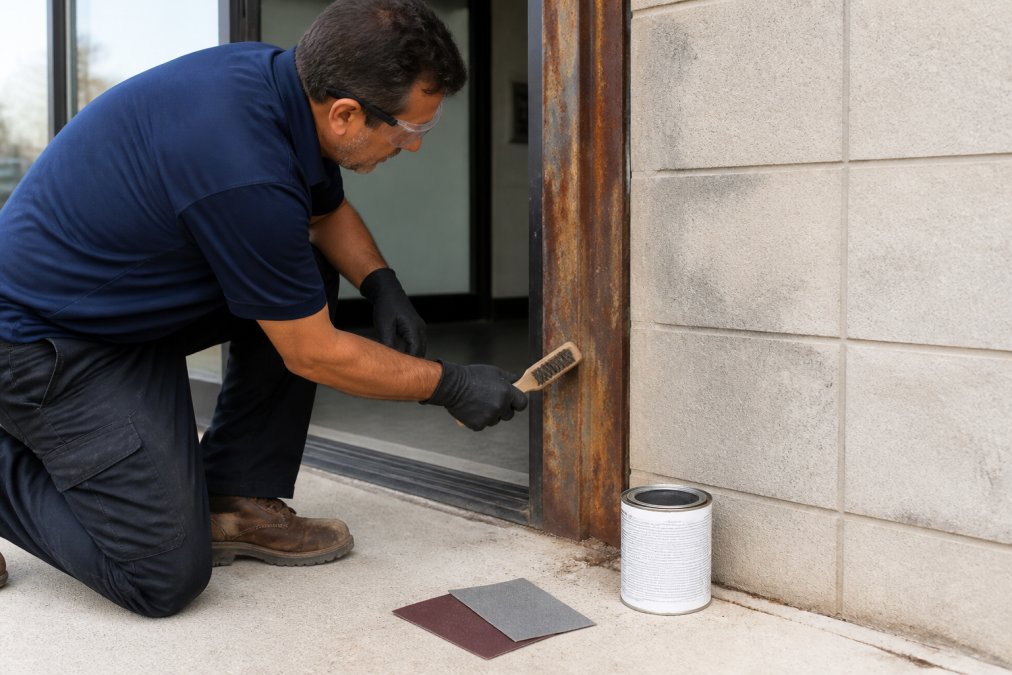
Step 1: Remove Rust and Prepare the Surface
Surface preparation decides whether your repair lasts. Skip it and the primer won't bond.
- Remove loose paint and flaking rust with a wire brush.
- Switch to an angle grinder or rotary tool for stubborn oxidation.
- Sand with 80-grit, then step up to 120-220 grit.
- Wipe down with a degreaser to remove dust and oils.
- Let the surface dry completely before priming.
For light oxidation, white vinegar can loosen rust before abrasives. The goal is clean, bare metal with no flaking edges.
Step 2: Apply Rust-Inhibiting Primer and Paint
Primer is the moisture barrier that stops corrosion from returning. Apply a rust-inhibiting primer in thin, even coats, curing each per the manufacturer's instructions, then apply your topcoat once the primer is fully dry.
Paint adhesion depends on Step 1's prep work. If the surface was dusty or oily, the topcoat will peel within months. Two thin coats beat one thick coat every time.
Step 3: Use Metal Filler or Jamb Patch for Severe Damage
When corrosion has eaten into the metal, filler or a patch restores the frame's profile. Metal filler and epoxy resin work for small pits and gouges; for hinge-side or strike-side damage, a jamb patch is more durable.
The Jamb Patch Kit (4") from Door Innovation handles early rust at the first sign of corrosion on steel frames. For strike-side damage, the Strike Side Jamb Patch is a 21-5/8" non-handed patch that comes with installation hardware and instructions. Hinge-side damage has dedicated left-hand and right-hand versions, each with a 4-1/2" commercial hinge pocket.

Installation follows a simple three-step process.
Commercial Door Frame Repair Kits: A Cost-Effective Alternative
Repair kits exist because full replacement is rarely the only option. A jamb patch restores a rusted frame without cutting into the wall or re-hanging the door.
Door Innovation's kits are built for rusted steel and corroded aluminum frames. Each ships with hardware and instructions.
For facility managers running dozens of openings, the kits are designed for repeat use across a facility, not one-off fixes, a maintenance team can work through a list of damaged doors with the same process and tools.
Cost of Replacing Commercial Door Frames vs. Repair
Replacement costs more than most facility managers expect: the new frame, demolition, wall repair, re-hanging the door, and re-installing hardware. Labor is the biggest line item, and it scales with every door on your list.
Repair shifts the math. A jamb patch kit lists at $130.37, and the Strike Side and hinge-side patches are $180.91 each. Your labor cost is installation time, which most maintenance staff can absorb into an existing schedule.
| Approach | Parts Cost | Labor | Downtime |
|---|---|---|---|
| Jamb Patch Kit (4") | $130.37 | In-house, one afternoon | Minimal |
| Strike/Hinge Jamb Patch | $180.91 | In-house, one afternoon | Minimal |
| Full frame replacement | Higher | Contractor, multi-day | Opening out of service |
The savings compound across a facility, forty doors repaired in-house versus forty replacements is a different budget entirely.
Preventing Rust on Metal Door Frames
Prevention is cheaper than any repair: keep moisture off bare metal and catch problems before they spread. The right schedule depends on the environment, a quarterly walk-through that works in a dry inland warehouse will miss the failure window in a coastal or high-humidity building. The schedule below is built around that reality.
The mechanism behind each step:
- Maintain the paint barrier. Paint is the frame's moisture barrier; a chip or scratch exposes bare metal, and oxidation begins within days in a wet environment. Touch up chips within the same maintenance cycle, not the next one.
- Seal the threshold and casing. Water intrusion starts where the jamb meets the threshold and the casing meets the wall. Failed sealant there keeps the frame bottom wet through every rain event.
- Improve drainage around exterior openings. Standing water at the door base is the most common driver of bottom-of-jamb rust.
- Clean off road salt and chemicals tracked in from outside. Salt accelerates the electrochemical reaction that breaks down metal and stays active as long as it sits on the surface.
- Inspect on a defined cadence rather than when someone notices a problem.
Inspection cadence by environment:
| Environment | Inspection Frequency | What to Prioritize |
|---|---|---|
| Coastal / salt air | Monthly | Bottom of jamb, threshold sealant, any bare metal |
| High humidity / interior (laundries, pools, food processing) | Monthly to quarterly | Condensation zones, hinge and strike pockets |
| Industrial / chemical exposure | Quarterly | Coating integrity, chemical residue on frames |
| Dry inland / climate-controlled | Semi-annually | Paint chips, threshold sealant |
What to look for during an inspection:
- Flaking or bubbling paint, bubbling means rust is already forming underneath
- Discoloration at hinges and strikes, where hardware penetrates the coating and moisture collects
- Soft or spongy metal when probed with a screwdriver, the line between repairable and structural
- Staining on the floor or threshold, water is reaching the frame base
- White or gray powder on aluminum frames, aluminum's version of rust, and a sign the anodic layer has failed
Environmental factors change the treatment, not just the schedule:
- Salt air (coastal) deposits chloride, which drives pitting faster than plain moisture. Rinsing frames with fresh water during routine cleaning removes the chloride load before it works into the coating.
- High humidity (interior) causes condensation on cold frame surfaces, especially in temperature-fluctuating spaces. Ventilation and humidity control do more than any coating.
- Industrial chemical exposure can degrade some primers and topcoats faster than moisture alone. Verify the coating is rated for the exposure before relying on it.
A walk-through on the cadence above catches most early rust. The Jamb Patch Kit is designed for that first sign of corrosion, so a small spot never becomes structural, and the inspection record justifies the repair budget when you need it.
Common Mistakes to Avoid When Fixing Rusted Door Frames
Most failed repairs trace back to the same errors. Avoid these and your fix will hold.
- Skipping surface preparation. Primer won't bond to dusty, oily, or flaking metal.
- Painting over rust. Topcoat over active corrosion traps moisture and accelerates the damage.
- Using the wrong filler. Standard body filler isn't rated for structural metal repair. Use metal filler or epoxy resin.
- Ignoring the moisture source. If water still reaches the frame, rust returns regardless of how well you patched it.
- Over-grinding thin sections. Aggressive abrasives can weaken an already-thinned jamb.
The coating matters as much as the metal work, a perfect patch under a poor topcoat will fail.
Rusted door frames don't have to mean a full replacement and a contractor invoice. The challenge is choosing the right repair for the damage level and stopping moisture from returning. Door Innovation builds specialized Jamb Patch kits for rusted steel and corroded aluminum frames, with a simple three-step installation that keeps your maintenance team in control. You save time and money, keep openings safe and presentable, and extend the life of the door systems you already have. Order Now and restore your rusted frames without the cost of replacement.
Frequently Asked Questions
Can a rusted metal door frame be repaired, or does it need full replacement?
Most rusted metal door frames can be repaired if the damage is surface-level and structural integrity remains intact. For commercial steel frames, repair kits like the Jamb Patch offer a cost-effective fix that restores function without full replacement. If rust has caused deep pitting, flaking, or compromised the frame's strength, replacement may be necessary. Assess the extent of corrosion and consult a professional if unsure.
What tools and materials are required for professional door frame repair?
You'll need safety goggles, a respirator, wire brush, angle grinder or rotary tool, sandpaper (various grits), degreaser, rust-inhibiting primer, metal filler (such as Bondo), paint, and a sanding block. For commercial applications, specialized repair kits like the Jamb Patch include hardware and instructions. Always follow safety guidelines and use proper protective equipment when working with metal and chemicals.
How do I prevent rust from returning to a door frame after repair?
Preventing rust on metal door frames involves regular maintenance and protective coatings. After repair, apply a rust-inhibiting primer and a quality topcoat to create a moisture barrier. Inspect frames seasonally for signs of oxidation, touch up paint as needed, and keep the area around the door dry. In commercial settings, schedule annual inspections and address minor rust immediately to avoid costly repairs.
What is the cost difference between repairing and replacing a commercial door frame?
The cost of replacing commercial door frames can be substantial, including labor and materials. In contrast, repair kits like the Jamb Patch cost around $130-$180 and can be installed in a few hours, significantly reducing labor expenses. Repairing also extends the life of existing door systems, making it a budget-friendly option for facility managers managing multiple doors.