
Installing Door Frame Patches Without Contractors
Table of Contents
- Why Installing Door Frame Patches Without Contractors Makes Sense
- What You'll Need Before You Start
- Step 1: Assess the Damage and Mark the Repair Zone
- Step 2: Prep the Surface for Steel Door Frame Rust Repair
- Step 3: Install the Patch and Secure the Hardware
- Door Frame Repair Tools You Actually Need (and What You Can Skip)
- Door Frame Replacement vs Repair: When to Choose Each
- Common Mistakes to Avoid When Installing Door Frame Patches
- Frequently Asked Questions
Last Updated: October 6, 2026
Why Installing Door Frame Patches Without Contractors Makes Sense
Rusted door frames don't fix themselves, and the usual answer, a full frame replacement, means weeks of scheduling, permits, and labor. Installing door frame patches without contractors flips that math. At Door Innovation, we help facility teams restore rusted steel and corroded aluminum openings with a simple patch kit instead of a tear-out.
The case for doing it in-house is simple. A patch covers the damaged section and restores a safe, secure opening. A replacement means removing the frame, re-anchoring it, and rehanging the door.
- No contractor scheduling delays
- No large capital outlay
- No downtime for the doorway
- Your own crew controls the timeline
For a facility with a handful of rusted frames, that difference is everything. For a facility with dozens, it's a budget line item you can actually defend.
What You'll Need Before You Start
Before you touch a single screw, gather your materials. A door jamb repair kit is the core item, but the right prep tools matter just as much.

Here's what a typical install calls for:
- A door jamb repair kit sized to your damage
- A wire brush or sanding block
- A drill with the correct bits
- The included installation hardware
- Safety glasses and gloves
- A marker or pencil for layout
Choosing the Right Door Jamb Repair Kit
Match the kit to the damage, not the other way around. This is where most first-timers go wrong.
- Under 2 inches of rust: a standard 4-inch Jamb Patch Kit covers it
- More than 2 inches at the bottom: use a Strike Side or Hinge Jamb Patch
- Hinge side damage: pick the correct left or right hand hinge patch
- Strike side damage: the strike side patch handles it
Door Innovation's Jamb Patch is a non-handed design, so it fits either side of the opening. It works with masonry frames from major U.S. manufacturers.
Step 1: Assess the Damage and Mark the Repair Zone
Start by looking at the full height of the rusted area. Measure how far the corrosion climbs from the bottom of the frame.
Mark the top of the repair zone with a pencil. This line tells you where the patch will sit. If rust runs past 2 inches, stop and switch to a taller patch. A standard 4-inch patch won't cover it.
Check both sides of the opening while you're there. Rust often shows up on the strike side and hinge side at the same time.

Step 2: Prep the Surface for Steel Door Frame Rust Repair
Clean metal is the whole game. A patch bonds and sits flush only when the surface underneath is free of loose rust and debris.
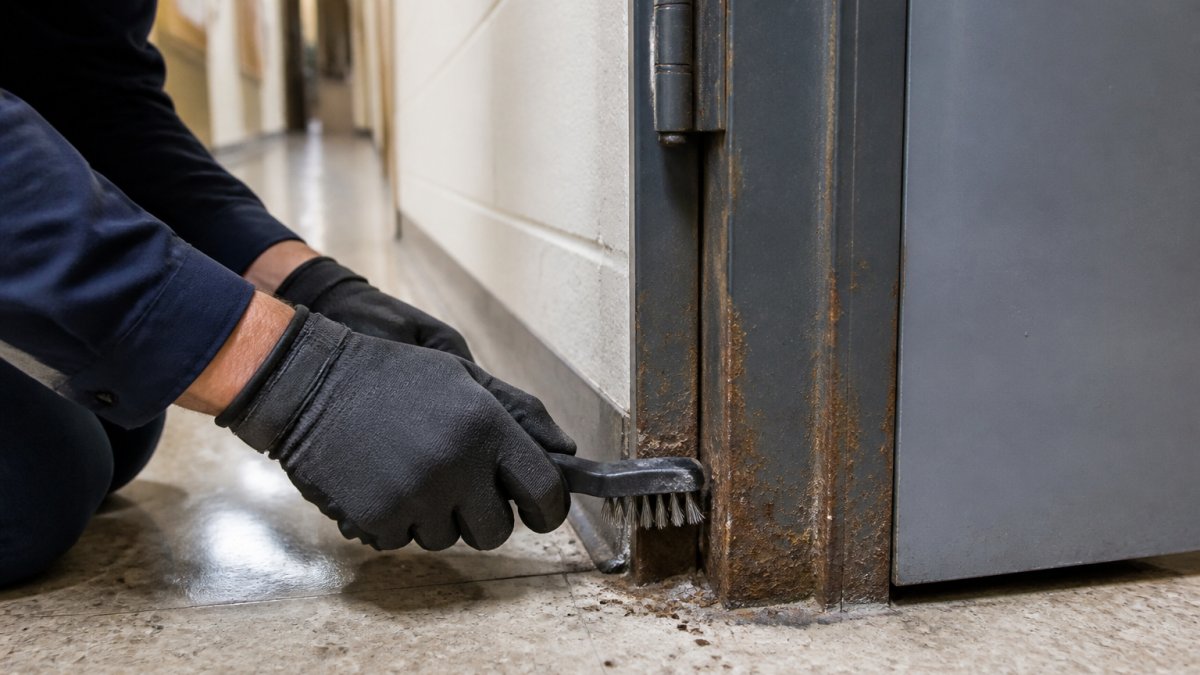
Scrub the rusted area with a wire brush until you hit solid metal. Wipe away the dust.
Step 3: Install the Patch and Secure the Hardware
Set the patch against the frame and line it up with your mark. Hold it flush, then drive the included hardware through the pre-drilled points.
Tighten each fastener in a star pattern so the patch pulls down evenly. Don't over-torque; you'll strip the metal and lose the hold. Once it's seated, check that the door still swings and latches cleanly.
Door Frame Repair Tools You Actually Need (and What You Can Skip)
You don't need a full contractor's van. A door frame repair tools list for this job is short.
| Tool | Needed? | Why |
|---|---|---|
| Wire brush | Yes | Removes loose rust before install |
| Drill with bits | Yes | Drives the included hardware |
| Tape measure | Yes | Confirms damage height |
| Pencil or marker | Yes | Marks the repair zone |
| Welder | No | The kit is a bolt-on solution |
| Angle grinder | Usually no | Only for severe, uneven metal |
The point of a patch kit is to avoid heavy equipment.
Door Frame Replacement vs Repair: When to Choose Each
Door frame replacement vs repair comes down to how much of the frame is compromised. A patch restores a localized rusted section. A replacement is for structural failure.
Choose a patch when:
- Rust is confined to the bottom of the frame
- The frame is otherwise sound and plumb
- You need a fast, low-cost fix
Choose a replacement when:
- The frame is bent, cracked, or twisted
- Rust has spread across most of the jamb
- The door no longer aligns or latches
For commercial facilities, patching handles a common case: rust at the base from years of mopping and moisture.
Common Mistakes to Avoid When Installing Door Frame Patches
The install is simple, but a few errors trip people up.
- Patching over loose rust. Always clean to bare metal first.
- Using the wrong size kit. More than 2 inches of rust needs a taller patch.
- Ignoring the handing. Hinge patches are side-specific.
- Over-tightening hardware. It strips the frame and weakens the hold.
- Skipping the door test. Always confirm the door swings and latches after install.
Door Innovation's kits ship with installation hardware and instructions.
Frequently Asked Questions
Can you repair a door frame without replacing it?
Yes, if the damage is limited to surface rust or corrosion. The Jamb Patch Kit is designed for early rust repair on steel frames and installs over the existing jamb without removing the frame. It works when rust covers 2 inches or less at the bottom. If rust extends beyond that, a taller patch like the Strike Side Jamb Patch or Hinge Jamb Patch is the better choice. Full replacement is only necessary when the frame has lost structural integrity.
How do you patch a rusted steel door frame?
Start by cleaning the rusted area with a wire brush, then dry-fit the patch to confirm alignment. Apply the provided hardware to secure the patch over the damaged section. The Jamb Patch Kit includes two 4-inch patches, installation hardware, and instructions. For rust taller than 2 inches, use the Strike Side Jamb Patch or a Hinge Jamb Patch, which measure 21-5/8 inches tall.
What tools do you need to install a door frame patch?
You need basic hand tools: a wire brush or sandpaper for surface prep, a drill with the correct bit size for the included screws, a tape measure, and a level. The Jamb Patch Kit comes with all mounting hardware and step-by-step instructions. No welding or specialized contractor equipment is required. A cordless drill and a few common hand tools are enough to complete the job.
Will a door frame patch affect the door's fit or operation?
No, when installed correctly. The Jamb Patch is a thin, non-handed plate that mounts flush over the damaged area. It does not change the door opening dimensions or interfere with the hinge or strike plate. The 4-inch Jamb Patch Kit is designed for early rust, and the taller Strike Side or Hinge Jamb Patch kits include a 4-1/2 inch commercial hinge pocket to match standard hinges. Test the door swing after installation to confirm smooth operation.
Rusted frames won't wait, and a full replacement is rarely the smart first move. Door Innovation gives facility teams a cost-effective way to restore openings with the Jamb Patch and Jamb Anchor kits, a simple three-step install, and hardware included. Keep your buildings safe, secure, and presentable without the contractor timeline. Order now and extend the life of your existing door frames.