
Labor Savings for Door Frame Repairs: 2026 Cost Guide
Table of Contents
- The Real Labor Savings for Door Frame Repairs in 2026
- Door Frame Replacement Cost vs. Repair: A 2026 Comparison
- Commercial Door Frame Repair Kits: Cut Labor Hours with the Right Tools
-
Step-by-Step Labor-Saving Hacks for Door Frame Repairs
- Hack 1: Pre-stage the kit before you touch the door
- Hack 2: Match the fastener to the frame, not the kit box
- Hack 3: Mortise hinges and strikes with a router jig, not a chisel
- Hack 4: Shim once, check plumb, then fasten
- Hack 5: Batch repairs by hallway, not by work order
- Hack 6: Rent the tools you use once, buy the tools you use weekly
- Hack 7: Document the repair so the next one is faster
- What these hacks are worth
- Door Frame Maintenance Best Practices That Prevent Costly Repairs
- How to Estimate Labor Costs for Door Frame Repairs
- Frequently Asked Questions
Last Updated: September 15, 2026
The Real Labor Savings for Door Frame Repairs in 2026
Labor, not materials, drives the true cost of door frame repairs. A rusted steel jamb patched in under an hour saves a facility far more than the parts ever cost.
Most cost guides quote a full replacement figure and stop there, ignoring the billable hours, door downtime, and security gaps that come with a frame swap.
At Door Innovation, our repair kits exist because a rusted or corroded frame usually doesn't need to come out, it needs to be stabilized, patched, and returned to service.
Below, we break down where the labor goes, how to cut it, and which repairs justify full replacement.
Door Frame Replacement Cost vs. Repair: A 2026 Comparison
The difference is scope. A full replacement removes the jamb, resets a new one, and rehangs the door, carpentry labor, disposal, and finish work. A targeted repair addresses only the damaged section.
Here's how the two approaches typically compare:
| Factor | Full Frame Replacement | Targeted Frame Repair |
|---|---|---|
| Labor hours | 4-8 hours | 1-2 hours |
| Door downtime | Full day or more | Under an hour |
| Disruption to adjacent walls | Often required | Minimal |
| Security gap during work | Yes | No |
| Best for | Structural failure | Rust, corrosion, loose anchors |
A common mistake is treating every rust spot as a replacement trigger. Surface corrosion on a hollow metal frame can often be repaired; structural cracking, sagging, or a frame pulled away from the wall may require more extensive intervention.
Commercial Door Frame Repair Kits: Cut Labor Hours with the Right Tools
The right tool can simplify a multi-hour carpentry job into a more manageable maintenance task. Commercial door frame repair kits are pre-engineered components that restore a specific damaged section of a jamb without removing the frame.
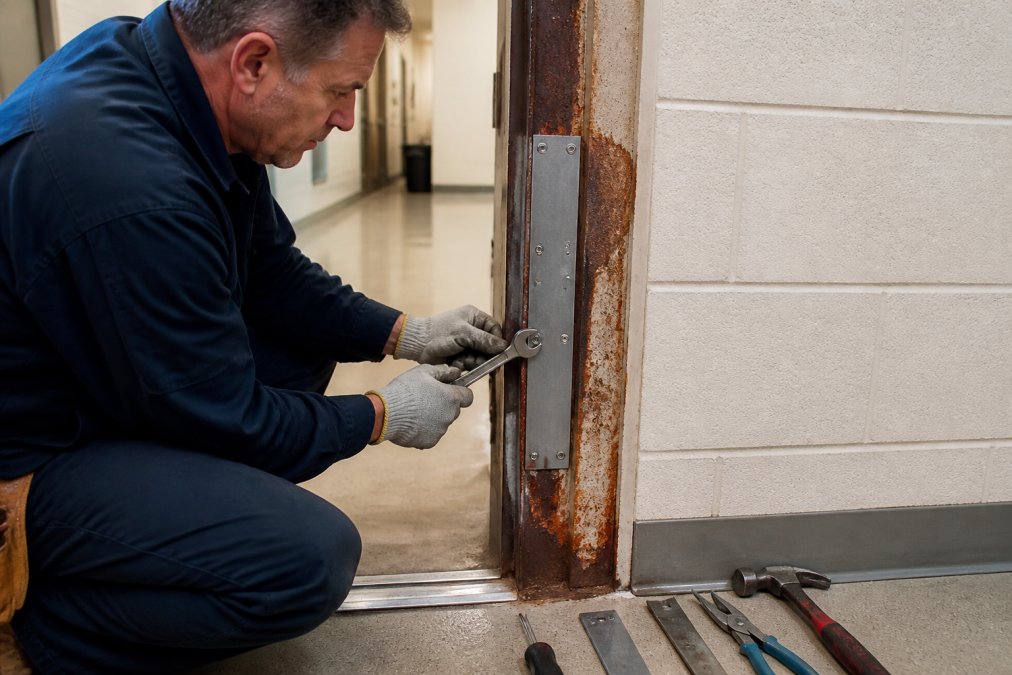
Door Innovation builds these kits around a three-step process: clean the damaged area, position the patch or anchor, and fasten it with the included hardware. No welding, no frame removal, no carpentry background required.
The product line covers the most common failure points:
- Jamb Patch Kit (4") for early-stage rust on steel frames
- Strike Side Jamb Patch for damage at the strike plate
- Jamb Anchor Side Jamb Kit for loose or pulled aluminum frames
For facilities with mixed steel and aluminum doors, the Jamb Patch and Jamb Anchor catalogue shows which kit fits which frame type.

Step-by-Step Labor-Saving Hacks for Door Frame Repairs
Preparation is where labor hours are won or lost. A technician who arrives with the right kit, fasteners, and plan finishes in a fraction of the time. These hacks separate a one-hour patch from a three-hour callback.
Hack 1: Pre-stage the kit before you touch the door
A tech who diagnoses damage, drives to the supply room, finds the wrong patch size, and returns the next day adds 45 to 90 minutes of non-billable time. Photograph and measure the damage, then pull the matching kit before leaving the shop. For steel frames, a 4" jamb patch can address early-stage rust; for strike-side damage, the Strike Side Jamb Patch is designed for that specific repair.

Hack 2: Match the fastener to the frame, not the kit box
Self-drilling screws may not be ideal for thin-gauge hollow metal; self-tapping screws are often more suitable for aluminum. Using the correct fastener is crucial for a secure patch. Keep both types in the kit bag and match them to the jamb material.
Hack 3: Mortise hinges and strikes with a router jig, not a chisel
A hinge jig and trim router can cut a mortise more quickly than hand-chiseling. Using the right tools can significantly reduce job time.
Hack 4: Shim once, check plumb, then fasten
Inexperienced techs shim, fasten, test, discover the door binds, unfasten, and repeat. The faster sequence: dry-fit the patch or anchor, check plumb and level with a 24" level, adjust shims, then drive fasteners. One shim pass instead of multiple can save significant time per door.
Hack 5: Batch repairs by hallway, not by work order
Travel and setup often exceed the repair itself. If three doors in one corridor show early rust, fix all three in one session so setup happens once. Batching quarterly inspections into a single repair day can often reduce per-door labor.
Hack 6: Rent the tools you use once, buy the tools you use weekly
A hammer drill, trim router, and hinge jig are worth buying if you repair doors monthly; a one-off job is cheaper with a rental. A rotary hammer can be rented. A general rule of thumb is to consider renting tools that are used infrequently and have a high purchase cost relative to a typical billable hour.
Hack 7: Document the repair so the next one is faster
A photo log of every repair, damage, kit used, fastener type, time to complete, turns the next similar repair into a lookup instead of a diagnosis, so a tech knows which kit fits which frame in under a minute.
What these hacks are worth
Stacked together, these moves can significantly reduce the time required for a jamb patch or strike-side repair. At a typical commercial labor rate, this can make a repair a highly competitive option compared to replacement.
Door Frame Maintenance Best Practices That Prevent Costly Repairs
Preventative maintenance can be more cost-effective than reactive repairs, especially when it's scheduled, triggered, and tied to specific actions. A structured maintenance calendar with defined intervals, triggers, and responses can be a highly effective way to manage door frame labor costs over time.
A preventative maintenance schedule that actually gets followed
Most guides stop at "inspect regularly." A workable schedule assigns frequency by exposure and traffic, not a blanket rule.
| Frame location | Inspection interval | Primary risk | Action trigger |
|---|---|---|---|
| Exterior-facing, high traffic | Monthly | Moisture intrusion at jamb base | Any rust bloom or soft paint |
| Exterior-facing, low traffic | Quarterly | Weatherstripping failure | Visible gap at sweep or seal |
| Interior, high traffic | Quarterly | Hinge and strike screw loosening | Door binds or latch misaligns |
| Interior, low traffic | Semi-annually | Paint scratches exposing steel | Bare metal visible |
| Restroom and wet areas | Monthly | Constant moisture, corrosion | Rust at base or hinge line |
The triggers matter more than the intervals. A monthly inspection that ignores a rust bloom can be less effective than a quarterly one that catches it: addressing early rust on a hollow metal frame can often be a patch job, while late rust may necessitate a frame replacement.
The five-minute inspection routine
A tech can often inspect a door frame efficiently with no special tools:
- Run a hand along the jamb base. Feel for bubbling paint, soft spots, or rust bloom. Moisture collects at the base first.
- Open and close the door. Listen for a scrape or bind.
Material durability: why the frame you choose changes your labor bill for years
The maintenance actions that pay for themselves fastest
Ranked by labor savings per dollar spent:
When maintenance is not enough
How to Estimate Labor Costs for Door Frame Repairs
Frequently Asked Questions
How much should I charge to fix a door frame?
For commercial door frame repairs, labor charges typically range from $50 to $120 per hour, depending on your region and the technician's skill level. A simple patch installation might take 1 to 2 hours, so you could charge $100 to $240 in labor. If you use a kit like the Jamb Patch Kit (4"), which costs $130.37, the total repair cost stays well below a full frame replacement. Always factor in material markup and any prep work when quoting.
Are door frames expensive to replace?
Yes, replacing a commercial door frame is costly. The door frame replacement cost often runs $400 to $800 per opening, including materials and labor. That's because a full replacement involves removing the old frame, shimming, leveling, and reinstalling a pre-hung door or new jambs. By contrast, a repair kit like the Strike Side Jamb Patch costs $180.91 and can be installed in a fraction of the time, saving significant labor hours.
What is the most cost-effective way to repair a rusted door frame?
The most cost-effective method is to use a specialized repair kit at the first sign of rust or corrosion. Products like the Jamb Patch Kit (4") for $130.37 or the Jamb Anchor Side Jamb Kit for $119.00 address the damage without removing the entire frame. These kits require only basic tools and can be installed in under two hours, drastically reducing carpentry labor and billable hours compared to a full replacement.
Do commercial door frame repair kits require special training?
No special training is needed. Most kits, such as the Jamb Patch and Jamb Anchor, come with detailed instructions and are designed for easy installation by any maintenance technician. The process typically involves cleaning the affected area, applying the patch or anchor, and securing it with provided hardware. Your in-house team can complete the repair in an afternoon, avoiding the cost of hiring an outside contractor.