
Long-Term Durability of Frame Patches: What Lasts
Table of Contents
- What Determines Frame Patch Durability
- Door Frame Repair vs Replacement: When Patching Makes Sense
- Door Frame Patch Installation: Critical Steps for Long-Term Performance
- Preventing Corrosion in Metal Door Frames After Repair
- Commercial Door Frame Repair: Inspection and Safety Standards
- Monitoring and Maintaining Frame Patches Over Time
- Frequently Asked Questions
Last Updated: October 7, 2026
What Determines Frame Patch Durability
The long term durability of frame patches depends on three critical factors: the thickness and quality of the steel used, the welding method applied, and how well the repair prevents future corrosion. Get these right, and a patch can last decades. Miss them, and you'll be looking at another repair in a few years.
The patches that hold up longest share a common trait: they were installed with attention to both the materials and the protection applied afterward. A patch is only as strong as its weakest link, and that link is usually corrosion, not the weld itself.
Patch Thickness and Steel Quality
Patch thickness matters more than most people realize. A thin patch might pass initial inspection but fail under stress or freeze-thaw cycles. The steel thickness you choose determines how long the repair resists rust and maintains structural integrity.
For frame patches, thickness typically ranges from 1/8 inch to 3/16 inch. Thicker patches provide better load-bearing capacity and resist corrosion longer. However, thickness alone doesn't guarantee durability. The quality of the steel, its composition and resistance to rust, is equally important.
Steel patches should match or exceed the original frame material. Using lower-grade steel to save money creates a weak point that will corrode faster than the surrounding frame. This is false economy. The patch becomes the failure point, not the solution.
| Patch Thickness | Best For | Expected Performance |
|---|---|---|
| 1/8 inch | Early-stage rust, surface damage | 5-10 years with proper coating |
| 3/16 inch | Moderate rust, load-bearing areas | 10-20 years with proper coating |
| 1/4 inch | Severe damage, high-stress areas | 15+ years with proper coating |
Welding Methods and Heat Distortion
The welding method you choose affects both immediate integrity and long-term durability. Poor welds create stress points where cracks develop and water seeps in.

There are two main approaches: stick welding (SMAW) and MIG welding (GMAW). Stick welding generates more heat and causes greater distortion, but creates a strong, penetrating bead. MIG welding is faster and cleaner but requires proper technique to achieve full penetration.
The real issue isn't which method you choose, it's the skill of the welder. A poor stick weld is worse than a good MIG weld. A rushed MIG job leaves gaps that trap moisture.
Heat distortion is the hidden enemy. When too much heat is applied during welding, it warps the frame metal around the weld area. This distortion can prevent the door from closing properly and creates stress points that crack under repeated use.
Door Frame Repair vs Replacement: When Patching Makes Sense
Patching makes sense when the rust damage is localized and the remaining frame structure is sound.
The decision hinges on cost, safety, and remaining useful life. A patch costs a fraction of a full replacement and can extend the frame's life by 10-20 years.
For most commercial facilities, patching is the practical choice. You're stopping rust before it becomes a structural problem. Door Innovation's repair kits address this exact scenario: rust at the bottom of steel frames, where moisture collects and corrosion starts.

However, patching is not appropriate if the frame is rusted through in critical load-bearing areas, if the opening has shifted out of square due to frame failure, or if multiple patches would be needed to address all damaged sections.
Door Frame Patch Installation: Critical Steps for Long-Term Performance
The installation process determines whether a patch delivers 5 years of life or 20 years. Proper installation means metal preparation, correct welding technique, and complete protective coating. Skip any step, and durability suffers.
Metal Preparation and Rust Removal
Metal preparation is where most repairs fail. Rust must be completely removed down to bare metal. Any rust left under the patch will continue to spread, eating away at the bond between patch and frame.
Use a wire brush, grinder, or sandblaster to remove all rust and loose material. The surface should be clean, dry, and free of paint, oil, or debris. This takes time. Many installers rush this step to save labor hours. That's a mistake.
After removing rust, inspect the remaining frame carefully. Look for perforations, holes where rust has eaten completely through the metal. If the frame is rusted through in the area where you plan to weld, the patch won't hold.
Once the surface is clean, apply a rust-inhibiting primer immediately. Don't wait. Bare metal starts rusting within hours, especially if the air is humid or the frame is in a wet environment.
Protective Coating and Sealing
After welding, the patch and surrounding frame must be sealed against moisture. This is the barrier that prevents corrosion from returning. A protective coating system typically includes:
- A rust-inhibiting primer applied to bare metal and the weld area
- An intermediate coat for additional protection and adhesion
- A topcoat for weather resistance and appearance
Each layer serves a purpose. The primer stops rust. The intermediate coat builds thickness and bonds the topcoat. The topcoat protects against UV damage and weathering.
The entire system must seal the weld bead completely. Welds are porous and trap moisture. If the coating doesn't fill these gaps, water penetrates and rust starts underneath the patch. Within a few years, the patch separates from the frame.
Apply coatings in thin, even layers. Thick, uneven application traps air and moisture, reducing protection. Follow the manufacturer's cure times between coats. Rushing this step undermines everything you've done so far.
Preventing Corrosion in Metal Door Frames After Repair
Once a patch is installed and coated, the battle against corrosion continues. Environmental factors, road salt, humidity, temperature swings, chemical exposure, attack the coating and create new rust risks.
The best defense is regular inspection and maintenance. Check the patch area every 6-12 months. Look for signs of coating failure: peeling paint, discoloration, or visible rust at the edges. Address problems early, before they spread.
Road salt is particularly aggressive in northern climates. Salt accelerates corrosion and breaks down protective coatings faster than dry conditions.
Moisture is the constant threat. Door frames at ground level collect water from rain, snow melt, and humidity. Ensure that drainage around the frame is clear. Water should not pool or sit against the frame.
Temperature swings cause expansion and contraction. This movement stresses coatings and can open small gaps where water enters. Quality coatings accommodate this movement. Poor coatings crack and fail.
Commercial Door Frame Repair: Inspection and Safety Standards
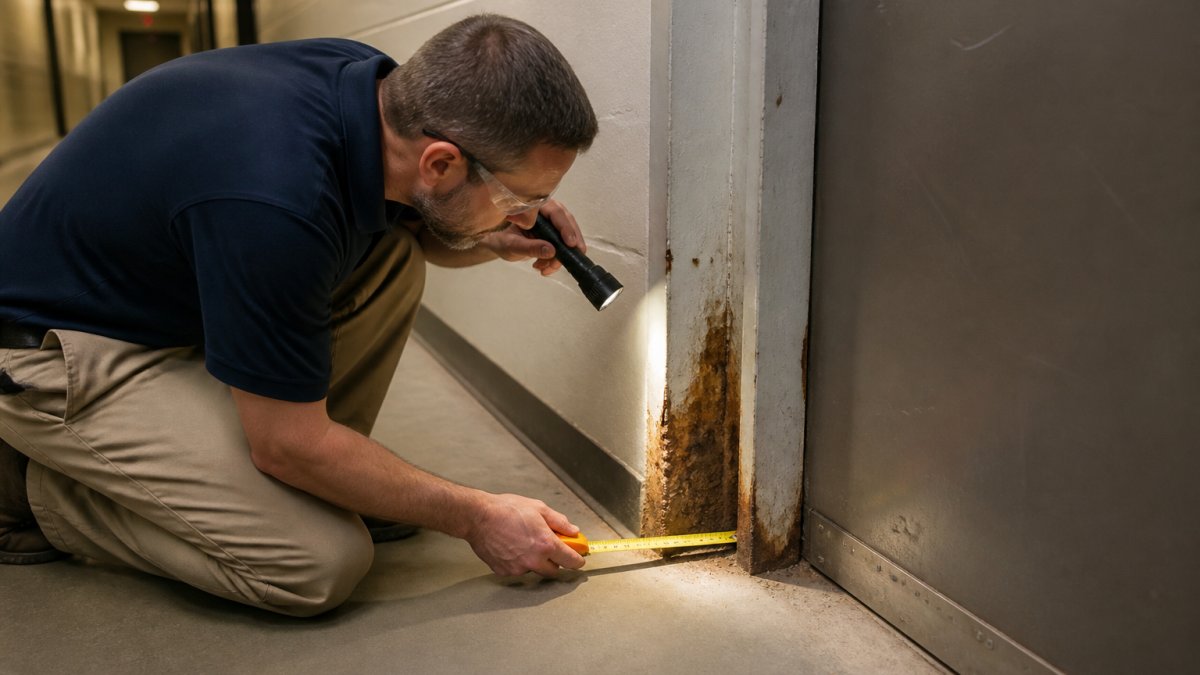
Professional assessment before patching is essential. An inspection determines whether a patch is appropriate, what size patch is needed, and whether the frame can safely support the repair.
Inspection focuses on three areas: the extent of rust, the structural integrity of the remaining frame, and the location of the damage. Each tells you something different about the repair.
When a Patch Is Unsafe or Should Be Rejected
A patch should be rejected if:
- Rust has perforated the frame (holes through the metal)
- More than 30 percent of the frame cross-section is compromised
- The frame is bent, twisted, or structurally misaligned
- The damage extends into critical load-bearing areas (hinge pockets, body mounts, suspension attachment points)
- Multiple patches would be required to address all damaged sections
- The frame has failed welds or prior repairs that are breaking down
In any of these cases, patching creates false security. The patch may look good, but the underlying frame is too weak to support it. A door that fails after repair is a safety and liability issue.
Safety standards from the American Society for Testing and Materials specify that structural repairs must maintain the original load-bearing capacity. A patch that doesn't restore full strength violates this standard. Professional installers know these limits and refuse unsafe repairs.
For commercial facilities, this is critical. A healthcare facility, school, or office building cannot afford a door frame failure. The liability and safety risks are too high. If a patch cannot safely restore the frame, replacement is the only appropriate choice.
Monitoring and Maintaining Frame Patches Over Time
Long-term durability depends on ongoing monitoring. A patch installed today won't stay protected without attention. Environmental exposure, coating wear, and age all degrade protection over time.
Establish a maintenance schedule:
- Months 1-6: Initial inspection to verify the patch is holding and coating is intact
- Year 1: Follow-up inspection to check for coating failure or rust at patch edges
- Years 2-5: Annual inspections, especially before winter or in high-salt environments
- Years 5+: More frequent inspections as the patch ages
During each inspection, look for:
- Peeling or cracked coating
- Rust stains or discoloration around the patch
- Water pooling or moisture on the frame
- Movement or separation at the patch edges
- Corrosion creeping from the edges inward
If you spot any of these, address them immediately. A small coating failure can expand to a large rust problem in months. Recoat the patch or repair the damaged area before rust spreads.
Documentation matters. Record each inspection, note any issues, and track repairs. Over time, this record tells you whether the patch is performing as expected or whether the frame is heading toward failure. This information guides decisions about future maintenance or replacement.
For facilities managing multiple doors, this becomes a systematic program. Door Innovation's Become a Certified Installer program provides training on inspection criteria and maintenance best practices, helping facility teams develop consistent protocols across their buildings.
Frame patches deliver long-term durability when installed properly and maintained actively. Door Innovation's Jamb Patch kits are engineered for steel frames, designed to be compatible with major manufacturers, and backed by a simple three-step installation process that facility teams can execute reliably. When you're facing rusted door frames across your facility, patching with quality materials and proper technique saves time, money, and the headache of full replacement. Order Now and extend the life of your existing door systems.
Frequently Asked Questions
How long do frame patches last on commercial door frames?
Quality frame patches typically last 10-20 years when installed correctly and maintained properly. Durability depends on patch thickness, welding quality, protective coatings, and environmental exposure. Facilities in high-moisture or salt-air environments may see shorter service life. Regular inspections and touch-up coatings every 3-5 years extend longevity significantly and prevent premature corrosion.
What's the difference between door frame patch installation and full replacement?
Patching costs a fraction of full frame replacement and can be completed more quickly. Patches work when rust is localized to the bottom or specific sections. Full replacement is necessary when damage extends across load-bearing sections, multiple areas are perforated, or structural integrity is compromised. Patches preserve existing door hardware and alignment, reducing installation complexity and facility downtime.
Can preventing corrosion in metal door frames stop rust from returning after a patch?
Yes. Rust-inhibiting primer and protective topcoats are critical. After patching, the exposed steel must be sealed to block moisture and road salt. Apply rust-inhibiting primer immediately after welding, then a topcoat. Annual inspections and touch-up coatings prevent corrosion from returning. Without sealing, moisture will penetrate and rust will develop around the patch edges within 1-2 years.
Is commercial door frame repair with patches safe for healthcare and secure facilities?
Yes, when performed to professional standards. Patches restore structural integrity and load-bearing capacity if installed by certified technicians using proper welding and reinforcement. Inspect the weld quality, verify patch thickness meets specifications, and confirm no heat distortion affects door operation. Frame patches meet the same functional requirements as replacement frames. However, reject any patch with visible gaps, incomplete welds, or rust bleeding through the coating.