
Repairing Corroded Aluminum Door Frames: 2026 Guide
Table of Contents
- Structural vs. Cosmetic Corrosion: What You're Actually Fixing
- Tools and Materials for Aluminum Door Frame Repair Kit Projects
- Step 1: Clean and Prepare the Corroded Surface
- Step 2: Remove Oxidation, Loose Paint, and Pitting
- Step 3: Fill Holes, Sand Smooth, and Restore Profile
- Step 4: How to Fix Rotted Door Frames with Primers, Caulk, and Coatings
- Preventing Aluminum Corrosion in Commercial Buildings Long-Term
- Conclusion
- Frequently Asked Questions
Last Updated: September 17, 2026
Structural vs. Cosmetic Corrosion: What You're Actually Fixing
Repairing corroded aluminum door frames starts with one question most guides skip: is the damage cosmetic or structural? Aluminum oxidation shows up as a chalky white powder residue on the surface, while structural corrosion eats into the metal, causes pitting, and lets the frame shift inside the wall.
What actually causes aluminum to corrode
Aluminum doesn't rust the way steel does. Instead, it forms a thin, self-healing oxide layer that normally protects the metal. That layer breaks down under three conditions worth knowing by name:
- Galvanic corrosion, when aluminum touches a dissimilar metal like steel or stainless steel in the presence of moisture, the aluminum becomes the anode and gives up metal ions. This is why the corrosion is often worst right at the point where a steel hinge, closer, or anchor contacts the jamb.
- Crevice corrosion, when water and salt get trapped in a tight gap (under a gasket, behind a threshold, inside a hollow jamb), oxygen can't reach the surface and the protective oxide layer fails locally.
- Pitting corrosion, localized, deep attack that starts as a small white or gray speck and tunnels into the metal. Chlorides from de-icing salts and coastal air are the usual accelerants.
The field test: cosmetic vs. structural
Before you buy a single product, run this three-part check on the frame:
- Push test. Press firmly on the jamb at mid-height. Any flex, movement, or audible crack means the anchor has lost its grip on the rough opening. That is structural.
- Latch and swing test. Open and close the door through its full arc. Dragging, binding, or a latch that no longer lines up with the strike indicates the frame has shifted. That is structural.
- Pit depth test. Probe the deepest pit with the tip of a utility knife or a thin pick. If the pit is deeper than roughly the thickness of a quarter, or if you can see daylight through the metal, the section has lost load-bearing cross-section. That is structural.
When to repair vs. when to replace
A frame is worth repairing when the corrosion is confined to the surface, the anchors still hold, and the door hardware still aligns. Replacement becomes the better call when any of the following is true:
- The jamb has pulled free of the rough opening and the surrounding wall substrate is also deteriorated.
- Pitting has perforated the metal in more than one location along the same jamb.
- The frame has twisted or bowed enough that the door no longer seals.
- Galvanic damage has consumed the metal at every hardware contact point.
Tools and Materials for Aluminum Door Frame Repair Kit Projects
A complete aluminum door frame repair kit setup covers cleaning, filling, and re-anchoring, and you can assemble it for far less than a replacement frame costs. The list below covers both cosmetic restoration and structural re-anchoring, so buy for the condition you actually found in the step above.
- Stiff nylon brush and abrasive pad for oxidation removal
- Fine-grit sandpaper (120 and 220 grit) for feathering edges
- Metal filler or epoxy resin for pitting and holes
- Vinegar solution or a mild acidic cleaner for mineral buildup
- Corrosion inhibitor and a bonding primer rated for aluminum
- Caulk sealant and replacement weather stripping
- Jamb Anchor kits for frames that have come loose
Step 1: Clean and Prepare the Corroded Surface
Cleaning is where most repairs are won or lost, because primer adhesion depends entirely on what's left behind. Start by degreasing the frame with a mild detergent, then scrub the white powder residue off with a stiff brush. If salt or chemical buildup is present, wipe the surface with a diluted vinegar solution and rinse with clean water.

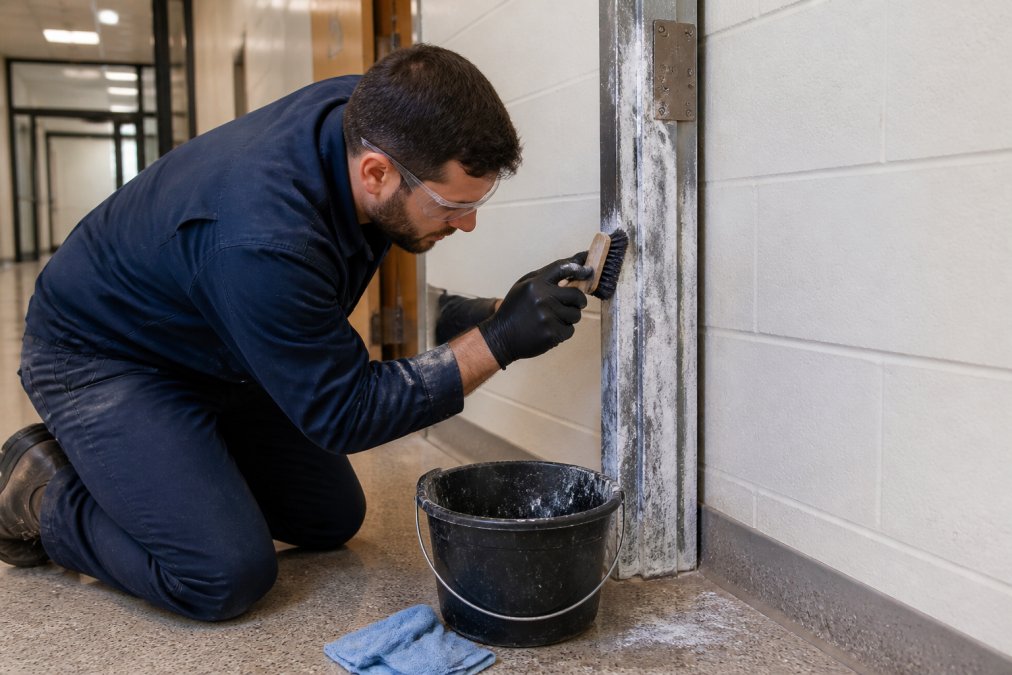
Step 2: Remove Oxidation, Loose Paint, and Pitting
Removing aluminum oxidation means taking the surface back to bare, sound metal, not just scuffing what's visible. Work the affected areas with an abrasive pad, then switch to fine-grit sandpaper to feather the edges of any remaining paint. You're aiming for a dull, uniformly bright surface with no chalky residue and no flaking edges.
Step 3: Fill Holes, Sand Smooth, and Restore Profile
Filling and sanding restores the frame's profile so coatings and hardware sit flush again. Apply metal filler or a two-part epoxy resin to pits and holes, overfilling slightly, then let it cure fully before sanding. Work from 120 grit down to 220 grit until the patch is level with the surrounding metal.
| Damage Type | Material | Cure Time | Finish Step |
|---|---|---|---|
| Shallow pitting | Metal filler | Per label | Sand 220 grit |
| Deep holes | Epoxy resin | Per label | Sand 120 then 220 |
| Loose jamb | Jamb Anchor kit | Per instructions | Reinstall hardware |
| Surface oxidation | Abrasive pad | None | Prime immediately |
Step 4: How to Fix Rotted Door Frames with Primers, Caulk, and Coatings
How to fix rotted door frames comes down to sealing the metal so moisture never reaches it again. Apply a corrosion inhibitor to the bare aluminum first, then a bonding primer formulated for aluminum. Let the primer cure per the manufacturer's instructions before topcoating.
Jamb Patch - Jamb Anchor Catalogue →

Preventing Aluminum Corrosion in Commercial Buildings Long-Term
Preventing aluminum corrosion in commercial buildings is a maintenance habit, not a one-time repair. The frames that fail fastest are the ones exposed to salt spray, standing water, and aggressive cleaning solutions, so target those first. Rinse frames in high-traffic entries regularly, repair caulk lines as soon as they crack, and inspect for galvanic reaction wherever aluminum meets steel or another dissimilar metal.
Stop galvanic corrosion at the source
Galvanic corrosion is the failure mode most inspection checklists miss, and it's the one that quietly destroys frames from the inside. It happens whenever aluminum contacts a dissimilar metal, steel hinges, stainless closers, steel anchors, even the screws holding a threshold, in the presence of moisture. The aluminum becomes the sacrificial anode and corrodes preferentially.
- Use nylon or neoprene washers under steel fasteners that pass through aluminum.
- Apply an anti-seize or corrosion-inhibiting compound rated for dissimilar-metal contact on bolt threads and mating surfaces.
- Isolate steel reinforcement plates from the aluminum jamb with a non-conductive gasket or tape.
- Replace steel fasteners with stainless or aluminum where the application allows.
Match your sealant and schedule to the environment
A single maintenance schedule doesn't fit every building. The exposure profile drives both the sealant chemistry and the inspection frequency:
- Coastal and salt-air entries. Chlorides are the primary accelerant. Use a marine-grade, salt-resistant sealant (a polyurethane or silicone rated for coastal exposure) rather than a standard acrylic caulk, and rinse frames monthly to flush accumulated salt. Inspect anchor points quarterly for the white bloom that signals galvanic attack.
- Inland, de-iced entries. Road salt tracked in on boots and carts creates the same chloride exposure in winter. Rinse monthly during de-icing season, and inspect caulk lines after every freeze-thaw cycle.
- High-traffic retail entries. Cart impacts and constant use loosen anchors and crack caulk. Inspect monthly, rinse quarterly, and re-torque anchor hardware on the same cadence.
- Healthcare and senior facilities. Aggressive disinfectants and cleaning solutions attack sealants and coatings. Inspect monthly, check hardware alignment each visit, and confirm the sealant is rated for the chemicals in use.
- Industrial and warehouse doors. Equipment impacts are the dominant risk. Inspect after every impact, check anchors quarterly, and keep a spare jamb anchor kit on hand so a hit doesn't become a replacement.
Build the inspection into your existing routine
You don't need a separate program. Add three checks to whatever walkthrough your team already does:

- Caulk line check. Look for cracks, gaps, or separation where the frame meets the wall. A cracked caulk line is the entry point for the water that drives crevice corrosion.
- Hardware contact check. Look for white or gray bloom around hinges, closers, and anchors, the visual signature of galvanic attack.
- Push and swing check. Repeat the field test from the first section. A frame that has started to move is far cheaper to re-anchor now than to replace later.
Conclusion
The challenge with repairing corroded aluminum door frames is knowing when to patch and when to re-anchor, and getting that call wrong costs you the whole repair. Door Innovation builds kits for the structural side of that decision: the Jamb Anchor Side Jamb Kit and Center Jamb Kit re-anchor loose jambs with a simple installation process, and the Jamb Patch and Jamb Anchor catalogue lays out every option with specifications.
Frequently Asked Questions
What causes white powder corrosion on aluminum door frames?
White powder on aluminum is aluminum oxide, formed when the metal reacts with oxygen and moisture. In commercial buildings, salt spray, cleaning chemicals, and airborne pollutants speed up the process. The powder itself is usually harmless, but if it hides pitting or lets moisture sit against the metal, it can weaken the frame. Clean it off, check for pitting, and seal the surface to stop it returning.
Can you repair pitted aluminum door frames, or do they need replacing?
Most pitted frames can be repaired if the damage is cosmetic. Clean the pits, fill them with a metal filler or epoxy resin, sand smooth, and refinish. If pitting has eaten into the structural profile or the frame is loose, re-anchor it with a kit such as the Jamb Anchor Side Jamb Kit, which is designed for aluminum frames loosened by corrosion. Replace only when the profile is too thin to hold hardware.
Is it better to repair or replace corroded aluminum door frames?
A repair kit such as the Jamb Anchor Side Jamb Kit costs $119. Replacement makes sense only when corrosion has caused structural failure, the frame is bent, or the profile is too far gone to hold anchors or locks.
How do you prevent future corrosion on aluminum frames?
Start by keeping the frame dry. Re-caulk weather stripping and jamb gaps so water cannot sit against the metal. Wash with a mild solution, not an acidic cleaner, and rinse thoroughly. Apply a corrosion inhibitor or protective coating to bare spots. In coastal or high-humidity buildings, schedule a quick inspection every six months so you catch oxidation before it pits the surface.