
School Door Frame Safety: Maintenance & Repair Guide
Table of Contents
- Why School Door Frame Safety Matters
- Elements of School Door Security and Frame Integrity
- NFPA 80 Inspection Requirements for Schools
- Identifying Signs of Wear and Tear in Door Frames
- Step-by-Step Inspection Process for School Door Frames
- School Door Frame Repair Kits vs. Full Replacement
- Commercial Door Frame Rust Repair and Preventative Maintenance
- Compliance, ADA Accessibility, and Fire Safety Standards
- Frequently Asked Questions
Last Updated: September 29, 2026
Why School Door Frame Safety Matters
School door frame safety is essential for protecting students, staff, and visitors during emergencies. A compromised door frame can fail when you need it most, during a lockdown, fire evacuation, or forced entry attempt.
A door frame that doesn't seal properly, align correctly, or hold its hardware creates vulnerabilities. Rust eats through steel frames, corrosion loosens aluminum anchors, and misaligned jambs prevent latches from engaging, each issue compounds over time.
Most frame problems don't require full replacement. Early intervention with targeted repairs saves money and keeps facilities secure.
This guide covers the inspection process, repair options, and compliance requirements that keep school door frames functional and safe.
Elements of School Door Security and Frame Integrity
School door security depends on the frame (the anchor) and hardware working together to create a barrier.
Forced-entry resistance and structural components
Forced-entry resistance measures how long a door assembly resists penetration under pressure, buying time during an active threat. A solid-core door paired with a steel frame and quality hardware can resist forced entry for 15-30 seconds, allowing students and staff to evacuate or secure the room.
The frame itself provides the structural foundation:
- Steel frames are stronger but vulnerable to rust
- Aluminum frames resist corrosion but can loosen at anchor points
- Frame depth affects how securely hardware mounts
- Strike plate alignment determines whether the latch catches properly
When a frame deteriorates, forced-entry resistance drops: rusted steel loses structural integrity, and loose aluminum anchors allow the frame to shift, breaking the seal between door and jamb.
Panic hardware and emergency egress requirements
Panic hardware (crash bars) must function in emergencies, students and staff push the bar and the door opens immediately. The frame must support it without flex or failure; poor alignment or corrosion can seize the mechanism.
Emergency egress codes require hardware that operates with a single motion, clear opening paths, frames that hold hardware securely under pressure, and regular testing. When you inspect for school door frame safety, test panic hardware operation; if it sticks, binds, or requires extra force, the frame may be the culprit.
NFPA 80 Inspection Requirements for Schools
NFPA 80 is the standard for fire doors and frames (Fire Doors and NFPA 80 FAQs). Schools must comply with annual inspections at minimum; many facilities inspect quarterly or semi-annually in high-traffic areas or where environmental conditions accelerate deterioration.
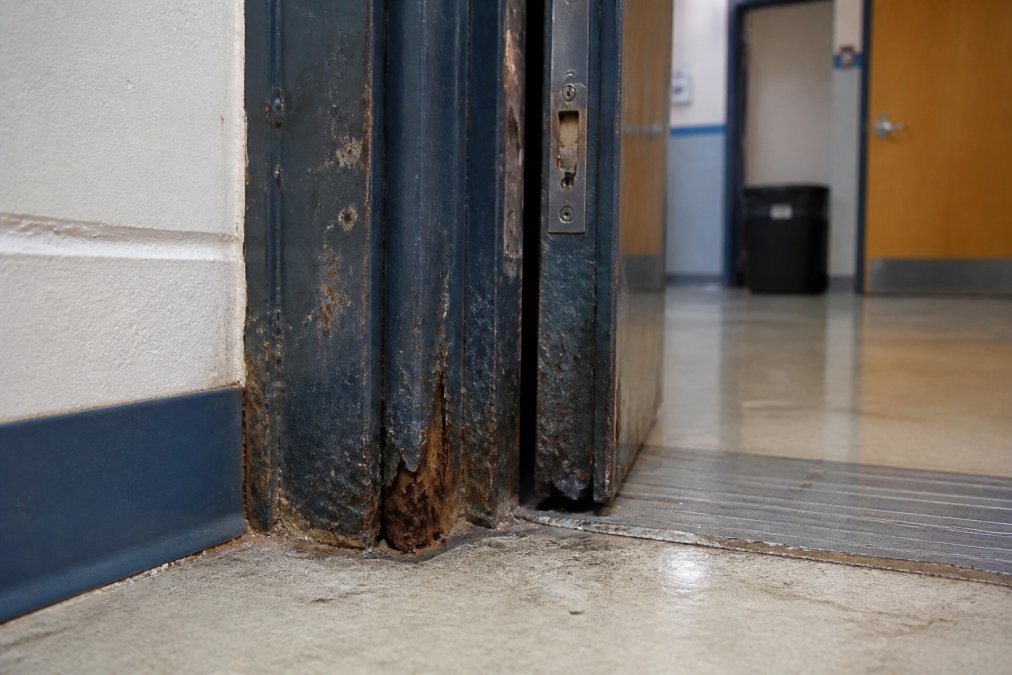
NFPA 80 covers frame condition, hardware functionality, clearances, hinges, latches, closing mechanisms, seals, and documentation of inspections and repairs. Non-compliance creates liability; documentation proves you took the standard seriously. Early repair prevents the deterioration that forces full replacement.
Identifying Signs of Wear and Tear in Door Frames
Frame problems announce themselves, you need only attention to spot them.
Rust, corrosion, and mechanical failure indicators
Rust on steel frames starts as surface discoloration and progresses to pitting, then deeper corrosion. Early-stage rust appears as orange or brown staining at the frame bottom where water collects, this is the time to act with a repair kit.
Mechanical failure includes:
- Hinges that don't hold the door weight
- Latches that don't engage or release properly
- Closer arms that leak fluid or fail to dampen
- Strike plates that sit proud of the frame (sticking out) instead of flush
Door alignment, gap clearance, and latch engagement problems
Misalignment is easy to spot: the door drags or closes unevenly, with gaps wider on one side. It results from loose anchors, uneven building settlement, rust or corrosion, or bent hardware mounting points.
Step-by-Step Inspection Process for School Door Frames
A systematic inspection catches problems early, creates compliance documentation, and takes about 10 minutes per door.
Step 1: Visual assessment and documentation
Walk around the entire frame, top to bottom, documenting rust or corrosion, visible damage, gaps, hardware condition, water damage, and previous repairs. Take photos and use a simple checklist.
Step 2: Hardware testing and functionality checks
Open and close the door 5-10 times, testing door closer operation, panic hardware activation, latch engagement, hinges, and strike plate alignment. Listen for squeaks (lubrication needed), grinding (wear), or rattles (shifting hardware).
Step 3: Structural integrity evaluation
Push on the frame at different points; a healthy frame feels solid, while a compromised frame flexes or creaks. Check frame depth, construction (steel vs. aluminum), and anchor point security. Assess rust depth: surface rust is manageable, but deep pitting beyond 1/4 inch requires professional evaluation.
School Door Frame Repair Kits vs. Full Replacement
The decision comes down to cost, timeline, and severity.
When repair kits are the right choice
Repair kits work when rust or corrosion is localized, the frame is structurally sound, hardware is functional, and alignment is acceptable. The Jamb Patch Kit covers early-stage rust on steel frames up to 4 inches of height with 1-2 hours installation. The Jamb Anchor Side Jamb Kit re-anchors loose aluminum frames without removal.
Jamb Patch - Jamb Anchor Catalogue →

Repair kits are also the choice when:
- You have multiple doors with similar issues (volume justifies the approach)
- Downtime must be minimized (no frame removal needed)
- You want to extend frame life before eventual replacement
Cost comparison and long-term durability
A full frame replacement costs significantly more per opening, including labor and disposal, and installation takes longer and may require door removal.
Commercial Door Frame Rust Repair and Preventative Maintenance
Rust is predictable. It follows a timeline. Understanding that timeline helps you intervene at the right moment.
Addressing rust early: Jamb Patch solutions for steel frames
Steel frames rust in stages:
- Stage 1 (months 1-6): Surface discoloration, no structural loss
- Stage 2 (months 6-18): Pitting visible, minor material loss
- Stage 3 (18+ months): Deep corrosion, structural weakness
Stage 1 is the intervention window. The Jamb Patch Kit targets this phase. It comes complete with two 4” tall, non-handed Jamb Patches, installation hardware, and instructions for early rust repair on steel door frames.
Installation is three steps:
- Clean the corroded area and remove loose rust
- Position the patch and mark mounting holes
- Bolt the patch in place using the provided hardware
Aluminum frame corrosion and Jamb Anchor stabilization
Aluminum doesn't rust like steel. It corrodes at anchor points where the frame connects to the wall or door opening.
Corrosion is triggered by:
- Salt exposure (coastal areas, road salt spray)
- Water infiltration
- Cleaning solutions
- Impact damage from carts or equipment
Maintenance schedules and environmental protection
Preventative maintenance is cheaper than repair.
Establish a schedule:
- Monthly: Visual inspection, listen for unusual sounds
- Quarterly: Test hardware functionality, check for new rust or corrosion
- Semi-annually: Clean frames and hardware, lubricate hinges and closers
- Annually: Full inspection per NFPA 80, document condition
Environmental protection reduces corrosion:
- Install door sweeps to prevent water pooling at the base
- Ensure gutters and downspouts drain away from frames
- Reduce humidity in areas prone to moisture
- Minimize salt exposure (use alternative de-icing products near entrances)
- Protect frames from impact (add corner guards in high-traffic areas)
- Apply protective coatings to steel frames in corrosive environments
Regular lubrication of hinges, closers, and latch mechanisms extends hardware life and reduces wear on frames.
Compliance, ADA Accessibility, and Fire Safety Standards
Safety codes and accessibility standards apply to school door frames. Compliance is mandatory.
Fire safety compliance and UL-listed hardware requirements
Fire doors must meet UL (Underwriters Laboratories) standards. The frame and hardware work together to provide fire resistance for a specified duration (typically 20, 45, or 60 minutes).
UL-listed hardware includes:
- Fire-rated hinges
- Automatic door closers (required on fire doors)
- Fire-rated latches and strike plates
- Fire-rated seals and gaskets
ADA compliance in door frame maintenance and accessibility
The Americans with Disabilities Act (ADA) requires accessible door operation. This includes:
- Door opening force (not more than 5 pounds for push doors)
- Clear opening width (minimum 32 inches for wheelchairs)
- Smooth operation without binding or excessive resistance
- Accessible hardware (lever handles, not knobs)
- Level thresholds (no tripping hazards)
When you inspect frames, test for ADA compliance:
- Measure opening force with a force gauge
- Check clear opening width
- Test smooth operation through full range
- Verify hardware is accessible (lever style)
- Inspect threshold condition
Frequently Asked Questions
How often should school door frames be inspected for safety?
NFPA 80 requires annual inspections of door assemblies in schools, with more frequent checks in high-traffic areas or where environmental factors (moisture, salt exposure) accelerate corrosion. Many facilities conduct quarterly inspections to catch rust and alignment issues before they compromise security. Document all inspections to maintain compliance records and identify patterns in frame deterioration.
What is the difference between a door frame repair kit and full replacement?
Repair kits like Door Innovation's Jamb Patch address localized rust or corrosion without removing the entire frame, typically costing $130.37-$180.91 plus labor. Full replacement involves removing the frame, installing new hardware, and reinstalling the door, which costs significantly more and disrupts school operations longer. Repair kits are designed for early rust repair, while severe structural damage may require replacement. Both approaches maintain security and compliance when installed correctly.
Are rusted door frames a violation of school safety codes?
Yes. Rust that compromises structural integrity, prevents proper latch engagement, or creates gaps violates fire safety codes and NFPA 80 requirements. Rust also weakens forced-entry resistance, a critical element of active threat mitigation in schools. Addressing rust promptly through inspection, repair, or replacement is mandatory to maintain code compliance and ensure student and staff safety.
Can my maintenance staff install door frame repair kits, or do we need a professional?
Door Innovation's repair kits are designed for straightforward installation by facility maintenance teams in an afternoon, with no special training required. The three-step process includes positioning the patch, securing hardware, and finishing. However, complex structural damage, fire-rated frame modifications, or ADA compliance concerns should involve a professional locksmith or door specialist to ensure safety and code adherence.