
Don-Jo Door Hardware Alternatives: A Buyer's Guide
Table of Contents
- Why Facility Managers Choose Door Hardware Alternatives
- Understanding Door Frame Repair Kits vs. Full Replacement
- Wrap-Around Door Reinforcers: Protection Without Full Replacement
- Commercial Door Frame Repair: Steel and Aluminum Solutions
- Rusted Steel Door Frame Repair: Step-by-Step Approach
- Installation, Compatibility, and Security Standards
- Cost Comparison: Repair Kits vs. Full Door Hardware Replacement
- Common Mistakes When Selecting Door Hardware Alternatives
- Frequently Asked Questions
Last Updated: October 15, 2026
Why Facility Managers Choose Door Hardware Alternatives
When a commercial door frame shows rust or damage, facility managers face a choice: replace the entire frame at significant cost and downtime, or repair it with a targeted solution. Most choose repair because specialized door hardware alternatives cost a fraction of full replacement while restoring security and appearance in hours instead of days.
Door hardware alternatives are now standard practice because they address the actual problem, localized frame damage, rather than replacing components that are still structurally sound. A single rusted steel door frame repair kit costs less than a new frame, and installation requires minimal training.
At Door Innovation, we've worked with facility managers across healthcare, education, and commercial real estate who manage dozens or hundreds of doors. The feedback is consistent: at that volume, repair kits become the only practical approach. A healthcare facility with 40 rusted doors cannot afford 40 replacements, but it can systematically repair each one.
Understanding Door Frame Repair Kits vs. Full Replacement
A door frame repair kit patches specific damage without removing the existing frame. Full replacement means removing the entire frame, disposing of it, and installing a new one. The difference in time, labor, and cost is substantial.
Repair kits cover the damaged area with reinforcement plates or patches engineered to bridge gaps, cover rust pitting, and restore structural integrity. Full replacement requires cutting away the old frame, often disturbing drywall, trim, and sometimes flooring, which adds cost and disruption.
The choice depends on the extent of damage. Minor rust or surface damage that hasn't compromised structural integrity responds well to repair kits. Deep corrosion that has eaten through the frame, or frames kicked or forced repeatedly, may require replacement.
Cost favors repair kits: a kit for a single frame costs less than the labor alone for a full replacement, and savings multiply across a facility.
Wrap-Around Door Reinforcers: Protection Without Full Replacement
A wrap-around door reinforcer is a metal plate that wraps around the frame's edge where the lock and latch sit, covering the area most vulnerable to break-in attempts and frame damage. It extends across the frame's width and wraps partway around the sides, creating a protective barrier.
Wrap-around reinforcers serve two purposes: they protect against future damage and repair existing damage by covering it. When a frame has been kicked or forced, the material around the lock is often splintered or dented; the plate covers that damage and prevents it from worsening.
Installation is straightforward: position the plate over the damaged area and fasten it with screws or bolts through pre-drilled holes. The fasteners anchor the plate to the frame, shifting the load from a concentrated point to a distributed surface.
How Wrap-Around Plates Prevent Break-In Damage
The lock and latch area is the primary target for forced entry. When someone kicks or shoulders a door, force concentrates at the latch strike plate and the surrounding frame material, which can splinter, crack, or deform under impact.
A wrap-around plate covers this zone with heavy-gauge steel or aluminum. It's thicker and stronger than the original frame material, distributing impact force more effectively and extending the surface area that absorbs force, preventing localized stress concentration.
The result is that frames protected with wrap-around plates withstand more force before failing, making forced entry harder and slower. This also matters for liability in healthcare and educational facilities where safety standards are non-negotiable.
Material Choices: Stainless Steel vs. Antique Brass
For most commercial facilities, stainless steel is the practical choice: it costs less than brass, requires no maintenance, and performs identically in every environment. Brass makes sense only when the design aesthetic calls for it and the facility can maintain it.
Commercial Door Frame Repair: Steel and Aluminum Solutions
Commercial buildings use two primary frame materials, steel and aluminum, each presenting different repair challenges because they corrode differently and respond differently to reinforcement.
Steel frames rust when exposed to moisture and oxygen; the rust expands as it forms, creating pressure that can push the frame out of square or crack surrounding material. Aluminum frames corrode through oxidation, creating a white powdery surface that weakens the material without the same expansion pressure.
Both materials can be repaired with targeted kits. Steel repair kits cover the corroded area with protective material and fasten through the damage to sound material beneath. Aluminum kits do the same but account for aluminum's different structural characteristics and corrosion patterns.
Addressing Rust in Steel Frames
Steel rust is a three-stage problem: it weakens the material, its expansion creates mechanical stress, and the corroded surface cannot hold fasteners securely.
Repair begins by removing loose rust and corrosion, not by grinding back to bare metal, which is unnecessary and time-consuming. A wire brush or light grinding removes actively flaking or expanding rust, exposing sound steel beneath.
Once loose rust is removed, the repair kit is installed. Its fasteners penetrate through the damaged area into sound material below, anchoring the plate securely. The plate covers the rust, preventing moisture from reaching it and stopping further corrosion: it doesn't cure the rust, it isolates it and prevents spreading.
Handling Corrosion in Aluminum Frames
Aluminum corrosion appears as white or gray powdery deposits. Unlike steel rust, it doesn't expand, but it weakens the material significantly: corroded aluminum loses structural integrity and cannot hold fasteners effectively.
Repair requires removing the corrosion to expose sound aluminum. A wire brush or light sanding removes the white oxidation, then the frame should be cleaned with a degreaser to remove residue that might interfere with fastener seating.
The repair kit is then installed, with fasteners penetrating into sound aluminum beneath the corroded surface. The plate covers the corroded area, and a protective coating or sealant prevents future corrosion. Aluminum frames are more corrosion-prone than steel in certain environments, so ongoing maintenance and inspection matter.
Rusted Steel Door Frame Repair: Step-by-Step Approach
Repairing a rusted steel door frame follows a consistent process most maintenance staff can complete without specialized training.
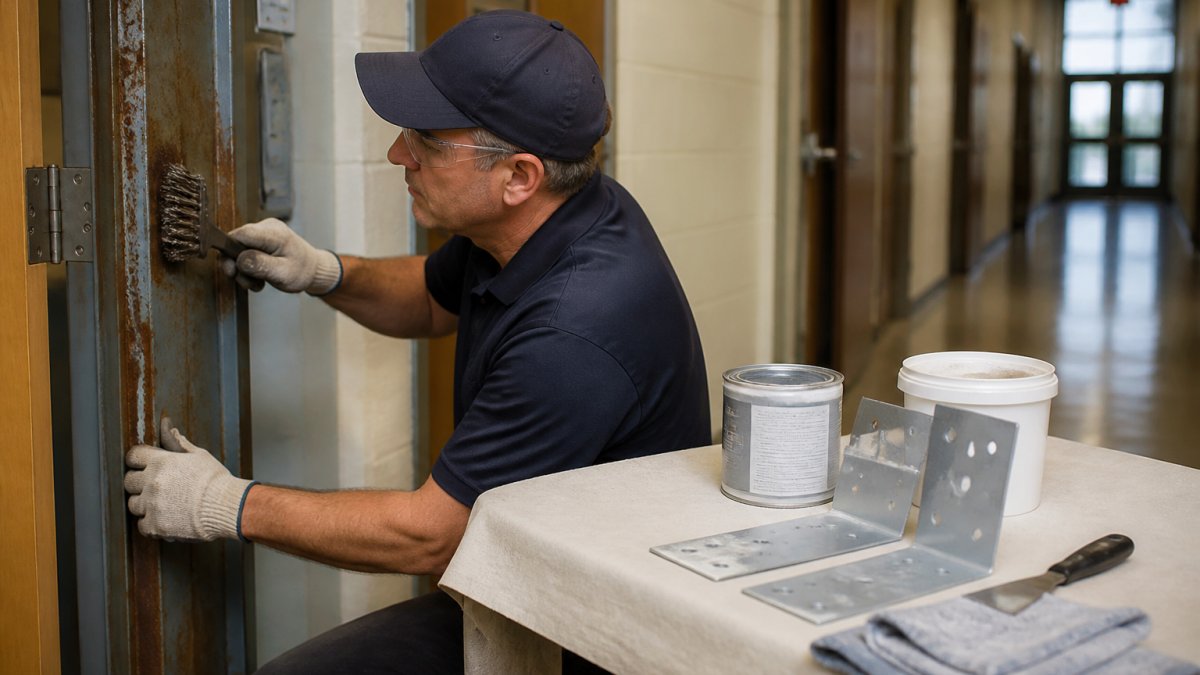
Step 1: Assess the damage. Examine the frame to determine how much rust is present and whether it has compromised structural integrity.
Step 2: Remove loose rust. Use a wire brush or light grinding to remove actively flaking rust until you reach solid steel.
Step 3: Clean and dry the frame. Wipe away rust dust and any debris. Allow the frame to dry completely. If moisture remains, corrosion will continue under the repair kit.
Step 4: Install the repair kit. Position the reinforcement plate or jamb patch over the damaged area, aligning it with pre-marked holes or a template.
Step 5: Seal and protect. Apply a protective coating or sealant around the edges of the repair kit to prevent moisture from entering. This stops future corrosion at the repair boundary.
Installation, Compatibility, and Security Standards
Installing door hardware alternatives requires understanding how frames are measured and what compatibility factors matter, since a kit that fits one frame may not fit another that appears similar.
Door Thickness, Backset, and Hole Diameter Compatibility
Door frames come in standard thicknesses, most commonly 1⅜, 1¾, and 2¼ inches. Thickness determines which kits fit: a kit designed for a 1¾-inch frame won't install properly on a 1⅜-inch frame because the fasteners won't align.
Backset is the distance from the door's edge to the center of the lock hole; standard backsets are 2⅜ and 2¾ inches. It determines where the lock and latch sit on the frame, which affects where the reinforcement plate must be located.
Hole diameter refers to the holes drilled for fasteners, standardly ⅜ inch and ½ inch. The kit's fasteners must match these sizes, or new holes must be drilled.
Before ordering, measure frame thickness, identify the backset, and note the existing hole diameter to ensure the kit installs correctly without modification.
Security Performance and Long-Term Durability
A properly installed repair kit restores security performance to near-original condition: the reinforcement plate distributes impact force more effectively than the original frame material, making forced entry harder.
Long-term durability depends on material and maintenance. Stainless steel kits maintain integrity indefinitely in normal conditions; steel kits need periodic inspection to keep the protective coating intact; aluminum kits benefit from occasional cleaning to prevent corrosion recurrence.
Inspect the fasteners annually: vibration from door use can loosen them over time, and periodic tightening extends the kit's service life and maintains security performance.
Cost Comparison: Repair Kits vs. Full Door Hardware Replacement
The economics of repair versus replacement are straightforward. A repair kit costs a fraction of a new frame, and labor time is significantly lower.
Full frame replacement requires removing and disposing of the old frame, installing a new one, adjusting hinges and closers, and finishing trim and paint.
A repair kit requires: assessing damage, removing loose rust, installing the kit, and sealing. This takes 2-4 hours and can often be done while the facility remains open. The kit itself costs less than the labor for a single frame replacement.
For a facility with multiple damaged frames, the difference is dramatic: 40 rusted doors could mean substantially more spent on 40 full replacements, or systematic repair with kits at a fraction of the cost.
Door Innovation's repair kits are engineered specifically for this scenario. The Jamb Patch and Jamb Anchor products address the most common damage patterns in commercial facilities.
| Approach | Time per Door | Material Cost | Labor Cost | Total per Door | Facility Downtime |
|---|---|---|---|---|---|
| Repair Kit | 2-4 hours | Lower | Lower | Significantly lower | Minimal |
| Full Replacement | 6-8 hours | Higher | Higher | Significantly higher | 6-8 hours |
Common Mistakes When Selecting Door Hardware Alternatives
Facility managers often make predictable mistakes when choosing between repair and replacement. Understanding them prevents costly decisions.
Mistaking surface rust for structural damage. Light surface rust looks alarming but often doesn't affect structural integrity, yet managers sometimes order full replacements for frames a simple kit could repair.
Choosing the wrong material for the environment. A humid coastal facility needs stainless steel or coated materials; uncoated steel there guarantees corrosion recurrence within months.
Installing a kit that doesn't match the frame specifications. A kit for a 1¾-inch frame won't install on a 1⅜-inch frame.
Neglecting to clean rust before installing the kit. Loose rust prevents fasteners from seating and lets corrosion continue beneath the kit.
Assuming all repair kits are equivalent. Door Innovation's Jamb Patch and Jamb Anchor products are engineered for the damage patterns commercial facilities encounter most frequently.
Choosing the right door hardware alternative depends on your facility's situation: extent of damage, frame material, environmental conditions, and volume of damaged doors all factor in.
Door Innovation specializes in this exact scenario. The three-step installation process means your maintenance staff can complete repairs without specialized training, and the kits restore security and appearance without the cost and downtime of full frame replacement. Order Now and extend the life of your existing door systems while keeping your facility safe and presentable.
Frequently Asked Questions
What is the difference between a door reinforcer and a jamb repair kit?
A door reinforcer, such as a wrap-around plate, protects the area around locks and latches from break-in damage and wear. A jamb repair kit addresses structural damage to the door frame itself, such as rust or corrosion. Reinforcers are preventive; repair kits fix existing damage. Many facilities use both: repair kits to restore compromised frames and reinforcers to protect the repaired area long-term.
Can a damaged commercial door frame be repaired without replacing it?
Yes. Door frame repair kits designed for rusted steel and corroded aluminum frames restore structural integrity without full replacement. These solutions work for moderate damage and are installed in a simple three-step process. However, severe structural compromise may still require replacement. Assess the extent of rust or corrosion first, if the frame is still sound underneath the surface damage, repair kits are effective and cost-efficient.
Do door hardware alternatives work on both steel and aluminum frames?
The specific product matters. Jamb repair kits may be formulated differently for steel versus aluminum due to their different corrosion patterns. Check product specifications for your frame material.
How much can I save by using door frame repair kits instead of full replacement?
Savings depend on frame condition, labor costs, and volume. A repair kit reduces material costs compared to a full frame replacement. Labor time is also shorter, installations can be handled by standard maintenance staff, no specialized training required. For facilities managing 40+ doors with rust issues, kit-based repairs across multiple units offer significant savings compared to full replacements, plus you avoid facility downtime and disruption.