
How to Stabilize Hollow Metal Door Frames in High Traffic
Table of Contents
- Why High-Traffic Openings Loosen Hollow Metal Door Frames
- Tools and Materials You'll Need Before You Start
- Step-by-Step: How to Stabilize Hollow Metal Door Frames
- Commercial Hollow Metal Door Frame Repair by Wall Type
- Choosing a Door Jamb Repair Kit for High-Traffic Doors
- Loose Metal Door Frame Repair: When to Patch vs. Replace
- Hollow Metal Frame Anchor Repair for Long-Term Stability
- Preventive Maintenance and Inspection Intervals
- Frequently Asked Questions
Last Updated: October 20, 2026
Why High-Traffic Openings Loosen Hollow Metal Door Frames
A hollow metal door frame is a steel or aluminum frame that holds a commercial door in a wall opening, and it stays rigid only as long as its anchors grip the wall. High-traffic openings test that grip every hour. Carts clip the jamb, doors slam, and the frame flexes slightly with each pass.
Over time, that constant flexing works the fasteners loose. At Door Innovation, we see this pattern most often at entrances near loading docks, break rooms, and main corridors.
Water and cleaning solutions speed up the problem. They corrode the anchor points until the frame no longer holds tight.
Diagnosing the Source of Frame Movement
Find the movement before you fix it. Grab the hinge jamb near the top hinge and push gently. If the whole frame shifts, the anchors are loose. If only the door moves, the problem is in the hinges or the door itself.
Next, check the header for gaps against the wall. A gap that opens and closes as the door swings points to anchor failure, not a bad door.
Watch one full open-and-close cycle. Note where the frame moves and where it stays firm. That tells you which jamb needs work.
Tools and Materials You'll Need Before You Start
Gather everything first so the repair runs in one pass. Here is what we recommend having on hand:
- A 4-foot level and a framing square
- A screwdriver set and a drill
- Metal shims in several thicknesses
- A spreader bar to hold the frame square
- Replacement anchor screws
- Bondo body filler and a putty knife
- Safety glasses and gloves
The Bondo is the slow part. Mixing takes a minute, but curing takes real time. Plan the rest of the job around that wait.
Step-by-Step: How to Stabilize Hollow Metal Door Frames
Stabilizing hollow metal door frames in high traffic areas comes down to three checks: square, shim, and anchor. Work through them in order and you fix the cause, not just the symptom.
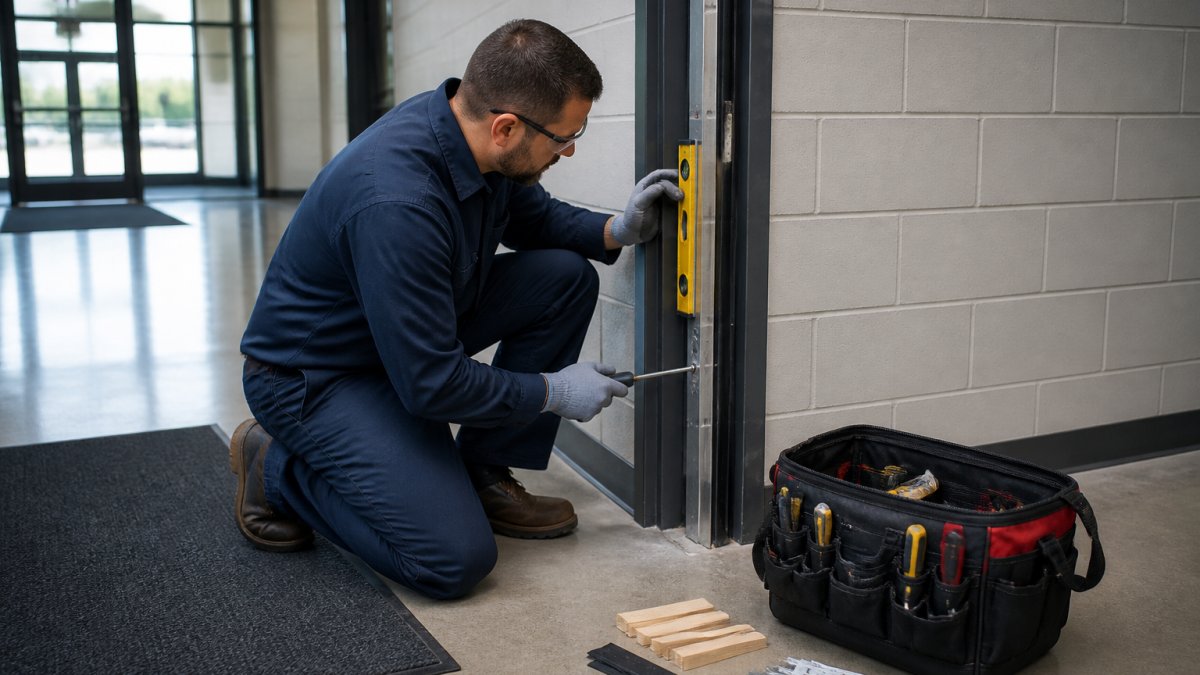
Step 1: Check Square, Plumb, and Level
Set your level against the hinge jamb and check plumb. Then check the header for level. Finally, measure both diagonals of the opening. If the two diagonal measurements match, the frame is square.
A frame that is out of square will fight every door swing. Correct it before you tighten anything.
Step 2: Correct Shimming and Edge Clearance
Slide shims behind the jamb at each anchor point. Push them in until the frame sits tight and the reveal gap around the door is even.
Check the edge clearance at the latch side. A door that rubs the strike jamb needs the frame pulled back slightly. Small shim changes make a big difference here.
Step 3: Secure the Hinge Jamb and Strike Jamb
Tighten the anchor screws at the hinge jamb first, working from the bottom hinge up. Then repeat at the strike jamb.
If the screw holes are stripped, move up one size or use a repair anchor. Fill any gap behind the jamb with Bondo, then let it cure fully before hanging the door.
Commercial Hollow Metal Door Frame Repair by Wall Type
Repair methods change with the wall. In a masonry wall or CMU block, the frame anchors into the block, and loose anchors often mean the block itself has cracked. Grout behind the frame can restore the grip.
In a drywall or stud wall, the anchors bite into steel studs. Loose studs need backing before any anchor will hold.
Frame condition matters too. Light corrosion around the anchors is a patch job. Heavy corrosion that has eaten through the jamb calls for a different fix.
Choosing a Door Jamb Repair Kit for High-Traffic Doors
A door jamb repair kit restores the anchor point without pulling the frame out of the wall. That is the whole point for a busy opening: you keep the door in service and skip a full tear-out.
Look for three things in a kit:
- Anchors sized to your jamb type, side or center
- Hardware that matches your frame material
- Instructions a maintenance tech can follow without special training
At Door Innovation, our Jamb Anchor kits are built for exactly this job. The Jamb Anchor Side Jamb Kit re-anchors aluminum frames that have come loose from corrosion or repeated impacts. The Jamb Anchor Center Jamb Kit does the same for inboard jambs.


Both kits use a simple three-step install. No professional is required, and the repair adds years to an existing door system.
Loose Metal Door Frame Repair: When to Patch vs. Replace
Patch when the frame is sound and only the anchor has failed. Replace when the frame itself is bent, crushed, or rusted through. That is the short answer.
Use this quick guide to decide:
| Condition | Patch | Replace |
|---|---|---|
| Loose anchors, frame straight | Yes | No |
| Light surface rust at anchors | Yes | No |
| Bent or twisted jamb | No | Yes |
| Rust through the jamb face | No | Yes |
| Door rubs despite shimming | Check frame first | If frame is warped |
A patch costs far less than a full frame replacement and keeps the opening in use. Replacement makes sense only when the metal can no longer hold its shape.
Hollow Metal Frame Anchor Repair for Long-Term Stability
Hollow metal frame anchor repair is about restoring grip, not just tightening a screw. A stripped hole will not hold, no matter how hard you turn the driver. In a high-traffic opening, the repair also has to survive repeated impact and cycling, so the goal is a solid backing behind the jamb, not a bigger fastener in soft air.
Step 1: Remove the old fastener and inspect the hole. Back the screw out and look at the threads. Fine metal shavings or a hole that has enlarged tell you the original anchor has wallowed out. Clean the hole with a brush or compressed air so the new material can bond.
Step 2: Decide the repair method by condition. If the metal is sound and the hole is only slightly enlarged, step up one size in anchor screw. If the metal is thin, corroded, or the hole is badly wallowed, use a repair anchor that spreads the load across a wider area of the jamb face. If the block or stud behind the jamb is crumbled or soft, fix the backing first, no anchor will hold in loose material.
Step 3: Restore the backing with Bondo. Fill the void behind the jamb with Bondo body filler so the anchor has solid material to bite into. Pack it in with a putty knife, then let it cure completely before driving the new fastener. This is the slow part of the job, mixing takes a minute, but curing takes real time. Plan the rest of the repair around that wait.
Step 4: Re-anchor and verify. Drive the new anchor into the cured backing. Then run the acceptance checks: the jamb should not rock under hand pressure, the diagonals should match within about 1/8 inch, the door should close without rubbing, and the latch should engage smoothly. If any check fails, the backing or the anchor size is still wrong, fix it before the opening goes back into service.
Preventive Maintenance and Inspection Intervals
Check high-traffic openings on a set schedule, not when something breaks. We suggest a quick visual check every month and a hands-on check every quarter.
The monthly walk-through takes minutes:
- Push each jamb to test for movement
- Look for rust or water stains at the base
- Confirm the door closes without rubbing
- Check hinge screws for looseness
The quarterly check adds a level and square test. Catching a loose anchor early turns a big repair into a small one.
Frequently Asked Questions
How can I tell whether a hollow metal frame is loose or damaged?
Push against the jamb near the hinges and strike plate. Movement, rattling, or gaps at the wall line point to a loose frame. Check that the door latches cleanly and that hinges and strike plates sit flush. Look for rust, corrosion, or cracked paint around anchors and fasteners. A frame that shifts when the door swings is a loose metal door frame repair candidate, not a replacement job, in most cases.
Can a DIYer install a hollow metal door frame repair kit?
Yes. Door Innovation's Jamb Anchor kits are designed for DIY installation and do not require a professional. Each kit includes anchors, installation hardware, and instructions. The work itself is quick; the main time investment is waiting for Bondo to cure when patching. Maintenance staff can typically handle several openings in an afternoon once they've done one.
What causes a hollow metal door frame to loosen in a high-traffic area?
Repeated impacts from carts, equipment, and doors, plus corrosion from salts, water, and cleaning solutions, break down the original anchoring over time. High-traffic openings take constant force at the hinge jamb and strike jamb, and once fasteners lose grip, the frame shifts. Catching movement early and using a hollow metal frame anchor repair keeps the opening stable without a full replacement.
When should a hollow metal door frame be repaired or replaced?
Repair first when the frame is structurally sound but loose, corroded at the anchors, or out of alignment. A door jamb repair kit like the Jamb Anchor Side Jamb Kit ($119.00) or Center Jamb Kit ($119.00) re-anchors aluminum frames that have come loose from corrosion or impacts. Replace only when the frame itself is bent, cracked, or too deteriorated to hold an anchor.
High-traffic doors will always take a beating. The question is whether a loose frame turns into a full replacement or a quick repair. At Door Innovation, we built the Jamb Anchor kits so your own maintenance team can re-anchor a failing frame in three steps and get the door back in service fast. Order the Side Jamb or Center Jamb kit that matches your opening and stop replacing frames that only needed an anchor.