
Steel vs Aluminum Door Frame Durability for High Traffic
Last Updated: October 22, 2026
Quick Summary
Steel wins door frame durability for high-traffic interior openings because it resists impact and keeps hinges and latches aligned, while aluminum resists corrosion better in humid, coastal, and exterior exposures. Steel fails through rust at the jamb base; aluminum fails at anchors, thresholds, and dented strike sides.
- Judge a frame by deflection, cycle performance, and strike and hinge reinforcement, not the material name alone.
- Rust confined to the lower few inches of a steel jamb is usually repairable in place.
- Inspect steel jamb bottoms quarterly and aluminum strike sides for denting and latch alignment.
- Check aluminum thresholds and anchors twice a year, since corrosion starts there first.
- A bent frame or compromised wall needs full replacement, not a patch.
Table of Contents
- Steel vs Aluminum Door Frame Durability: A Direct Comparison
- Steel Door Frame Impact Resistance in High Traffic Areas
- Aluminum Door Frame Corrosion Resistance and Environmental Exposure
- Commercial Hollow Metal Door Frame Repair: What Facility Managers Miss
- Repair vs Replace Commercial Door Frame: Cost and Downtime
- Maintenance Schedules and Failure Modes for Steel and Aluminum Frames
- Which Material Wins for Your Building Type and Traffic Level?
- Frequently Asked Questions
Steel vs Aluminum Door Frame Durability: A Direct Comparison
Door frame durability comes down to one question: which material holds its shape, hardware, and security after years of daily abuse? Steel wins on impact resistance and structural stability. Aluminum wins on corrosion resistance and weight. That trade-off drives nearly every decision facility managers make about high-traffic openings.
This guide from Door Innovation breaks down how each material actually performs, where each fails, and when repair beats replacement. We build and sell frame repair kits, so we have a strong opinion about one thing most guides skip: a rusted steel frame usually does not need to come out of the wall.

Quick Comparison Table
| Factor | Steel Door Frame | Aluminum Door Frame |
|---|---|---|
| Impact resistance | High; resists denting and deformation | Lower; dents and bends more easily |
| Weight | Heavy; needs more labor to handle | Lightweight; easier to install |
| Corrosion resistance | Poor without protective treatment | Strong; naturally resists rust |
| Best environment | Interior, high-traffic, secure entries | Humid, coastal, exterior exposures |
| Common failure | Rust at the bottom of the jamb | Corrosion at anchors and thresholds |
| Maintenance load | Repainting and rust checks | Finish inspection and cleaning |
Steel Door Frame Impact Resistance in High Traffic Areas
Steel door frame impact resistance is the material's biggest advantage, and it shows up fastest at the strike and hinge sides. But "steel is stronger" is not a durability argument on its own. What matters in a high-traffic opening is how the frame behaves under repeated, measurable loads: door cycles per day, cart and gurney strikes, forced-entry attempts, and the constant torque of a closer pulling the door shut.
What to actually measure
When comparing steel and aluminum frames for a high-traffic opening, practitioners tend to look at four things rather than a single strength claim:
- Deflection under load. How far the jamb or head moves when a door is slammed or a cart hits the strike side. Less deflection means the latch keeps engaging and the hinges stay aligned.
- Cycle performance. How the frame and its anchors hold up after tens of thousands of open/close cycles. This is where anchoring and reinforcement matter more than raw metal thickness.
- Impact resistance at the strike and hinge. These are the two points that take the most abuse. A frame with a reinforced strike and heavy-gauge hinge reinforcement survives far better than a thin frame of the same material.
Why steel usually wins on these measures
A hollow metal steel frame absorbs cart traffic, door slams, and forced-entry attempts without losing its shape. That rigidity keeps hinges aligned and latches engaging, which is what security actually depends on.

But steel frames are not interchangeable. Gauge, hinge and strike reinforcement, and anchor type vary widely. A light-gauge steel frame with minimal reinforcement can deflect and loosen in a high-traffic opening just as an aluminum frame can.
Where steel frames actually fail
The weakness is at the bottom. Moisture wicks into the jamb base, paint fails, and rust starts. That rust is almost always cosmetic and structural damage confined to the lower few inches, not a reason to tear out the whole frame. Catching it early is the difference between a small patch and a major repair.
The aluminum comparison on impact
Aluminum frames are lighter and easier to handle, but they dent and bend more readily under repeated cart impact. In a high-traffic interior where the strike side takes constant hits, denting can distort the latch opening faster than corrosion ever would.
The practical takeaway: judge a frame by its deflection, cycle performance, and reinforcement at the strike and hinge, not by the word "steel" on the spec sheet.
Aluminum Door Frame Corrosion Resistance and Environmental Exposure
Aluminum door frame corrosion resistance is genuinely strong, which is why aluminum shows up in humid, coastal, and exterior openings. The metal forms its own protective oxide layer, and a powder coating adds a second barrier.
They corrode differently. Salt air, standing water at the threshold, and galvanic contact with steel anchors eat into aluminum over time. The finish also scratches and fades under heavy use.
Commercial Hollow Metal Door Frame Repair: What Facility Managers Miss
Most facility managers do not know that a damaged commercial hollow metal door frame can be repaired instead of replaced.
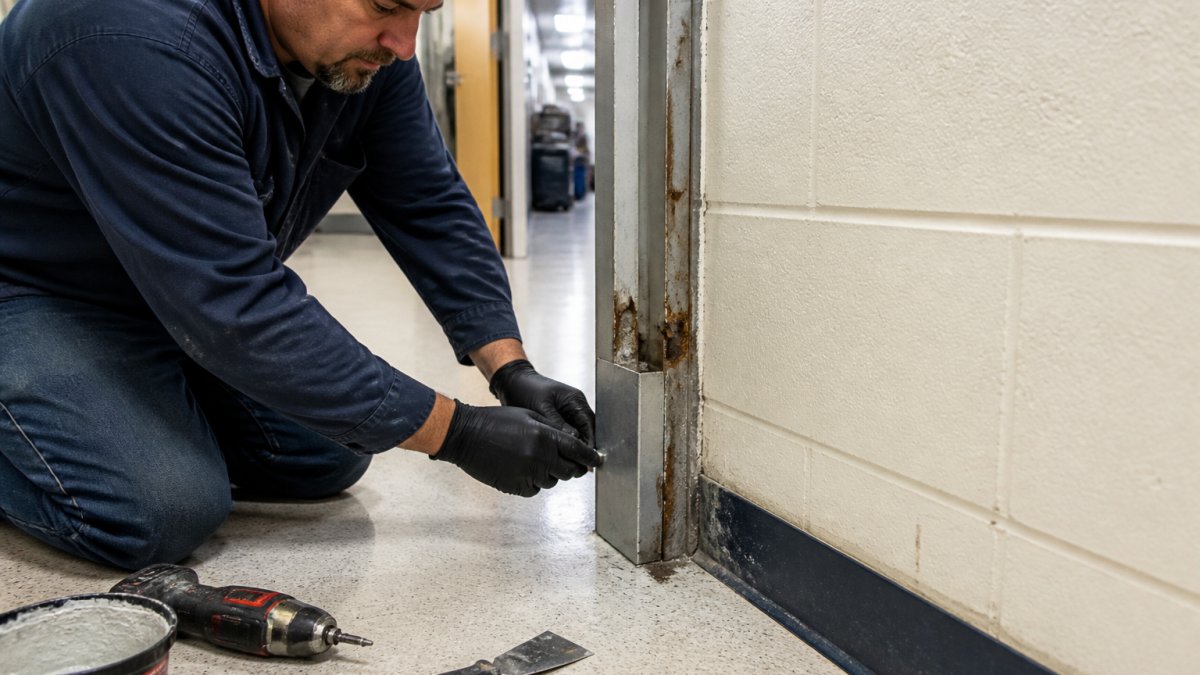
The repair option is a patented patch that fits over the damaged section. Door Innovation's Jamb Patch is built for exactly this job, and it is designed to be installed by someone that is a DIY type of person.
Repair vs Replace Commercial Door Frame: Cost and Downtime
The repair vs replace commercial door frame decision usually comes down to scope. A full replacement means removing the frame, repairing the surrounding wall, reinstalling, repainting, and rehanging the door.
Jamb Patch - Jamb Anchor Catalogue →
A patch repair keeps the existing frame, skips the wall work, and restores the damaged section in place. Our Jamb Patch Kit runs $130.37, and the Strike Side and Hinge Jamb Patches run $180.91 each.

| Situation | Best Move | Why |
|---|---|---|
| First sign of rust | Jamb Patch Kit | Stops damage early, lowest cost |
| More than 2" of rust at the bottom | Strike or Hinge Jamb Patch | Restores the full damaged section |
| Frame bent or wall compromised | Full replacement | Patch cannot fix structural failure |
Maintenance Schedules and Failure Modes for Steel and Aluminum Frames
A simple inspection schedule prevents most frame failures, but the schedule only works if the inspector knows what to look for and what each finding means. Most guides list failure modes without explaining the mechanism behind them, which is why small problems get misread as either harmless or catastrophic. Here is a practical, mechanism-first approach.
Steel frame failure modes
Steel fails from the bottom up, and the mechanism is predictable:
- Paint failure at the jamb base. Moisture from mopping, spills, and humid air collects at the bottom of the jamb. The paint film breaks down first.
- Surface rust. Once paint fails, bare steel oxidizes. Surface rust is cosmetic and does not compromise the frame.
- Section loss. If ignored, rust eats into the metal, thinning the jamb. This is the point where the frame's structural capacity starts to drop.
- Hinge and strike compromise. Rust reaching the hinge pocket or strike plate changes how hardware seats, and the door stops latching cleanly.
The key inspection question is not "is there rust?" but "how much metal has been lost, and where?" Rust confined to the lower few inches of the jamb is usually repairable in place. Rust that has reached the hinge pocket or strike plate, or that has thinned the jamb enough to flex, is a different problem.
Aluminum frame failure modes
Aluminum fails differently, and the failure points are less visible:
- Corrosion at anchors and thresholds. Standing water and galvanic contact with steel fasteners attack aluminum at the contact points first, often before anything shows on the visible face.
- Finish breakdown. Powder coating scratches and fades under heavy use, exposing bare aluminum.
- Denting at the strike side. In high-traffic interiors, repeated cart impact dents the face and can distort the latch opening.
A practical inspection schedule
| Interval | Steel frames | Aluminum frames |
|---|---|---|
| Quarterly | Bottom of each jamb: paint condition, surface rust, metal loss | Strike side: denting, latch alignment |
| Twice a year | Hinge pockets and strike plates: rust, hardware seating | Thresholds and anchors: corrosion, loose fasteners |
| Annually | Full frame: deflection, anchor tightness, door alignment | Full frame: finish condition, galvanic contact points |
Wipe and inspect hardware at the same time. A sticking door or a loose hinge is often the first visible sign of a frame problem that started lower down.
Matching the fix to the failure mode
Steel fails from the bottom up through rust. Aluminum fails at contact points through corrosion and at the face through denting. Matching the fix to the failure mode keeps small problems small. Localized rust at the base of a steel jamb can be repaired in place; a bent frame or a compromised wall needs replacement. The inspection schedule is only useful if it leads to the right repair decision at the right time.
Which Material Wins for Your Building Type and Traffic Level?
Steel wins for high-traffic interior commercial entries where security and impact resistance matter most. Aluminum wins for humid, coastal, and exterior openings where corrosion resistance is the priority. Neither material is universally better, and a mixed building often needs both.
Here is how we would decide:
- High-traffic interior, secure entry: steel frame, with quarterly rust checks.
- Humid or coastal exposure: aluminum frame, with anchor inspections.
- Existing rusted steel frame: repair with a Jamb Patch before considering replacement.
Frame damage rarely announces itself. It shows up as a sticking door, a loose hinge, or rust creeping up a jamb, and by then the opening is a liability.
Frequently Asked Questions
Are steel or aluminum door frames more durable in high-traffic areas?
Steel frames generally handle impact and forced entry better because the material resists denting and deformation under repeated hits. Aluminum frames are lighter and resist corrosion, but they can bend or dent more easily when struck. For high-traffic commercial entries like schools or hospitals, steel is usually the stronger choice for door frame durability. Aluminum works well in lighter-use or humid environments where rust prevention matters more than impact strength.
Can a damaged hollow metal door frame be repaired instead of replaced?
Yes. Commercial hollow metal door frame repair is possible when rust or corrosion is caught before it compromises the structural integrity. Patented Jamb Patch kits from Door Innovation are designed for this exact repair and can be installed by a DIY-oriented maintenance person without a professional. The Jamb Patch Kit (4") at $130.37 handles early rust, while Strike Side and Hinge Jamb Patch kits at $180.91 each address more than 2 inches of rust at the bottom of the frame.
How does corrosion affect steel and aluminum door frames?
Steel frames rust when moisture reaches bare metal, usually at the bottom where water pools and road salt collects. Aluminum frames resist rust but can still corrode in coastal or chemical-heavy environments, forming a white powdery oxidation. Both materials benefit from protective treatments like galvanizing or powder coating. Catching corrosion early is key: the Jamb Patch Kit (4") is designed for first-sign rust, while larger patches handle advanced damage.
What maintenance helps commercial door frames last longer?
Inspect the bottom 6 inches of every frame quarterly for rust, bubbling paint, or white oxidation. Keep thresholds and weatherstripping sealed so water cannot pool. Touch up scratched paint on steel frames and reapply protective coatings as needed. For high-traffic openings, check hinge and strike plates for looseness and tighten hardware regularly. When rust appears, repair it early with a kit like the Jamb Patch Kit (4") rather than waiting for structural damage that forces a full replacement.
Do Jamb Patch kits work on both steel and aluminum frames?
The Jamb Patch is designed for commercial hollow metal door frames, which are typically steel. Door Innovation's catalogue covers repair products for rusted and corroded metal door frames, and the product listings specify compatibility with steel frames from manufacturers like Steelcraft, Ceco, Curries, and Mesker. If your building has a mix of steel and aluminum doors, check the catalogue at doorinnovation.com to confirm which kit matches each frame type before ordering.