
9 Signs of Water Damage in Door Jambs to Catch Early
Last Updated: November 4, 2026
Quick Summary
The signs of water damage in door jambs include discoloration and water stains at the base, bubbling paint, soft spots, warping, rust at the bottom of a steel frame, white chalky residue, peeling caulking, sticking doors, and daylight or drafts under the threshold. Discoloration is the earliest and most reliable sign, so check the base of the jamb first.
- Press the jamb with a screwdriver handle; if the metal gives, structural integrity is already compromised.
- A pin-type moisture meter reads the base, then 6 and 12 inches up, plus the caulking line and threshold.
- A base reading several points above a known-dry reference point means active moisture in the frame.
- Repair a rusted jamb by cleaning to bare metal, treating with rust converter, then bonding a patch with Bondo.
- Replace the frame when it is bent, racked, out of plumb, or the anchors are failing.
Table of Contents
- Why Door Jambs Show Water Damage First
- 9 Visible Signs of Water Damage in Door Jambs
- How to Find Hidden Moisture Before Rot Sets In
- Causes of Door Frame Rot and Seepage
- How to Fix Rusted Door Jambs on a Commercial Frame
- Commercial Hollow Metal Frame Repair vs. Full Replacement
- Stopping the Next Leak: Maintenance That Actually Works
- Order the Jamb Patch Kit That Matches Your Damage
- Frequently Asked Questions
Why Door Jambs Show Water Damage First
Water damage in door jambs is the corrosion, staining, or soft material that appears where moisture collects at the bottom of a door frame.
The bottom of the jamb takes the hit while the rest of the frame stays sound.
The signs of water damage in door jambs are easy to read once you know what to look for.
Watch out: most facility teams replace an entire frame when only the bottom few inches have failed.
9 Visible Signs of Water Damage in Door Jambs
The nine signs below are what you will actually see on a commercial frame. Check the base first, then work upward.
- Discoloration and water stains at the base
- Bubbling paint or cracked coating
- Soft spots when you press the metal
A common mistake is to paint over these signs. Paint hides the symptom and traps the moisture inside.
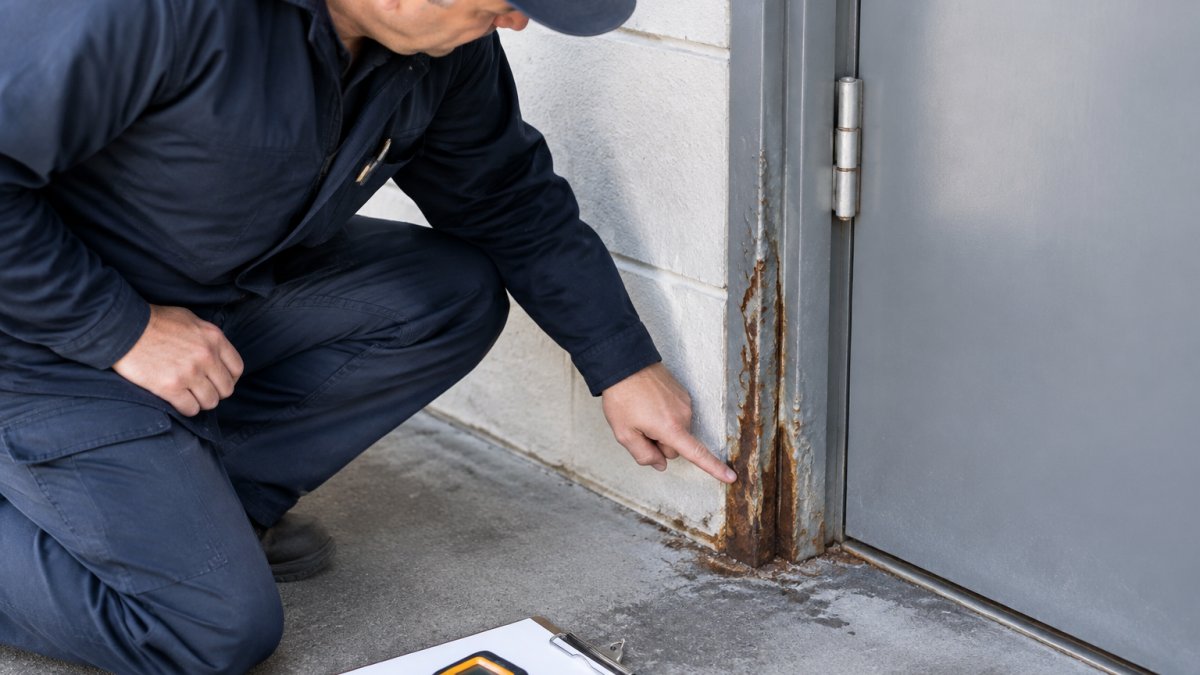
Discoloration and Water Stains at the Base
Discoloration is the earliest and most reliable sign. Look for brown, orange, or dark streaks running up from the floor line.
On a steel frame, these streaks usually mean rust is bleeding through. On the painted face, water stains show as dull patches that will not wash off.
Bubbling Paint, Soft Spots, and Warping
Bubbling paint means moisture is pushing out from behind the coating. Press the area with a screwdriver handle. If the metal gives, the structural integrity is already compromised.
Warping shows as a jamb face that is no longer flat. A warped jamb throws off the door alignment, so the door drags or will not latch.
Rust at the Bottom of a Steel Frame
Rust at the bottom of a steel frame is the clearest sign of all. It starts as surface orange and turns to flaking scale.
Once you see more than a thin patch, the frame has been wicking moisture for a while. That is where a repair kit makes sense, and we cover that below.
How to Find Hidden Moisture Before Rot Sets In
Hidden moisture is water trapped inside the frame that has not yet shown on the surface. By the time rust or bubbling paint is visible, the cavity has usually been wet for months. A moisture meter is how you catch it earlier, and it is the one tool most guides skip.
Reading a Pin-Type Moisture Meter on a Steel Frame
A pin-type meter drives two small pins into the material and measures electrical resistance between them. Water conducts, so wetter material reads higher. On a painted steel frame you are not really reading the steel, you are reading the coating, the caulking, and any wood blocking or shim material behind the face.
Take readings in this order:
- Pick a known-dry reference point. The upper third of the same jamb, well above any splash zone, is your baseline. Note the number.
- Work up from the floor in 6-inch increments. Read at the base, then 6 inches up, then 12 inches up, on both the face and the return of the jamb.
- Read the caulking line and the threshold. These are the entry points, so they often read wet even when the jamb face looks fine.
- Read the drywall or masonry beside the frame. If the wall reads wet next to a dry frame, the water is coming from the wall, not the door.
A common pattern is a sharp jump between the base reading and the 12-inch reading. That gradient tells you the water is wicking up from the floor line rather than condensing inside the cavity.
What the Numbers Actually Mean
Meter scales vary by manufacturer, so treat the reference reading as your anchor rather than chasing an absolute number.
Watch out: pins leave tiny holes in paint, and every hole is a future corrosion site on a steel frame. Probe the caulking and the floor line where the damage is already suspect, not the pristine face you are trying to protect.
Confirming What the Meter Tells You
A meter flags a suspect zone; it does not tell you how far the damage runs. Confirm with three cheap checks:
- Tap the jamb face with a screwdriver handle. A dull thud instead of a sharp ring means the metal behind is scaled or the cavity is packed with debris.
- Press the caulking at the base. If it moves or crumbles, water has been getting behind it.
- Look under the threshold for dark, damp concrete, subfloor, or sill pan residue. Standing water there feeds the jamb from below.
FEMA guidance on moisture and flood damage
Once the meter and the tap test agree, you know whether you are looking at surface staining or a frame that needs the bottom section repaired.
Causes of Door Frame Rot and Seepage
Door frame rot and seepage come from water that gets in and cannot get out. The source is rarely the frame itself.
- Failed caulking at the base lets water behind the jamb
- A missing or blocked sill pan lets water pool at the threshold
- Bad flashing above the head casing sends water down the frame
Steel frames rust from the inside out. The moisture sits in the hollow cavity, so the damage is worse than the outside suggests. Our guide on why steel door frames really rust explains how that trapped moisture starts the corrosion.
How to Fix Rusted Door Jambs on a Commercial Frame
You can repair a rusted jamb without a contractor.
Here is how to fix rusted door jambs in six steps:
- Clean the rusted area down to bare metal with a wire brush or grinder.
- Treat the remaining rust with a rust converter and let it dry.
- Dry-fit the patch over the damaged section to check the fit.
- Apply Bondo to fill and bond the patch to the frame.
- Clamp and let the Bondo cure. This is the step that takes time.
- Sand, prime, and paint to match the frame.
The install itself moves quickly. The wait is the Bondo cure, so plan the job around that.
Watch out: skip the rust converter and the new patch will fail at the same seam within a season.
For the full walkthrough, see our step-by-step rusted door frame guide and the patch kit installation guide.
Commercial Hollow Metal Frame Repair vs. Full Replacement
The decision comes down to one question: is the damage localized to the bottom of the jamb, or has the frame itself lost its shape or its anchor to the wall? Everything else follows from that.
Check the Frame Before You Check the Damage
Run these four checks before you price anything. They separate a repairable frame from a replacement job.
- Plumb and square. Hold a level against the hinge jamb and the strike jamb. A frame that is out of plumb by more than a slight lean has moved, and a patch will not fix a moved frame.
- Anchor integrity. Look for cracks in the wall at the frame corners, loose masonry anchors, or a frame that flexes when the door is swung. Failing anchors mean the opening itself is compromised.
- Head and hinge condition. If the head casing or the hinge reinforcement plates are bent, cracked, or pulled loose, the damage is no longer at the bottom.
If all four checks pass and the damage is rust, scale, or soft metal in the bottom few inches of the jamb, repair is the right call. That is the majority of commercial frames we see: the bottom takes the hit while the head, hinges, and anchors stay sound.
What Repair Actually Involves
A bottom-jamb repair on a hollow metal frame means cutting back to sound metal, treating the rust, bonding a formed patch into place, and refinishing. The Jamb Patch is a patented kit made for exactly this job on commercial hollow metal frames, and it is designed to be installed by a DIY-capable maintenance tech with basic tools, no door contractor required.
When Replacement Is the Honest Answer
Replace the frame when any of the following is true:
- The frame is bent, racked, or out of plumb
- Anchors are failing or the wall opening is cracked
- The head casing or hinge reinforcement is damaged
In those cases a patch is cosmetic on a frame that has already lost structural function, and it will fail again.
| Factor | Bottom-Jamb Patch Repair | Full Frame Replacement |
|---|---|---|
| Scope | Bottom of jamb only | Entire frame and opening |
| Installer | Any DIY-capable maintenance tech | Door contractor |
| Downtime | Short, one opening | Longer, wall work involved |
| Frame condition required | Plumb, square, anchors sound | Any condition |
| Best for | Localized rust or corrosion at the base | Bent, racked, or failing frame |
The upper frame and head casing are usually fine, which is why the four checks above matter more than the damage photo.
Our comparison of repair vs. replace for rusted commercial doors breaks down the decision in more detail.
Stopping the Next Leak: Maintenance That Actually Works
Prevention is a short checklist you run twice a year. It costs almost nothing and it stops the cycle.
- Re-caulk the base and threshold every fall
- Clear weep holes and the sill pan of debris
- Check flashing above the head casing
A little upkeep on the caulking and flashing line is what keeps the jamb dry. Do that and the frame lasts far longer.
OSHA walking-working surfaces standard for door openings
Order the Jamb Patch Kit That Matches Your Damage
Match the kit to how much rust you have. That is the whole decision.
- Jamb Patch Kit (4") for the first sign of rust. Two 4-inch non-handed patches, $130.37.
- Strike Side Jamb Patch for more than 2 inches of rust on the strike side. One 21-5/8" non-handed patch, $180.91.
- Left Hand Hinge Jamb Patch for the hinge side, more than 2 inches of rust. $180.91.
All four fit many masonry frames from major US manufacturers, and all carry the same patent. Browse the full Jamb Patch collection to pick the one that matches your damage.
Every kit is designed to be installed by a DIY-minded maintenance tech, without a professional installer.
Frequently Asked Questions
How can I tell if my commercial door frame has water damage?
Check the bottom 6 to 12 inches of the jamb first. Look for discoloration, bubbling paint, rust bleeding through the steel, and soft spots you can press with a screwdriver. Run a moisture meter along the jamb and the subfloor seam; readings that stay high after a dry week point to moisture still getting in. Also open and close the door: a frame that suddenly sticks or swings differently often has a swollen or warped jamb behind it.
Can water-damaged door jambs be repaired without full frame replacement?
On commercial hollow metal frames, often yes. If rust is limited to the lower section of the jamb, a patch system restores that area without tearing out the whole frame. Door Innovation's Jamb Patch Kit ($130.37) handles early rust, while the Strike Side and Hinge Jamb Patches ($180.91 each) are the right call when more than 2 inches of rust is visible. The kit installs with basic hand tools, so your own maintenance staff can do the work.
Why does rust keep appearing at the bottom of my commercial door jamb?
Water pools at the base of the opening. A missing or failed sill pan, cracked caulking, worn weatherstripping, and splash from outside all push moisture into the seam where the frame meets the floor. Steel wicks that moisture and rusts from the inside out, so you see the damage late. Fix the water path first, then repair the metal, or the rust returns within a season.
How do I know if the damage is permanent or just surface level?
Probe it. Surface staining wipes away and the metal underneath is solid. Permanent damage means the steel has thinned, flaked, or lost its shape, or wood has gone soft and crumbly under the paint. A moisture meter reading that stays elevated after drying, plus a screwdriver that sinks into the jamb, tells you the material is compromised. At that point, patching the affected section is the practical fix.
Rusted door jambs do not have to mean a full frame replacement. Door Innovation built the Jamb Patch as a cost-effective fix for commercial hollow metal frames, with a simple install and a DIY-friendly process. The kits save time and money, keep openings safe and presentable, and extend the life of the frames you already have. Get started with Door Innovation and repair your rusted jambs without tearing out the frame.
