
Best Paint for Steel Door Frames: A Practical Guide
Last Updated: October 29, 2026
Quick Summary
The best paint for steel door frames is a bonding primer topped with acrylic latex for most interior frames, or oil-based or urethane enamel for heavy-wash and exterior areas. Always run an adhesion test first, since the finish fails if it bonds to old paint that is already lifting.
- Acrylic latex dries fast and cleans up with water, but it needs a bonding primer on steel.
- Oil-based and urethane enamels level to a harder finish and resist scrubbing in kitchens and restrooms.
- Score a 1-inch grid and pull tape to test whether existing frame paint is sound.
- Use a 1-inch angled sash brush and apply two thin coats rather than one heavy coat.
- Rehang the door only after the frame paint is hard enough to resist contact.
Table of Contents
- Why Steel Door Frames Need a Different Paint Approach
- Acrylic Latex vs. Oil-Based Paint: Which Holds Up on Metal
- Choosing the Right Primer for Steel Door Frames
- How to Paint a Metal Door Frame: Step-by-Step
- Paint Cure Time for Metal Frames and When to Rehang the Door
- When Commercial Hollow Metal Frame Repair Beats Repainting
- Matching Sheen and Paint to High-Traffic Commercial Frames
- Order the Right Jamb Patch Kit for Your Frame
- Frequently Asked Questions
Why Steel Door Frames Need a Different Paint Approach
Steel door frames fail at the paint layer long before the steel itself gives out.
Steel door frames are galvanized, galvannealed, or cold-rolled steel, and each surface holds paint differently. Factory primer is a thin, protective layer, not a finish coat.
Here is the part most guides skip: on a commercial opening, the frame takes more abuse than the door.
Acrylic Latex vs. Oil-Based Paint: Which Holds Up on Metal
Acrylic latex is a common choice for interior steel door frames because it dries quickly and cleans up with water. To judge how well a coating will hold up, it helps to know which steel frame materials you are painting and how each one behaves.
Oil-based paint and urethane enamel still have a place. They level out to a harder, smoother finish and resist scrubbing better in heavy-wash areas like kitchens and restrooms. The trade-off is slower drying, stronger fumes, and a finish that can crack as it ages.
| Paint Type | Adhesion on Steel | Dry Time | Best Use | Watch Out For |
|---|---|---|---|---|
| Acrylic latex | Good with primer | Fast | Most interior frames | Needs a bonding primer |
| Water-based enamel | Good | Fast | High-traffic interiors | Check recoat window |
| Oil-based enamel | Strong | Slow | Wash-down areas | Fumes, yellowing |
| Urethane enamel | Strongest | Slow | Exterior exposure | Higher cost |
A common mistake is buying "door and trim" paint and assuming it is rated for metal. Many are formulated for wood. Read the label for metal adhesion before you commit.
Choosing the Right Primer for Steel Door Frames
The right primer for steel door frames depends entirely on what is already on the metal. Skip this decision and the finish coat will fail no matter how good it is. The goal is not to prime everything, it is to prime only what needs it, with a coating that is compatible with what is already there.
Step 1: Identify what is on the frame
Steel door frames arrive in one of four conditions, and each one calls for a different primer decision:
- Factory-primed (galvanized or galvannealed): A thin, protective shop primer, usually gray or greenish. It is not a finish coat. It is there to survive shipping, not traffic.
- Previously painted: An unknown coating of unknown age and adhesion. Treat it as suspect until proven otherwise.
- Bare steel: Exposed metal after stripping, sanding, or damage. Flash-rusts quickly, so prime the same day you expose it.
Step 2: Run an adhesion test before you buy anything
On any previously painted or factory-primed frame, do a cross-hatch test before committing to a coating system. Score a 1-inch square grid through the existing film with a utility knife, press a piece of high-tack tape over it, and pull straight up. If more than a few flakes lift, the existing coating is not a sound base, strip it or spot-prime aggressively.
Step 3: Match the primer to the condition
| Frame Condition | Primer Decision | Why |
|---|---|---|
| Sound factory primer | Scuff and spot-prime bare areas only | Burying a sound shop primer under a heavy coat can cause solvent entrapment and peeling |
| Sound existing paint | Scuff, then use a bonding primer | Bonding primers grip slick, aged films that a standard primer will not |
| Bare steel | Rust-inhibitive metal primer | Bare steel flash-rusts; the primer must passivate the surface |
| Rusted steel | Remove rust, then rust-inhibitive primer | Primer over rust traps corrosion and fails from underneath |
| Unknown finish | Test first; if it holds, bonding primer | Unknown coatings are the leading cause of intercoat failure |
Step 4: Know the primer types
- Bonding primer (adhesion promoter): Formulated to grip hard, slick substrates, galvanized steel, aged paint, and factory primer. This is the workhorse for repainting an existing frame.
- Rust-inhibitive metal primer: Contains corrosion-fighting pigments and is the right choice for bare or previously rusted steel. It is not a substitute for bonding primer on a sound painted surface.
- Direct-to-metal (DTM) coatings: Some water-based acrylics are formulated to bond directly to bare metal without a separate primer. Read the label, DTM products still require clean, rust-free steel.
Do not mix primer systems. A solvent-based rust-inhibitive primer under a water-based acrylic topcoat can lift or wrinkle if the primer is not fully cured. Follow the primer label's recoat window exactly, and when in doubt, use a primer and topcoat from the same manufacturer.
Step 5: Prime only what needs it
A common mistake is priming the entire frame "to be safe." On a sound factory-primed or painted frame, that adds film build, softens edges at the stops and rabbets, and can cause the topcoat to fail at the corners.
An adhesion primer is the single most important purchase in this job. It is what makes the difference between a coating that lasts and one that peels in sheets.
How to Paint a Metal Door Frame: Step-by-Step
Painting a metal door frame takes a few hours of active work spread across two days. Most of that time is drying and curing, not labor. The frame is a narrow, profiled surface with more edges per square foot than almost anything else you will paint, so the tools and the masking matter more than the paint volume.
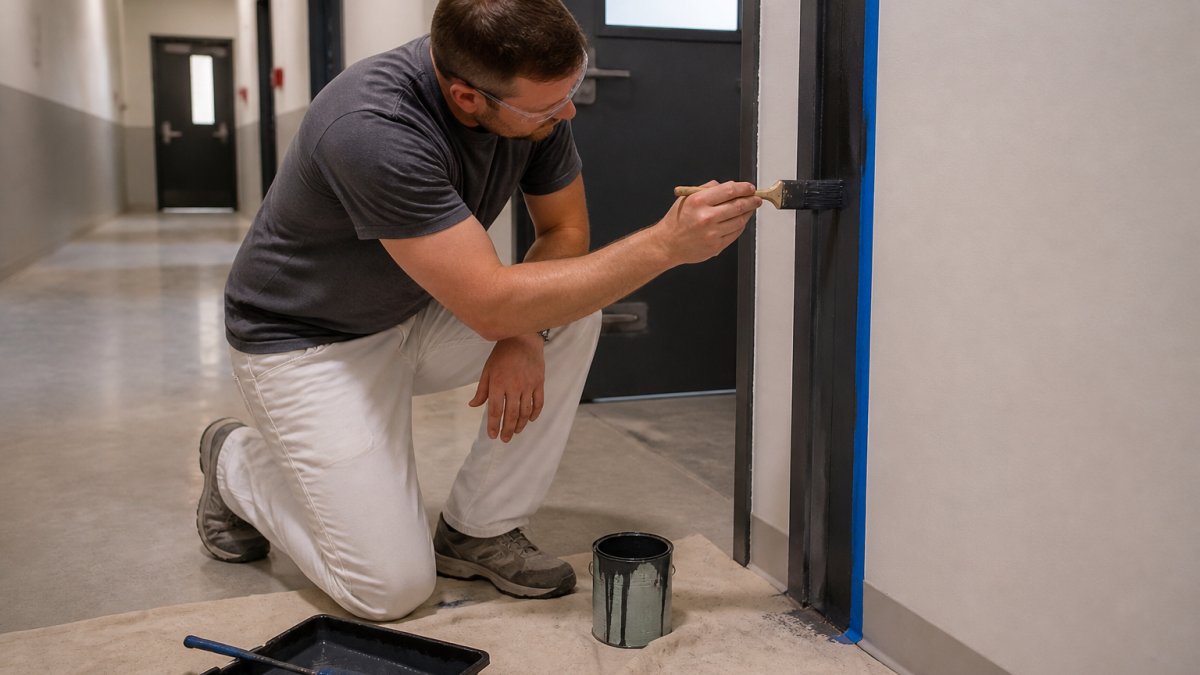
Prepping Factory-Primed, Painted, and Bare Steel
Prep decides the outcome. Wash the frame with a degreaser to remove hand oils and cleaning residue, then scuff the surface with fine abrasive pads to give the new coat something to grip. Feather any chipped edges flat. For frames with active corrosion, follow a proper rust removal sequence before you think about paint. Our guide to commercial door frame rust removal walks through that process step by step.
Masking the frame before you open a can
Mask in this order so you never tape over wet paint:
- Wall edges: Tape the wall along both sides of the frame with painter's tape, pressing the edge down firmly to stop paint bleed.
- Hinge pockets: Tape over the hinge mortises and screw holes. Paint buildup in a hinge pocket throws the door out of alignment and is very hard to remove once cured.
- Strike plate recess: Tape the strike plate and the recess. A thick coat here can prevent the latch from seating.
- Seals and gaskets: If the frame has weatherstripping or smoke seals, tape or remove them. Paint on a seal defeats its purpose and glues the door shut.
- Floor line: Tape the floor at the base of each jamb, this is where drips collect.
Application tips for narrow frame profiles
Frame faces are narrow, and a full-size roller just makes a mess. Use a 1-inch angled sash brush for the stops and rabbets, and keep the coat thin.
Work in this order on each jamb: the rabbet and stop first, then the face, then the edges.
Watch out: overloading the brush on a narrow profile sends paint into the hinge pocket and strike plate recess. Tape those off before you start.
Brush, roller, or spray on a frame
- Brush: The default for repainting an occupied building. A 1-inch angled sash brush reaches the stops and rabbets; a 2-inch brush covers the face faster. Best control, slowest speed.
- Roller: A 4-inch foam roller works on the flat face of a wide frame but is useless on profiles. Use it only to speed up the face, then tip off with a brush.
- Spray: Fastest and smoothest on a large commercial opening, but it requires masking the entire surrounding area and a sprayer rated for the coating. Not practical for a single frame in a live hallway.
Avoiding paint buildup at hinges and seals
The two failure points on a painted frame are the hinge side and the latch side. On the hinge side, paint that bridges the gap between frame and door fuses the two together as it cures. On the latch side, a thick coat in the strike recess stops the latch from seating. Keep both edges thin, wipe the hinge-side edge with a rag before it sets, and open and close the door gently once the film is touch-dry to break any accidental bridge before full cure.
Crisp edges and a smooth finish
Pull tape while the paint is still slightly soft, not wet, not fully cured. A sharp utility knife score along the tape line before pulling prevents the film from tearing. On the frame face, brush in one direction and tip off with light strokes to lay the paint flat. A thin coat applied with a quality brush leaves fewer brush marks than a thick coat applied fast.
Paint Cure Time for Metal Frames and When to Rehang the Door
Paint cure time for metal frames runs longer than most people expect. The coating feels dry to the touch in a few hours, but it is still soft underneath.
- Touch dry: a few hours, depending on product and humidity
- Recoat: follow the label, typically within a defined window
- Full cure: often several days before the film reaches full hardness
Rehang the door only after the frame paint is hard enough to resist contact. Closing a door against a soft film fuses the two surfaces together. If the frame needs structural repair rather than paint, that is a separate job, and we cover it next.
When Commercial Hollow Metal Frame Repair Beats Repainting
Repainting a rusted frame hides the problem for a season. It does not restore the metal, and on a hollow metal frame, the rust usually returns worse.
Commercial hollow metal frame repair is an alternative to full replacement. For a deeper comparison of the two paths, see our breakdown of rust damage repair versus replacement, and browse the full Jamb Patch repair kit collection to see what fits your frame.
Matching Sheen and Paint to High-Traffic Commercial Frames
Sheen is a durability decision, not a design preference. On high-traffic commercial frames, semi-gloss is the practical default: it wipes clean, hides minor scuffs, and holds up to repeated scrubbing better than flat or satin finishes.
Gloss finishes are generally harder and more washable but show surface imperfections more readily.
Match the paint system to the exposure. Interior frames in conditioned space can use a standard acrylic. Our guide to preventing door frame corrosion covers the long-term protection side of that choice.
Order the Right Jamb Patch Kit for Your Frame
Patching a frame is a DIY job, and the part that takes time is waiting for the Bondo to cure. Pick the kit that matches the damage:
- Jamb Patch Kit (4") for the first sign of rust at the bottom of the frame
- Strike Side Jamb Patch when more than 2 inches of rust is evident on the strike side
- Left or Right Hand Hinge Jamb Patch for hinge-side corrosion, matched to your door handing
Each kit includes installation hardware and instructions, and the patented design is compatible with masonry frames from several named manufacturers.
Frequently Asked Questions
What kind of paint is best for a steel door frame?
A water-based acrylic latex paint in a semi-gloss or satin sheen works well for most interior steel door frames because it cleans up easily and resists scuffing. For exterior frames or heavy traffic, a urethane enamel offers better corrosion resistance and washability. Always pair the topcoat with a metal primer rated for the surface, whether it is factory-primed steel or an existing painted finish.
Do steel door frames need a primer before painting?
Yes, primer is the layer that gives paint something to grip. Factory primer on pre-primed steel is often a thin shipping coat, so a bonding primer improves adhesion. Bare or rusted spots need a rust-inhibitive metal primer first. Skipping primer on steel door frames leads to peeling and early corrosion, especially at the bottom where moisture collects.
Can you paint a rusted hollow metal door frame?
You can paint over light surface rust after sanding it back to sound metal and applying a rust-inhibitive primer. If more than 2 inches of rust is evident at the bottom of the frame, paint alone will not restore structural integrity. In that case, a Jamb Patch kit from Door Innovation is an option to consider.
How long should paint cure before using the door?
Most acrylic latex and enamel paints feel dry to the touch within a few hours and can be recoated in the time listed on the can. Full cure takes longer, often several days to a week, depending on humidity and temperature. Keep the door open or limit traffic during that window so the film hardens without sticking or scuffing along the jamb.
Can a corroded commercial hollow metal frame be repaired instead of replaced?
Yes. A patented Jamb Patch installs over the rusted section of a commercial hollow metal frame and is designed for DIY installation without a professional. The kit includes hardware and instructions, and the repair is quick, though you need to allow time for the Bondo to cure before painting and rehanging the door.
Rusted frames do not have to mean replacement. Door Innovation builds repair kits that let your own maintenance team restore an opening in an afternoon, with a simple three-step installation, no specialist training, and a fraction of the cost of a new frame. Get started with Door Innovation and add years to the life of your door frames.
