
How Much Does It Cost to Fix a Commercial Door?
Last Updated: October 24, 2026
Quick Summary
Commercial door repair costs depend on what failed, who does the work, and when it happens, with parts usually the smallest cost and labor the largest. A sticking door is often a low-cost hinge or closer adjustment, while a rusted hollow metal frame can be patched with a kit instead of replaced. Our Jamb Patch Kit runs $130.37 for early rust, and the Strike Side Jamb Patch is $180.91 for heavier damage.
- A service call fee is a flat charge to show up and diagnose, often billed separately from the repair visit.
- Steel jambs rust from the bottom up, so patch the rusted jamb base instead of replacing the frame.
- Aluminum frames corrode and work loose, so re-anchor the jamb with a side or center jamb kit.
- A sagging door is a hinge problem until proven otherwise, so check the top hinge first.
- Ask whether the service call fee is credited toward the repair before you sign a quote.
Table of Contents
- What Drives Commercial Door Repair Cost
- Breaking Down Commercial Door Repair Cost by Repair Type
- Commercial Hollow Metal Frame Repair: The Cheapest Fix Most Facilities Miss
- Commercial Door Adjustment: Low-Cost Fixes for Sticking and Sagging Doors
- What a Hollow Metal Door Frame Repair Kit Costs vs. a Frame Replacement
- Repair or Replace? How to Run the Numbers
- Getting an Accurate Quote for Your Door
- Frequently Asked Questions
What Drives Commercial Door Repair Cost
Most facility managers assume a damaged door means a replacement bill. That assumption is expensive. The real answer to how much it costs to fix a commercial door starts with one question: what actually failed?
Commercial door repair is the practice of restoring a damaged door, frame, or piece of hardware instead of replacing the whole assembly. Costs split into three buckets: parts, labor, and the service call itself. Parts are usually the smallest number. Labor is where the money goes.
At Door Innovation, we build repair kits for commercial hollow metal frames. A technician charges for travel, diagnosis, and time on site before a single part gets installed.
Three things move the final number:
- What broke. A latch is cheap. A frame is not.
- Who does the work. A service call carries a minimum charge. A DIY install does not.
- When it happens. Nights and weekends cost more.
Component-by-Component Price Ranges
Parts pricing varies by supplier and region, so treat any figure as a starting point for comparison, not a quote. A lockset or closer is the priciest single component. Hinges, strikes, and weatherstripping sit at the low end.
The bigger point: a component swap is a short job. A frame replacement is not. That difference in labor hours dwarfs the difference in parts cost.
Service Call and After-Hours Fees
A service call fee is the flat charge a technician bills just to show up and diagnose the problem. Many companies apply a minimum labor charge on top of it.
Here is what most quotes hide: the diagnostic visit and the repair visit are often billed separately. Ask upfront whether the service call fee gets credited toward the repair. Some companies do it.
Breaking Down Commercial Door Repair Cost by Repair Type
Cost tracks repair type more than any other factor. A sticking door is an adjustment. A rusted frame is a restoration. Those are different jobs with different price tags.
| Repair Type | Typical Scope | Cost Level | DIY Friendly |
|---|---|---|---|
| Closer adjustment | Turn valves, reset swing speed | Low | Yes |
| Hinge replacement | Swap worn hinges, realign door | Low to medium | Sometimes |
| Lockset or latch swap | Replace hardware in existing prep | Medium | Sometimes |
| Weatherstripping | Replace worn seal at frame | Low | Yes |
| Threshold repair | Reset or replace saddle | Medium | Sometimes |
| Steel frame rust repair | Patch rusted jamb base | Medium | Yes |
| Aluminum frame re-anchor | Re-secure loose jamb | Medium | Yes |
| Full frame replacement | Tear out, reframe, refinish wall | High | No |
The table tells a clear story. The top rows are small jobs. The bottom row is a construction project. Everything in between is where the savings live.
Commercial Hollow Metal Frame Repair: The Cheapest Fix Most Facilities Miss
Here is the gap in the market. Most facility managers do not know a hollow metal frame can be repaired at all.
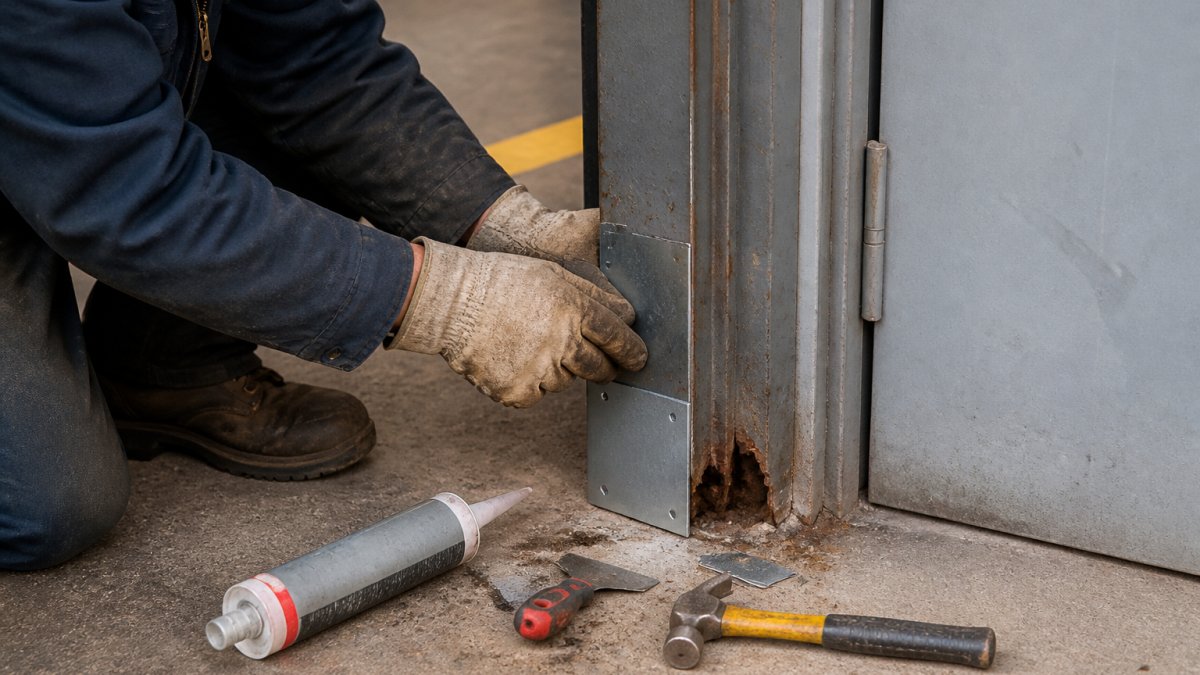
A hollow metal door frame repair kit is a prefabricated steel patch that covers the rusted section of a jamb and re-anchors it to the wall.
Prep and sealing matter, and the patch has to fit the frame profile. For a step-by-step walkthrough, see how to fix a rusted commercial door frame in place.
Steel Frames: Rust at the Base
Steel jambs rust from the bottom up. Mop water, road salt, and cleaning chemicals pool at the base and eat the paint, then the metal.
The fix is a patch sized to the damage. Minor surface rust takes a small patch. Heavy rust at the strike side takes a taller one. Prep the surface, apply the patch, fill and finish, then let the Bondo cure.
Aluminum Frames: Loose Jambs
Aluminum frames do not rust. They corrode and work loose. Salt, water, and repeated hits from carts and equipment break the anchor, and the jamb starts to move.
The fix here is re-anchoring, not patching. A side jamb kit re-secures the outboard jamb. A center jamb kit handles the inboard jamb. Both are bolt-in jobs, and both beat tearing out a wall.
Commercial Door Adjustment: Low-Cost Fixes for Sticking and Sagging Doors
A sticking door is almost never a replacement. It is an adjustment, and adjustment is the cheapest category of commercial door repair on the board.
Start with the simple checks:
- Does the door rub at the top, the latch side, or the floor?
- Are the hinges tight, or is the top hinge pulling out?
- Has the closer speed drifted?
- Is the strike plate out of line with the latch?
Most sticking doors trace to a hinge or a closer. Tighten or replace the hinge. Adjust the closer valves. Realign the strike.
A sagging door is a hinge problem until proven otherwise. Check the top hinge first. It carries the most load and fails first.
What a Hollow Metal Door Frame Repair Kit Costs vs. a Frame Replacement
This is the comparison that changes budgets. A frame replacement means demolition, new framing, wall repair, and refinishing.
The parts side is simple to price. Our Jamb Patch Kit runs $130.37 for early rust. The Strike Side Jamb Patch is $180.91 for heavier damage at the strike. The Jamb Anchor Side Jamb Kit is $119.00 for loose aluminum jambs. A Jamb Anchor Center Jamb Kit is also $119.00 for inboard jambs.


Now the labor side. A replacement needs a crew, a permit in many cases, and downtime at the opening. A kit needs one person with basic tools.
For the full cost picture on replacement, see our breakdown of rusted steel door frame replacement costs.
Repair or Replace? How to Run the Numbers
Run the decision in this order. It takes five minutes and settles the question.
- Is the damage rust or corrosion at the jamb base, or a loose jamb anchor? If yes, repair is on the table.
- Is the frame otherwise sound, square, and plumb? If yes, keep it.
- Is the damage confined to one jamb section? If yes, a patch fits.
- Is the wall around the frame intact? If yes, avoid demolition.
- Is the door still hanging and closing? If yes, repair the frame, not the opening.
If you answer no to the frame soundness or wall integrity checks, replacement may be the honest call. If you answer yes down the list, a kit wins on cost and downtime.
Getting an Accurate Quote for Your Door
An accurate quote starts with an accurate diagnosis. Describe the failure precisely: which jamb, what condition, how much damage. Vague requests get vague quotes, and vague quotes get padded.
Before you call anyone, separate the two numbers you are actually comparing. A repair bill covers parts, labor, and a service call on an existing door. An installation estimate covers a new door, frame, hardware, demolition, and wall finish.
The Factors That Move the Final Number
Every commercial door repair quote is built from the same inputs. Know them and you can predict the range before the technician arrives.
- Door material and type. A hollow metal frame patch is a different job from a storefront aluminum-and-glass re-anchor, and a fire-rated door adds labeling and compliance requirements that change both parts and labor.
- Size and weight. A heavy pair of doors needs heavier hinges and closers, and heavier hardware costs more and takes longer to hang.
- Hardware grade. Standard-duty and heavy-duty closers and locksets sit at different price points, and the grade has to match the traffic at the opening.
- Damage extent. Surface rust takes a small patch. Rust that has eaten the anchor at the strike side takes a taller patch and more prep. Structural damage to the frame changes the conversation entirely.
- Access and location. A door on a busy main corridor, behind a security checkpoint, or in a tight mechanical room takes longer to work around than one in an open warehouse bay.
- Timing. After-hours, weekend, and emergency dispatch carry premiums on both the service call and the labor rate.
Questions That Expose a Thin Quote
Ask every contractor these before you sign:
- Is the service call fee separate from labor, and is it credited toward the repair?
- Is there a minimum labor charge, and how many hours does it cover?
- Is the quote priced per door or per hour?
- Does it include prep, finish, and disposal?
- Are the parts listed by name and grade, or lumped into one line?
- For a fire-rated opening, are the replacement components labeled for that rating?
Compare quotes on the same scope. A cheap quote for a partial fix is not cheaper, and a quote that omits prep and finish is not complete.
When Repair Beats Replacement on the Quote
If the damage is rust or corrosion at the jamb base, or a loose jamb anchor, and the frame is otherwise sound, square, and plumb, a patch kit is the lower-cost path.
If the frame is out of square, the wall around it is failing, or the damage spans more than one jamb section, replacement may be the honest call.
If your team wants to handle frame repairs in-house, our guide to installing door frame patches without contractors walks through the process.
Frequently Asked Questions
Can a damaged hollow metal door frame be repaired instead of replaced?
Yes. Rusted steel frames and loose aluminum frames can often be restored with a hollow metal door frame repair kit. A Jamb Patch handles rust at the bottom of a steel frame, and a Jamb Anchor re-secures an aluminum frame that has pulled loose. Both are patented, DIY-friendly products that install with basic hand tools. The repair takes very little working time; the longest wait is letting the Bondo cure before finishing.
What factors affect the cost of commercial door repair?
The biggest drivers are the damaged component (hinge, closer, latch, or frame), whether the frame is steel or aluminum, and whether you hire a technician or install a kit in-house. Labor rates, service call fees, after-hours premiums, and regional pricing all move the final number. Frame repairs done with a kit typically cost far less than a full frame replacement because you skip demolition and reframing labor.
Can you repair a commercial hollow metal frame yourself?
In most cases, yes. Kits like the Jamb Patch and Jamb Anchor are designed for DIY installation and require no special training. Your maintenance staff can complete the install with standard tools in an afternoon, and the frame is back in service quickly. The main time cost is waiting for the Bondo to cure before sanding and painting.
When should a commercial door be repaired instead of replaced?
Repair when the door slab, frame, and hardware are structurally sound and the damage is localized, such as rust at the frame base, a loose jamb, or a misaligned closer. Replacement makes more sense when the frame is bent beyond realignment or the door has widespread damage. For localized rust and loose aluminum jambs, a repair kit restores the opening at a fraction of replacement cost.
Rusted steel and corroded aluminum frames do not have to mean a replacement project. Door Innovation builds patented repair kits, including the Jamb Patch and Jamb Anchor, designed for DIY installation with basic tools and a short cure time. Our kits re-anchor loose jambs, cover rusted frame bases, and extend the life of door openings across your facility. Get started with Door Innovation and fix the frame instead of replacing it.
