
Parts of a Door Jamb: Complete Guide
Last Updated: October 27, 2026
Quick Summary
The parts of a door jamb are the hinge jamb, strike jamb, head jamb, and sill or threshold. Each component supports the door and maintains the integrity of the opening, working together as a system where failure in one part affects the others.
- The hinge jamb is the vertical load-bearing member where hinges attach and support the door's weight.
- The strike jamb is the opposite vertical member where the strike plate mounts to receive the latch bolt.
- The head jamb is the horizontal member spanning the top that connects the verticals and distributes load.
- Localized repair of specific jamb sections is an alternative to complete frame replacement for commercial hollow metal frames.
- Targeted repair involves prepping the damaged area, fitting a patch component, applying filler, and allowing it to cure before painting.
Table of Contents
- What Is a Door Jamb and Why It Matters
- Door Frame Components and Their Functions
- Understanding Commercial Hollow Metal Door Frame Repair
- Door Frame Anchors and Reinforcement
- Metal Door Frame Repair: Addressing Common Damage
- How to Identify and Measure Door Jamb Parts
- Restoring Your Door Jamb with Repair Solutions
- Frequently Asked Questions
What Is a Door Jamb and Why It Matters
A door jamb is the vertical and horizontal frame surrounding a door opening that supports the door leaf.
When a jamb deteriorates from rust, corrosion, or impact damage, the whole door assembly is compromised.
The parts of a door jamb work as a system: when one fails, it affects the others. This guide breaks down every part.
Door Frame Components and Their Functions
A door frame consists of four primary components: the hinge jamb, strike jamb, head jamb, and sill or threshold. Each plays a distinct role in supporting the door and maintaining the integrity of the opening.
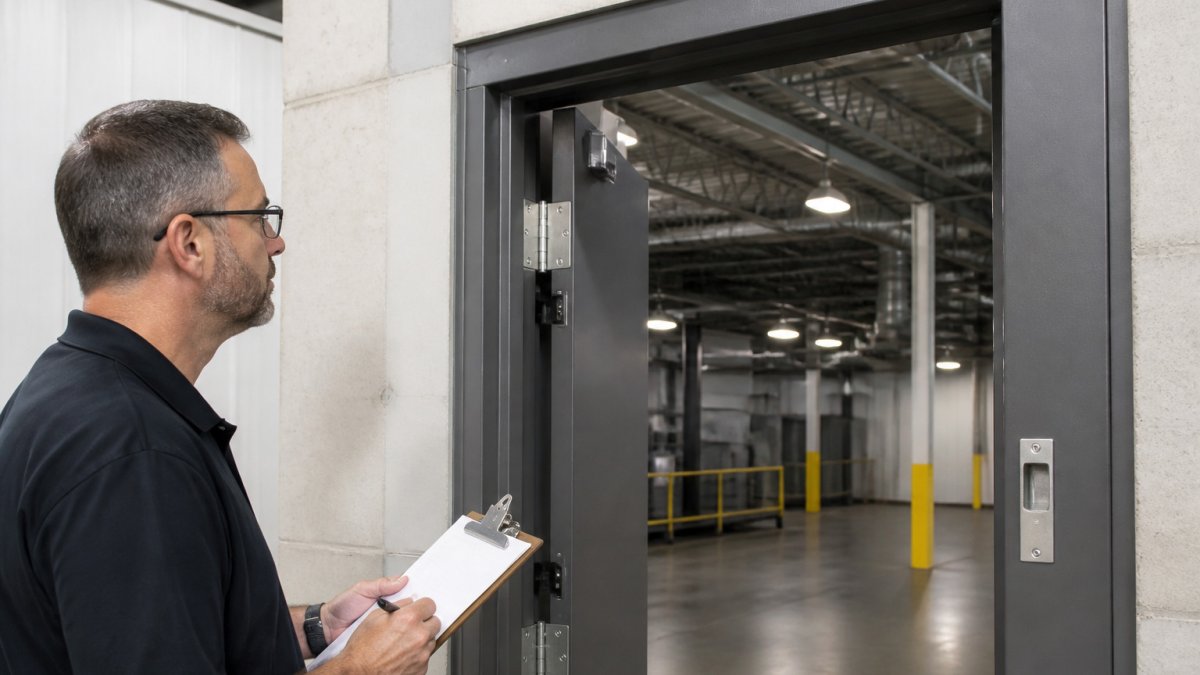
The hinge jamb is the vertical member where hinges attach, bearing the door's weight and cycle stress. The strike jamb is the opposite vertical member where the latch engages.
These components must work in concert.
The Hinge Jamb: Supporting Door Movement
The hinge jamb is the load-bearing vertical member, supporting the door leaf's full weight and absorbing thousands of cycles. Hinges mount into it through mortises or surface-mounted hardware.
In commercial hollow metal frames, the hinge jamb is typically reinforced with additional steel for high-traffic demands. When it deteriorates, the door sags, misaligns, and becomes hard to close, so inspect the hinge jamb first when a door stops operating smoothly.
The Strike Jamb: Securing the Latch
The strike jamb is the vertical member opposite the hinges, where the strike plate that receives the latch bolt mounts. It must align with the hinge jamb so the latch engages fully and the door locks securely.
When the strike jamb corrodes or shifts out of alignment, the latch no longer seats properly, the door may not close fully, or may close but not lock.
The Head Jamb: Spanning the Top
The head jamb is the horizontal member spanning the top of the opening. It connects the hinge and strike jambs, distributes load from the door and any transom or sidelight above, anchors weatherstripping, and mounts door closers and other hardware.
A compromised head jamb can rack the entire frame out of square, opening gaps that let air and water infiltrate and damage interior finishes.
Understanding Commercial Hollow Metal Door Frame Repair
Commercial hollow metal frames corrode when exposed to moisture, salt, cleaning chemicals, or repeated impacts from equipment or carts.
Many facility managers assume a corroded or damaged hollow metal frame must be replaced. Explore comprehensive repair kit options specifically designed for commercial hollow metal frames as an alternative to full replacement.
Damage can be localized: rust accumulates at the bottom where moisture collects, salt and cleaning solutions attack exposed surfaces, and impacts concentrate where carts strike the frame.
Door Innovation offers a patented repair product designed for DIY installation.
Door Frame Anchors and Reinforcement
Aluminum door frames frequently loosen when their anchoring system corrodes.
ANSI standards for door frame installation specify proper anchoring methods, but maintenance teams often lack the tools or knowledge to re-anchor frames correctly.
Frame anchors come in several types, expansion anchors in masonry, welded anchors on steel frames, and adjustable anchors. Browse repair kits and reinforcement products designed to restore frame stability.
Browse Jamb Anchor Side Jamb Kit for outboard jamb repairs, or Jamb Anchor Center Jamb Kit for inboard jamb repairs.


Metal Door Frame Repair: Addressing Common Damage
Metal door frames can be damaged in several ways. Understanding the damage can help you identify the affected area.
Rust and Corrosion in Steel Frames
Steel frames rust when the protective coating breaks down and moisture reaches bare metal. Explore specific solutions for steel frame corrosion to address this issue effectively.
The Strike Side Jamb Patch listing says to use the kit when more than 2 inches of rust is evident at the bottom of the frame.
For a steel-frame repair option, see the Strike Side Jamb Patch.

Full frame replacement is one alternative to patching a damaged section.
Loose Aluminum Frames and Anchoring Solutions
Aluminum frames corrode through electrochemical action when exposed to salt, chlorine, or acidic cleaners.
Tightening or replacing anchors requires access to the frame perimeter, often difficult in occupied buildings.
For loose aluminum side jambs, see the Jamb Anchor Side Jamb Kit; for loose aluminum center jambs, see the Jamb Anchor Center Jamb Kit.
How to Identify and Measure Door Jamb Parts
Assessing a damaged jamb requires understanding what you are looking at and how to measure the damage extent. This step helps you assess the damage and consider whether localized repair is appropriate.
Step 1: Identify Which Jamb Section You Are Looking At
Stand on the hinge side of the opening and confirm the layout before you measure anything:
- Hinge jamb, the vertical member the hinges are mortised into. It carries the door leaf's weight.
- Strike jamb (also called the latch jamb), the opposite vertical member that holds the strike plate and receives the latch bolt.
- Head jamb, the horizontal member across the top that ties the two verticals together.
Label each one on a photo of the opening before you start measuring.
Step 2: Measure the Opening and Jamb Dimensions
Use a tape measure and a 2-foot level. Record every number in inches, since commercial frame profiles and hardware are specified in inches.
| What to Measure | How to Measure It | Why It Matters |
|---|---|---|
| Jamb depth | Measure from the face of the jamb to the wall surface on the same side | Determines whether the frame is a standard drywall return or a deeper masonry profile |
| Jamb width (face width) | Measure across the visible face of the jamb, hinge side to strike side | Confirms the frame profile before ordering a patch |
| Rough opening height | Measure floor to the underside of the head jamb at both verticals | A difference between the two readings signals a racked frame |
| Rough opening width | Measure hinge jamb face to strike jamb face at the top, middle, and bottom | More than about 1/8 inch of variation indicates the frame is out of square |
| Hinge locations | Measure from the floor to the top of each hinge mortise | Needed to match replacement hardware and patch cutouts |
| Strike plate centerline | Measure from the floor to the center of the strike plate | Confirms latch alignment after repair |
Take each width and height reading three times, top, middle, bottom for width; left, right, center for height. Write the numbers down rather than trusting memory.
Step 3: Measure the Damage Itself
Once you know which jamb section is affected, quantify the damage:
Step 4: Distinguish Jamb Damage from Door or Hinge Problems
A sticking door is not automatically a jamb problem. Before you commit to a repair, rule out the other two suspects:
Step 5: Decide Whether Localized Repair Is Appropriate
Localized repair is a candidate when damage is confined to one jamb section, the rest of the frame is sound, and the frame is still plumb. If the head jamb is cracked, if the frame has racked, or if corrosion has penetrated deep into the section, the frame may be beyond a patch.
Restoring Your Door Jamb with Repair Solutions
A commercial hollow metal frame can be repaired by a DIY-oriented person without a professional installer. Discover comprehensive restoration methods to guide you through the process.
What Targeted Repair Actually Involves
The repair is a patch-and-fill process, not a fabrication job. The general sequence is the same whether you are addressing rust at the bottom of a hinge jamb or impact damage on a strike jamb:
- Prep the damaged area. Remove loose rust, scale, and flaking coating with a wire brush or grinder until you reach sound metal. Wipe the surface clean and let it dry.
- Fit the repair component. Dry-fit the patch or anchor component against the jamb to confirm the profile matches and the cutout lines up with the hinge or strike location. Adjust as needed before any adhesive is mixed.
- Mix and apply the filler. Mix the two-part filler (Bondo-style body filler is the common choice) per the product instructions and apply it to the prepared area. Work it into the pitted surface and build it slightly proud of the surrounding metal.
- Set the repair component. Seat the patch or anchor into the filler bed and hold it in position per the kit instructions. Confirm plumb and alignment before the filler begins to set.
- Let it cure. This is the only slow step. Cure time depends on the filler and ambient temperature; follow the product label. Plan the repair around the cure window rather than trying to rush it.
- Sand, prime, and paint. Once cured, sand the filler flush, prime bare metal, and repaint to match the frame. The paint is what protects the repair from the next round of corrosion.
Why This Works on Commercial Hollow Metal Frames
This repair is only for commercial hollow metal frames.
Steel Frames with Rust Damage
For a rusted steel strike-side frame, see the Strike Side Jamb Patch. For a rusted steel hinge-side frame, see the Left Hand Hinge Jamb Patch or Right Hand Hinge Jamb Patch.
Aluminum Frames with Loose Anchors
The Jamb Anchor Side Jamb Kit is designed to re-anchor loose aluminum outboard jambs. The Jamb Anchor Center Jamb Kit is designed to re-anchor loose aluminum inboard jambs.
What the Repair Does Not Require
- No professional installer, the product is designed for a DIY-oriented person.
Making the Repair Last
A repair holds up when the root cause is addressed. If rust came from a coating failure, repainting after the repair prevents recurrence. If corrosion came from salt or cleaning chemicals, controlling moisture and reapplying protective coatings extends the repair life. If looseness came from anchor corrosion, the new anchor points plus a protective coating head off the next failure.
Frequently Asked Questions
What is the difference between a door jamb and a door frame?
A door jamb is the vertical and horizontal frame surrounding a door opening that supports the door leaf. The jamb holds the hinges and strike plates.
What causes a metal door jamb to rust or corrode?
The Jamb Patch listing says to use the Strike Side Jamb Patch when more than 2 inches of rust is evident at the bottom of the frame. Jamb Anchor kits are designed to re-anchor aluminum frames that have come loose due to corrosion from salts, water, cleaning solutions, or repeated impacts from equipment or shopping carts.
Can a damaged commercial hollow metal door frame be repaired?
Yes. Door Innovation's repair product is designed for commercial hollow metal frames and DIY installation; it does not require a professional installer. Jamb Patch products are listed for rusted steel frames, and Jamb Anchor products are designed to re-anchor loose aluminum frames.
What is the strike jamb on a commercial door?
The strike jamb is the vertical side of the door opening where the strike plate is located. The Strike Side Jamb Patch is listed for repairing the strike side of a rusted steel door frame.
What are the vertical sides of a door jamb called?
The vertical sides of a door jamb are called the hinge jamb and the strike jamb. The head jamb spans the top. Door Innovation lists Jamb Patch products for rusted steel hinge-side and strike-side frame repairs.
What is the door stop on a jamb?
The door stop is a feature on a jamb. The verified product information does not describe its location or function.
How do I know if my door jamb needs repair?
Visible rust or corrosion, gaps between the door and frame, doors that don't close properly, loose frames, or damaged strike plates can be signs of a door-frame issue. Door Innovation's repair products are listed for rusted steel frames and loose aluminum frames.
Do repair kits work on both steel and aluminum frames?
Door Innovation lists Jamb Patch products for rusted steel frames and Jamb Anchor products designed to re-anchor loose aluminum frames. The appropriate product depends on the frame and the repair needed.
