
How Do You Install Steel Door Frames?
Last Updated: October 29, 2026
Quick Summary
To install steel door frames, set the hinge jamb plumb and shim it, level and tack the head, then set the strike jamb plumb and adjust shims until both diagonals match. Only tighten anchors after the frame is shimmed and checked, since an anchor stops the frame moving easily.
- Measure opening width, height, wall thickness, and both diagonals before setting the frame.
- Equal diagonal measurements mean the opening is square; a difference means it is racked.
- In steel-stud walls, brace and shim the frame plumb before fastening into the studs.
- In CMU walls, shim in small increments and re-check plumb after each adjustment.
- If the frame is rusted rather than out of square, a repair kit can restore it in place.
Table of Contents
- Steel Door Frame Installation Tools and Materials
- Preparing and Checking the Rough Opening
- How to Square a Door Frame Before Anchoring
- Installing Frames in Steel-Stud Walls
- Hollow Metal Door Frame Installation in CMU Walls
- Commercial Hollow Metal Frame Repair Instead of Replacement
- Order the Right Repair Kit for Your Door Openings
- Frequently Asked Questions
Steel Door Frame Installation Tools and Materials
Most facility teams never learn how to install steel door frames until a frame fails and they are quoted a full replacement for those steel door frames. If the frame is rusted or corroded rather than structurally gone, a repair kit can restore it in place.
Here is what you actually need.
Hand Tools and Fasteners
You do not need specialty equipment. A basic commercial maintenance kit covers the hand tools:
- Cordless drill with a hex driver set
- Metal-cutting snips or a reciprocating saw with a metal blade
- Screwdrivers, both Phillips and flathead
- A dead-blow mallet
- Tin snips for trimming shims
- Safety glasses and work gloves
Fasteners matter more than the tools. Match the fastener to the wall type and the frame anchor style. For deeper guidance, see the Heavy Duty Door Frame Anchor Installation Guide.
Layout and Alignment Tools
Keep these within reach:
- A 4-foot spirit level
- A magnetic torpedo level for the head
- A framing square
- A tape measure
- Wood or composite shims in a few thicknesses
- A plumb bob or laser level for tall openings
Preparing and Checking the Rough Opening
The frame only fits as well as the opening allows. Work from a written measurement checklist rather than eyeballing the opening.
Measure the opening in three places
Record these numbers before anything else:
- Opening width at the top, middle, and bottom of the opening.
- Opening height at the left jamb, center, and right jamb.
- Wall thickness at the top, middle, and bottom, taken at the jamb line.
- Diagonal measurements corner to corner, both directions.
Write the numbers down. The three-reading pattern can expose a tapered or bowed opening that one reading hides.
Compare against the frame and the tolerance
Match your readings to the frame's published opening size and the allowable tolerance for that frame series. Frame manufacturers publish a required rough-opening dimension and a tolerance band; the frame throat must fit the wall thickness with enough room for shims on both sides. If your width or height readings vary by more than the frame's stated tolerance, correct the opening before setting the frame. Do not shim a tapered opening into square, fix the substrate.
Check square, plumb, and clearance
- Square: compare the two diagonal measurements. Equal diagonals mean the opening is square; a difference means the opening is racked.
- Plumb: run a 4-foot level up each side and note which way it leans. Lean in either direction means the frame will fight you later.
- Clearance: confirm the frame throat fits the wall thickness with room for shims, and confirm the floor is level enough that the frame sill will not rock.
Clear the opening
Debris, mortar snots, and protruding fasteners cause more crooked frames than bad measuring does. Vacuum the sill, grind off anything sticking out, and confirm the floor line is sound where the base anchors will land. If the floor is uneven, note it now, you will need to account for it when you shim the sill.
How to Square a Door Frame Before Anchoring
Work in this order:
- Set the hinge jamb plumb and shim it.
- Set the head level and tack it in place.
- Set the strike jamb plumb, checking the diagonal measurements against each other.
- Adjust shims until both diagonals match.
- Only then tighten anchors.
A common mistake is anchoring as you go. Once an anchor bites, the frame stops moving easily. Shim and check first, fasten last.
Installing Frames in Steel-Stud Walls
Steel-stud walls need a different approach than masonry. The studs flex, so the frame has to be braced before it is anchored.
Start by locating the studs behind the drywall. Set the frame in the opening and shim it plumb on both jambs. Then fasten through the frame into the studs with the fasteners your frame manufacturer specifies. Add a base anchor at the floor and a wall anchor near the head.
Check the door operation before you finish. Open and close the door leaf through its full swing. Any rub means the frame moved during fastening. Loosen, re-shim, and retighten.
Jamb Patch - Jamb Anchor Catalogue →
Hollow Metal Door Frame Installation in CMU Walls
Hollow metal door frame installation in CMU walls follows the same logic as stud walls but with stiffer surroundings. Block walls do not flex, so alignment errors show up immediately and cannot be shimmed away as easily.
Set and shim the frame
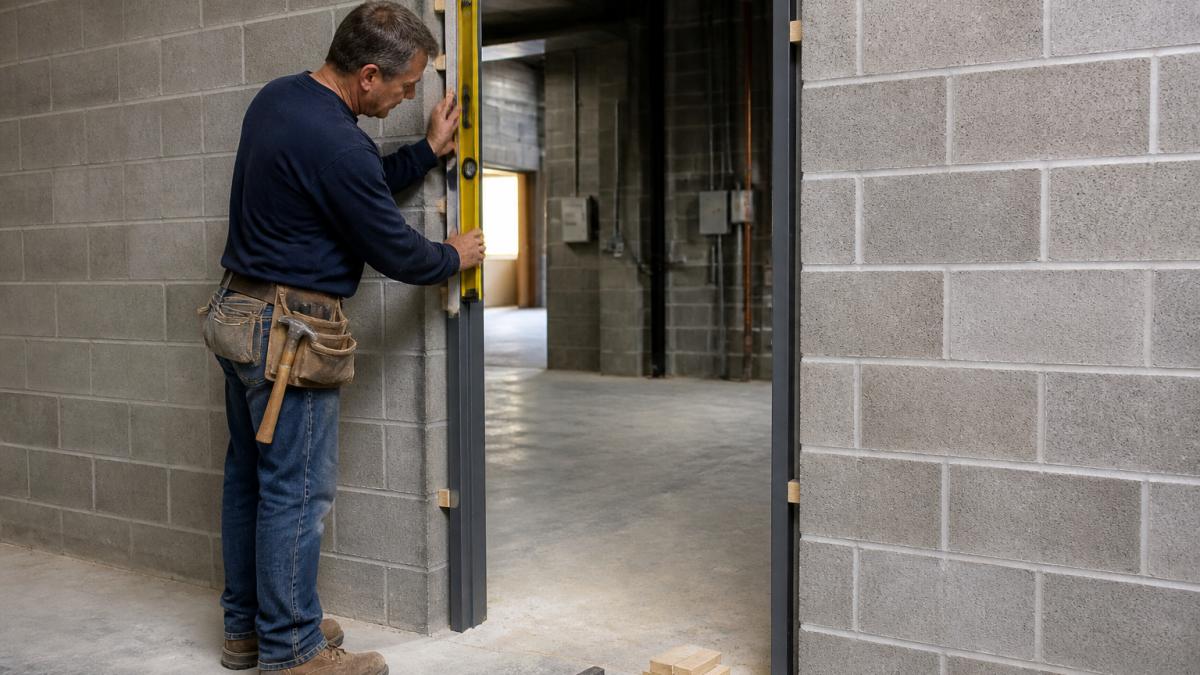
Set the frame into the masonry opening and shim it plumb on both jambs, checking the diagonals as you go. Because the block will not give, shim in small increments and re-check plumb after each adjustment. Knock-down frames get assembled first, squared on the floor, then set as one unit.
Anchor into block and floor
Anchor through the frame into the block or into the floor, depending on the frame style and the anchor schedule your frame manufacturer specifies. Match the fastener to the substrate: masonry anchors for block, and the specified base anchor at the floor. Do not substitute a fastener intended for steel studs.
Verify before you walk away
Run the measurable checks before you finish:
- Re-check both diagonals; they should match within the frame's tolerance.
- Run a level up each jamb and across the head.
- Open and close the door leaf through its full swing; any rub means the frame moved during anchoring.
- Confirm the reveal is even along the hinge and strike jambs.
If a check fails, loosen the nearest anchors, re-shim, and retighten rather than forcing the door to fit.
When the block frame is damaged, not misaligned
If the frame is rusted or corroded at the bottom rather than out of square, replacement is not the only option. Commercial hollow metal frame repair can restore the opening in place without opening the wall. The Jamb Patch is a patented steel repair piece that fits over rust damage at the bottom of a frame; it is non-handed, so one part works on either side of the opening, and it is designed for use when more than 2 inches of rust is visible at the frame bottom. It does not require a contractor, a DIY-minded maintenance tech can install it, and most of the work is quick. The slow part is waiting for the Bondo to cure before you paint and reassemble.
Commercial Hollow Metal Frame Repair Instead of Replacement
A rusted or corroded frame at the bottom does not always need replacement. For the in-place method, see How to Fix a Rusted Commercial Door Frame in Place. Commercial hollow metal frame repair can restore the opening in place, and the wall never gets opened.
The Jamb Patch is a patented steel repair piece that fits over rust damage at the bottom of a frame. It is non-handed, so one part works on either side of the opening. It is designed for use when more than 2 inches of rust is visible at the frame bottom. The Jamb Anchor re-anchors aluminum frames that have come loose from corrosion, cleaning solutions, or repeated cart impacts.
Neither product requires a contractor. A DIY-minded maintenance tech can install either one. Facility staff can confirm the approach in Can Maintenance Staff Install Frame Patches: A How-To Guide. Readers who want the full process can follow Installing Door Frame Patches Without Contractors. Most of the work is quick. The slow part is waiting for the Bondo to cure before you paint and reassemble.
Order the Right Repair Kit for Your Door Openings
Picking the right kit comes down to two questions: what is damaged, and what is the frame made of?
| Damage | Frame Type | Kit to Order |
|---|---|---|
| Rust at the bottom of the jamb | Steel | Strike Side Jamb Patch |
| Loose side jamb | Aluminum | Jamb Anchor Side Jamb Kit |
| Loose center jamb | Aluminum | Jamb Anchor Center Jamb Kit |
| Mixed damage across a facility | Steel and aluminum | Full catalogue review |
The Strike Side Jamb Patch comes with one 21-5/8 inch tall non-handed patch, hardware, and instructions. The Jamb Anchor Side Jamb Kit comes with one left-hand Anchor, one right-hand Anchor, hardware, and instructions. The Jamb Anchor Center Jamb Kit comes with either two left-hand or two right-hand Anchors, hardware, and instructions.
For facilities with dozens of doors, start with the Jamb Patch and Jamb Anchor catalogue. It lists product descriptions and specifications, with FAQs at the back.

Frequently Asked Questions
Can you install a steel door frame in an existing wall?
For rusted or corroded commercial hollow metal frames, a repair kit can restore the opening without tearing out the wall.
What tools are needed to install a hollow metal door frame?
Basic steel door frame installation tools include a tape measure, a 4-foot spirit level, a plumb bob or laser level, a drill with the correct bits, a screwdriver, a rubber mallet, and a pry bar. You also need shims, fasteners, and anchors suited to the wall type, plus a square for checking corners. For welded frames, a welder or the specified fasteners are required. For knock-down frames, a nut driver for the corner connections. Download the manufacturer's installation instructions for the exact fastener schedule.
Can a damaged commercial hollow metal frame be repaired instead of replaced?
When rust is evident at the bottom of a commercial hollow metal frame, a jamb patch can restore the affected section. The Strike Side Jamb Patch is a 21-5/8 inch non-handed patch designed for use when more than 2 inches of rust is evident at the bottom of the frame. Loose aluminum frames can be re-anchored with Jamb Anchor kits.
How do you keep a steel door frame square during installation?
Set the frame in the opening, then shim at the hinge jamb, strike jamb, and head. Check plumb on both jambs with a level and check the head for level. Measure diagonals from corner to corner of the opening; equal diagonals mean the frame is square. Adjust shims until the readings hold, then anchor in the sequence the instructions specify. Recheck plumb and square after each anchor is set, because tightening fasteners can pull the frame out of alignment.
Rusted frames do not have to mean torn-out walls and weeks of downtime. Door Innovation builds repair kits that a maintenance tech can install without a contractor, using a patented design that restores the opening instead of replacing it. Our Jamb Patch and Jamb Anchor lines cover steel and aluminum frames, ship with hardware and instructions, and fit openings across most major US frame brands. Get started with Door Innovation and extend the life of the door systems you already have.
